Get Adobe Flash playerPlugin by wpburn.com wordpress themes

Archive for October, 2008

Concert Program for October 28, 2008

Merkin Hall, New York City

Moshe Zorman – Hora for Violin and Piano
 
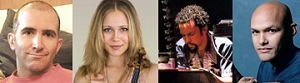
Arnaud Sussmann, Violin
Vincent Balse, Piano
 

Menachem Wiesenberg – Like clay in the Potter’s Hand  for Cello and Piano
 

Gal Nyska, Cello
Vincent Balse, Piano
 

Paul Ben Haim – Pastorale Variee Op. 31b for Clarinet and Piano
 

Moran Katz, Clarinet
Vincent Balse, Piano
 
INTERMISSION
 
Olivier Messiaen – Quartet for the End of Time
 
1. Liturgie de cristal 2. Vocalise, pour L’ange qui annonce la fin du temps 3. Abime des oiseaux 4. Intermede 5. Louange a l’Eternite de Jesus 6. Danse de la fureur, pour le sept trompettes 7. Fouillis d’arcs-en-ciel,   pour l’Ange qui annonce la fin du temps 8. Louange a l’Immortalite de Jesus
 
 
Charles Neidich, Clarinet
Arnaud Sussmann, Violin
Gal Nyska, Cello
Vincent Balse, Piano
 

Program Note Essay  by Christian Carey  

This concert celebrates sixty years of the cultural history of Israel; a country that has greatly supported classical music and given the world a number of important composers. Three are highlighted this evening: Moshe Zorman, Menachim Wiesenberg, and Paul Ben-Haim.Moshe Zorman (b. 1952) received his Ph.D. in composition from CUNY Graduate Center, where he studied with George Perle. He is currently on the faculty at Levinsky Teacher’s College in Tel Aviv. Zorman has also been a composer for various dance, theater, and television productions.Menachim Wiesenberg (b. 1950) studied at the Juilliard School and Mannes College of Music. He is now Senior Lecturer in Music at the Jerusalem Academy of Music and Dance. He has arranged numerous Hebrew and Yiddish folksongs. Wiesenberg was recently awarded a 2008 Landau Prize for the Performing Arts.    

Paul Ben-Haim (1897-1984) was born in Germany. His early career as a conductor and composer was spent in Augsburg and Munich. Upon the rise to power of the Nazis in 1933, he emigrated to Palestine. Central to the Post-war musical life of Israel, Ben-Haim was active as a composer, collector of Eastern Mediterranean folk music, and academic: teaching at conservatories in Tel Aviv and Jerusalem.                

Tonight’s program also commemorates the hundredth anniversary of the birth of Olivier Messiaen (1908-92) with a performance of his ground-breaking work Quatuor pour la fin du temps (Quartet for the End of Time). At first glance, one might not see much see much similarity between Messiaen, a lifelong Catholic and longtime organist at La Sainte-Trinité in Paris, and the Israeli composers presented here. But there is a historical link between them. Messiaen’s Quartet for the End of Time was composed in 1940 and premiered on 15 January 1941 at Stalag VIIIA in Görlitz, Germany, where he was held captive as a prisoner of war. The composer played the piano part, performing on an instrument in terrible disrepair. He was joined by instrumentalists who were also fellow captives. The audience on that bitterly cold day consisted of guards and other POWs.Messiaen was fortunate enough to be repatriated in February, 1941, escaping the fate of so many prisoners at the hands the Nazis. But the quartet shares a kinship with stirring works written during the Second World War at other internment camps, such as Viktor Ullmann’s Der Kaiser von Atlantis, composed at Terezin. They are symbols of defiance when faced with repression, affirmations of the spirit in spite of the genocidal hatred and brutality of the Nazi regime. Both Messiaen and composers of Israel have had to come to grips with the destruction and havoc wrought during World War II as an intrinsic aspect of their personal histories.     There are musical affinities between the composers on this program as well. Like Messiaen, who based his quartet on scriptural references (from the Book of Revelation in the New Testament of the Bible), Wiesenberg’s “Like clay in the potter’s hand” is inspired by a religious text, from a prayer traditionally said on Yom Kippur. Ben-Haim’s interest in the scales and rhythms of Middle Eastern music are mirrored in Messiaen’s incorporation of a wide variety of musical resources from both Near and Far East. And all of the composers heard tonight have viewed folksong traditions as a significant touchstone.There is much lore surrounding the circumstances of the creation and premiere of Quartet for the End of Time. Messiaen scholar Rebecca Rischin has done a commendable job sifting through the various stories to clarify numerous points in her book For the End of Time: the Story of the Messiaen Quartet (Cornell University Press, 2003). Rischin debunks apocryphal legends about the first performance: that it included a cello with only three strings and a clarinet with a melted side-key, for instance. But where she pares away some colorful anecdotes, she also restores a measure of the astonishment with which the work was greeted in 1941, both in its Stalag VIIIA and subsequent Paris premieres. While few of those in the audience at either of these events probably ‘understood’ the quartet, so novel was its language and approach, we are told by Rischin and elsewhere by Messiaen and others that they were very respectful towards this piece and its performers. Indeed, the composer often said that he had never been listened to more attentively.What made Quartet for the End of Time so astonishing to audiences in 1941 and, correspondingly, makes it such a fresh-sounding piece even for seasoned concert-goers today? A number of aspects of the work are noteworthy: Messiaen’s famous fluency in birdsong, which is found throughout the quartet; his use of harmony, which has a synaesthetic component – it is purported that Messiaen  ’saw’ certain colors when hearing specific chords; his innovative approach to rhythm, which incorporated aspects of both Medieval isorhythms and Indian tâlas. But what is truly staggering about the quartet is the way in which Messiaen is able to combine all these various techniques to suspend the traditional formal constraints and directed trajectory of Western concert music: to give glimpses of eternity by making time seem to stand still. Finally, there is a daring fervency, an overtly programmatic religiosity found in the piece that marks it as something quite unusual, especially for a chamber work in the mid-Twentieth century.It is no accident that, shortly after his return to Paris upon repatriation, Messiaen attracted a number of student followers who were eager to learn more about his polyglot approach to contemporary composition. Numbered among them are composer-conductor Pierre Boulez, the pianist Yvonne Loriod (who would become Messiaen’s second wife), and, later, the pianist Peter Hill and composer George Benjamin. And while Messiaen attracted devotees, one can honestly say that no other composer writes music that sounds like his. This is not for lack of materials to study: there are numerous scores and recordings of Messiaen’s works in print, as are his multi-volume treatises describing his approach to composition. Yet there is a singularity of application of these various techniques which puts an indelible personal stamp on his music.        The verses upon which Messiaen bases Quartet for the End of Time describe a banishment of temporal reality in favor of an eternity in which “the Hidden purpose of God will have been fulfilled”(Revelation 10:7). The incorporation of a program inspired by the Book of Revelation into Quartet for the End of Time may understandably be a bit off-putting to non-Christians; but it needn’t be if one considers that Messiaen’s ardent Catholicism never extended to parochialism: he was very interested in a wide variety of faiths’ musical and cultural traditions. In addition, it is worth noting that one of the performers at the Stalag VIIIA premiere of the quartet was Henri Akoka, a Jewish clarinetist. According to Rischin, the string players were both lapsed Catholics: one agnostic and one atheist (Rischin, p. 42).

While one may or may not share Messiaen’s enthusiasm for the eschatological vision of the work – his performing colleagues probably did not – the quartet can instead be considered in the context of its history. Imprisoned in a POW camp, where privation is the norm, suffering and death can follow closely upon, and time drags interminably, what gesture can be more defiant than composing a work which describes the End of Time? Whether one believes in heaven or the indomitability of the human spirit, what better hope can be offered to fellow prisoners than that their captors do not wield ultimate power over them; do not, in the end, get the final word?

True, there probably was much bewilderment in Stalag VIIIA on 15 January 1941. It is also likely that, through strength of will and by courageous example, the composer at the battered piano served as inspiration to many of his comrades. And so he inspires listeners still today.                


Comments 1 Comment »


Heard from pianist Ashlee Mack that she and flutist John McMurtery are performing a program that includes five (!) of my pieces in Macomb, Illinois tonight. The pieces were also done on Monday at Denver University.“Dear Friends,


John McMurtery and I will be giving a recital of new music on Thursday, October 23rd at 7:30pm in COFAC Recital Hall at Western Illinois University.   The program will include works by Edward Taylor, Christian Carey, Michael Fiday, and James Romig.   The recital is free and open to the public.   For more information, the link is below.


http://www.wiu.edu/users/webcal/index.sphp?control=view&id=9255Feel free to contact me if driving directions are needed.   We hope to see you there!

Best,
Ashlee”


John and Ashlee have been stalwart supporters, and eloquent performers of ‘new modernist’ composers. I’m honored they’ve programmed my music.


I don’t know Michael Fiday’s work, but Jake Romig and Ed Taylor were in the doctoral program at Rutgers during my own studies there with Charles Wuorinen; they both write music that combines rigorous large-scale construction with attractive surfaces. While I won’t be in Illinois for the show, I look forward to hearing the tape of this one!


Comments No Comments »


Hauschka
Ferndorf
Fat Cat Records CD (www.fatcat-usa.com)

Dusseldorf-based experimental musician Volker Bertelmann creates an album for the Fat Cat imprint that displays his wide range of interests: prepared piano, Satie’s Gymnopedie, and the confluence of minimalism and electronica. The result is a group of short works that capture the immediacy of pop with a palette that favors the contemporary concert world. “Blue Bicycle,” all a-shimmer with winsome ostinati, the motoric “Rode Null,” and the poignant string-led “Freibad” can, in equal measure, give both Max Richter and Michael Torke a run for their money.

Einstürzende Neubauten
The Jewels
Potomak CD (distributed Ryko)

Blixa Bargeld and company hit the ball out of the park with last year’s Alles Wieder Offen, presenting a collection of songs that epitomized both their penchant for sonic exploration and an uncanny ability to create otherworldly funky grooves. Their latest, The Jewels, contains both of these sides of Einstürzende Neubauten, but leans towards the experimental end of the spectrum.

Catchy Kraut rock numbers such as “Acht Losüngen” and “26 Reisen” are interspersed with musique concrète styled electronic music, Schoenbergian Sprechstimme, and explosive batteries of percussion. While the juxtapositions come fast and furious enough to be dizzying, the recording proves to be an excellent alternative view of the sound world of Alles Wieder Offen, reassembled and refracted through the prism of the Post-War avant-garde.

Comments No Comments »


Julie Ocean

Long Gone and Nearly There

Transit of Venus CD


Driving home today, I refused to have my enthusiasm dampened. Ample potential dissuasion was provided. But the pervasive gloom of the news, highlighting the housing crisis and other tidings of economic disaster, the nastiness of this election’s competing sound byte swipes, and even the ridiculous amount of aggressive driving along Route 1 couldn’t dull the loveliness of the afternoon. Mid-October, 75 degrees and sunny, with the perfect soundtrack accompaniment: Long Gone and Nearly There, an effervescent power pop album from Washington DC’s Julie Ocean. I’ll freely admit that Mother Nature was firmly on Julie Ocean’s side today; but the band seems to have found the formula for good cheer all on their own. While “Bright Idea,” the mischievous and falsetto-laden “My Revenge,” and the optimistically-titled “#1 Song” might not be chart-toppers yet, they are welcome diversions that are in heavy rotation on both my car and home stereos.


Comments No Comments »


Awake My Soul

DVD and 2xCD Soundtrack


The United States has had several “roots music” revivals in the past decade or so, mostly spurred by successful films such as O Brother Where Art Thou and Cold Mountain. I’m rooting for Awake my Soul, a recent documentary on Sacred Harp singing in Georgia and Alabama, to stoke the fires of enthusiasm still further. The film captures excellent rehearsal and performance footage, as well as compelling interviews. A collection of old hands and new choristers at Sacred Harp gatherings discuss the musical and cultural significance of shape-note singing; musicologists trace the origins and development of its traditions.


A uniquely American idiom, shape-note singing combines rustic spirituals, an idiosyncratic solfege system, and boisterously exuberant singing. Both the DVD and its CD soundtrack contain stirring amateur music-making. The audio recording also contains a second disc of modern alt-folk and indie rock performers’ updated renditions of Sacred Harp tunes. Danielson, Richard Buckner, the Innocence Mission, and others treat the material respectfully and often imaginatively.

Comments 1 Comment »

U2: Under a Blood Red Sky/Live at Red Rocks

CD/DVD Reissue UMG

www.U2.com


Sometimes, a reissue of a popular recording transcends nostalgia to become a potent reminder. It’s easy to see U2 today through the lens of their pop culture celebrity status and forget what made people take notice in the first place. 1983′s Under a Blood Red Sky was the band’s first live album; it did an excellent job of presenting their energy, charisma, and potent performing capabilities. The Universal reissue includes a contemporaneous video recording, Live at Red Rocks, in its first release on DVD.   While the big hairdos may cause an initial cringe, the band’s emotive and exuberant music-making makes this a compelling glimpse at U2′s early career.

 u2.jpg


Comments 1 Comment »


This just in from David Halstead about some excellent upcoming shows by Arbouretum:


Thrill Jockey purveyors of doom-folk, acid-drenched guitar solos, mind melting jams and literary sophistication, Arbouretum, are set to hit the road with legendary drone rockers Earth this fall!  
 
Arbouretum will be touring in support of their recently released split 12″ “Kale”, a collection of new original tracks from the band and their psych rock brethren, Pontiak, that is built around a handful of John Cale covers. Arbouretum offer up their rendition of “Buffalo Ballet,” and Pontiak delivers a potent “The Endless Plain of Fortune” and a great new interpretation of “Mr. Wilson”. This limited edition split has been moving fast since it’s release in July and is nearing the end of it’s run. Not to fear however, as Arbouretum have been busy at work recording the follow up to their critically acclaimed Thrill Jockey debut “Rites of Uncovering”. Expect new music from them in early 2009!  
 
FALL TOUR DATES:  
 
Oct 11 Providence, RI Brown University w/Earth  
Oct 12 Burlington, VT TBA  
Oct 13 Boston, MA Great Scott w/Earth  
Oct 14 Brooklyn, NY Union Pool w/Earth  
Oct 16 Baltimore, MD Metro Gallery  
Oct 17 New York, NY Columbia University w/Earth  
Oct 18 New Haven, CT Weselyan University (Eclectic House)  
Oct 19 New York, NY Knitting Factory w/Earth  


Comments No Comments »

Colloque International: Hommage a Elliott Carter


I just got word from Max Noubel that I’ll be giving a paper on Elliott Carter’s hundredth Birthday – December 11 – in Paris.

I will be presenting at IRCAM.

The conference will include papers by a number of Carter scholars, including Andrew Mead, and Jonathan Bernard, and a concert by pianist Winston Choi.

I have never visited Paris.   I am very much looking forward to the trip!

Comments 3 Comments »