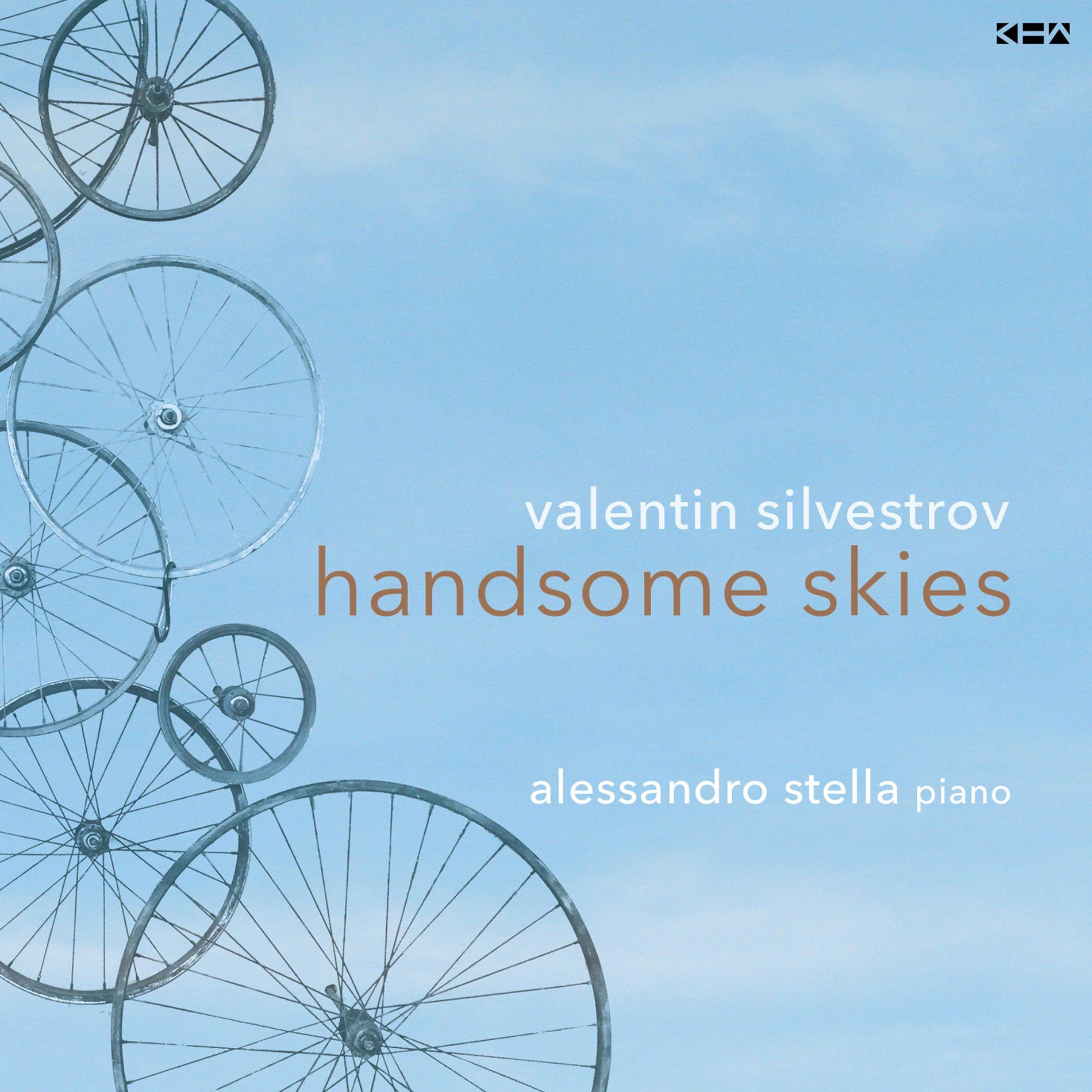
Alessandro Stella: Handsome Skies – Valentin Silvestrov
Valentin Silvestrov emerges from the late Soviet classical tradition as a figure of quiet resistance, not through overt polemic but by turning inward when history demanded proclamations. While many composers of his generation negotiated the pressures of socialist realism or the rigor of the avant-garde, Silvestrov gradually chose another path, treating music as an echo rather than a declaration. But he carried it further, dissolving form until what remained was remembrance itself. In his hands, composition became a kind of afterlife, where melody appears already worn by time, as if it remembers having been heard before.
Handsome Skies, as realized by Alessandro Stella, gathers these fragile remnants into a single atmosphere. The album does not unfold as a sequence of works so much as a slow change of light, each piece leaning toward the next like overlapping thoughts. Nostalghia sets the tone with its suspended tenderness, where the delicacy of the moment is filtered through awareness of impermanence. Notes arise like recollections that cannot quite be held, life and death entwined in a gentle blur, the self dissolving through stepwise descents until only listening remains.
From there, the 3 Bagatelles, Op. 1, feel like the genetic code of Silvestrov’s language. Each motif behaves as a living cell, compact yet expansive, unfurling across vast emotional distances with no need for explanation. The central bagatelle darkens into a low tidal pull, a rumbling that suggests urgency even as it undoes itself, breath cycling downward in slow motion toward silence. Entropy here is not destruction but revelation.
Those inward explorations deepen in the 3 Bagatelles, Op. 4, where the harmonic surface grows slightly more abrasive, though never unmoored. Dissonance appears as a passing weather, always giving way to equilibrium. The music seems to hover between states, revealing how fragility and balance depend upon one another. In that exchange, lived experience expands beyond narrative and becomes architecture, something you wander through rather than follow.
The 3 Waltzes with Postludium, Op. 3, carry a different tension. Their anxiety seeps rather than strikes, an unease that presses forward in search of time’s gradual remedy. These are not dances recalled from happier eras but movements shaped by present wounds, processing themselves through the subconscious. Hope lingers quietly, most vividly in the Postludium, where fragments settle into place with a retrospective beauty that feels earned at great sacrifice.
With the 4 Pieces, Op. 2, Silvestrov’s painterly patience comes into focus. The Lullaby offers tenderness without comfort, while the concluding Postludium glimmers with restrained light. Between them lies a porous emotional space where yearning never quite finds its object, and restraint becomes its own form of expression.
The Postludium, Op. 5, stands apart in its gravity. It feels bound to mortality, like a coffin descending, the sound weighted by farewell. Each gesture seems aware of its finality, yet refuses drama, allowing grief to exist without explanation.
The Waltz and two Serenades, Op. 193, lean into sentimentality, though without artifice. Their sincerity has a photographic clarity, capturing moments exactly as they are, unembellished and therefore more affecting. Melody closes the program with its forested resonance, a dream that never consents to waking, suspended in perpetual dusk.
Throughout Handsome Skies, Stella’s playing is so embodied that the distinction between interpreter and creator begins to blur. His pianism sounds as if it is thinking aloud, composing itself in real time, guided less by intention than by listening. What remains at the end is not an answer but a space, one where memory, sound, and silence coexist without hierarchy. Silvestrov’s music, as Stella reveals it, does not ask to be understood. It asks only to be entered, and once inside, the listener is free to decide whether these echoes belong to the past, the present, or something still arriving.