Opera as Hollywood: The Amazing Adventures of Kavalier & Clay
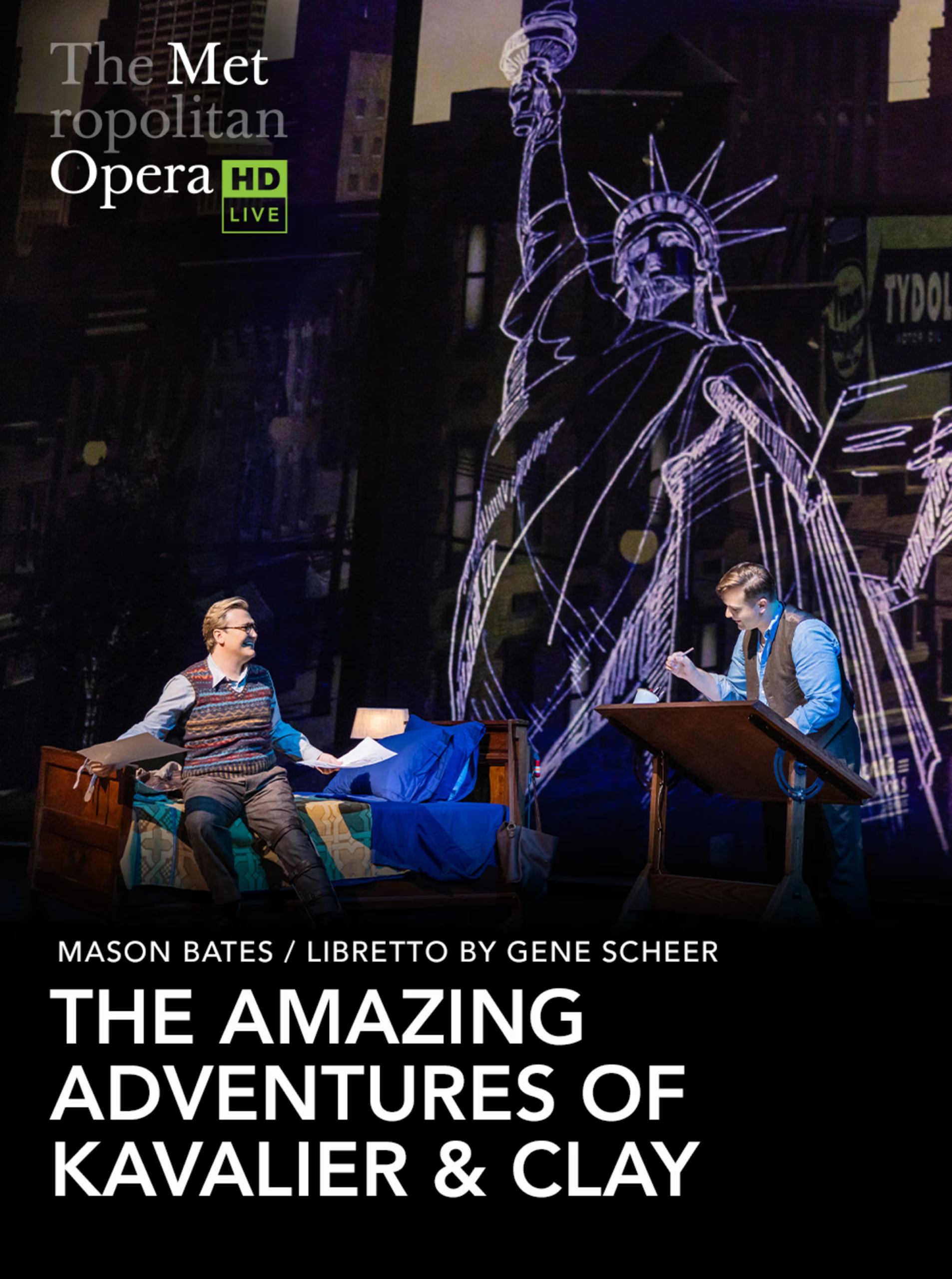 A few minutes into watching Mason Bates’ The Amazing Adventures of Kavalier & Clay at my local cineplex via The Metropolitan Opera’s Live in HD series, I realized that a movie theater was exactly the right place to see it. It’s basically a feature film that happens to be sung onstage by opera singers, with music that could easily have come from a Hans Zimmer or Danny Elfman soundtrack.
The libretto by Gene Scheer condenses Michael Chabon’s 600-page historical novel into two tidy acts, set amid World War II, the Holocaust and the Golden Age of Comics. At the center are two Jewish cousins: Josef (Joe) Kavalier, a talented illustrator and magician who’s just escaped from Prague by diving into the Moldau then hiding inside a train-borne coffin, and Sam Clay, an industrious New York copy writer and childhood polio survivor. Together they launch a comic book series starring The Escapist: a superhero who travels the world “coming to the aid of those who languish in tyranny’s chains”. It becomes a big hit, spawning a radio drama that brings the closeted Sam into the affections of its gay lead actor Tracy Bacon. When Tracy enlists following Pearl Harbor, a rowdy all-male sendoff party sports one of the bawdiest scenes seen at the Met since Karita Mattila’s Salomé stripdown.1 But the festivities are soon busted up by FBI agents, one of whom rapes Sam as Tracy escapes.
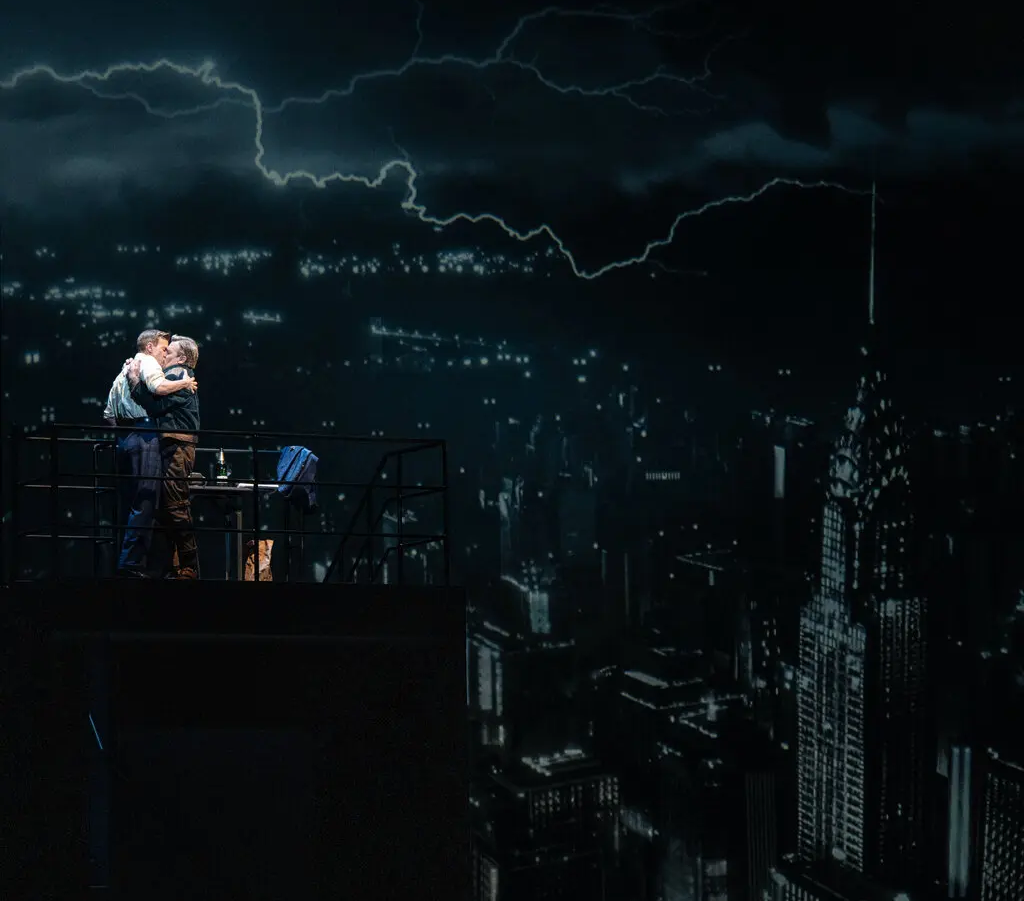
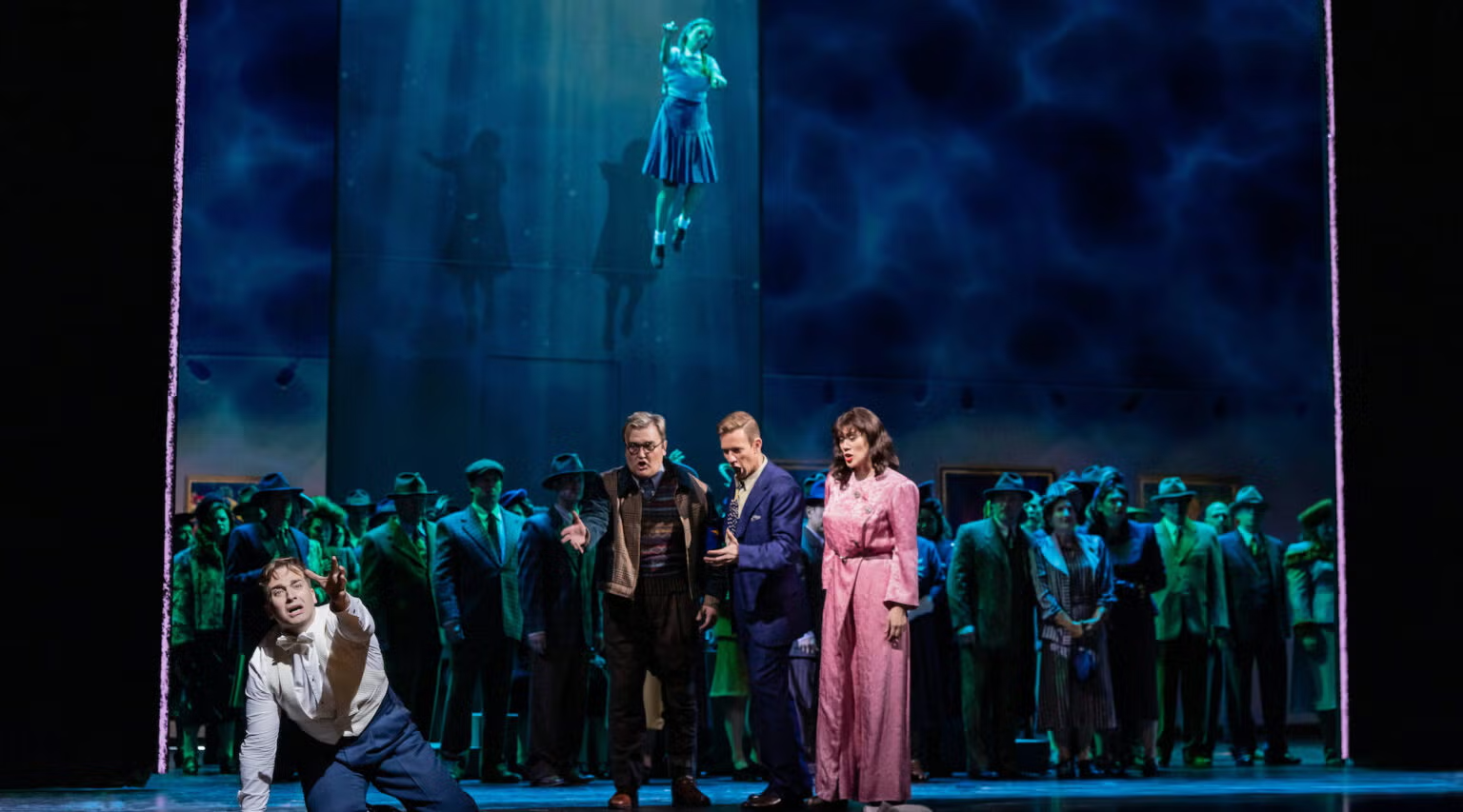
Joe meanwhile has fallen in love with fellow artist Rosa Saks who represents a relief agency that ferries Jewish children to safety in America. As Rosa arranges for Joe’s beloved sister Sarah to be smuggled onto a rescue ship, the couple dream about “a new beginning, like the tip of a pen drawing a new life”. But the ship is sunk by German torpedoes, the news triggering an emotional breakdown in Joe where a vision of a drowning Sarah mirrors his own watery escape from Prague. Bereaved and unaware that Rosa is pregnant, Joe also enlists, convinced that revenge is all he has left. A demoralized Sam, having lost his own love interest, offers Rosa a convenience marriage, and together they raise Joe’s daughter (who they name Sarah in honor of his sister) while successfully continuing the comic franchise in Joe’s absence.2 The irony of The Escapist is now apparent, as Sam has been recaptured by the closet and Joe has been recaptured by the war.
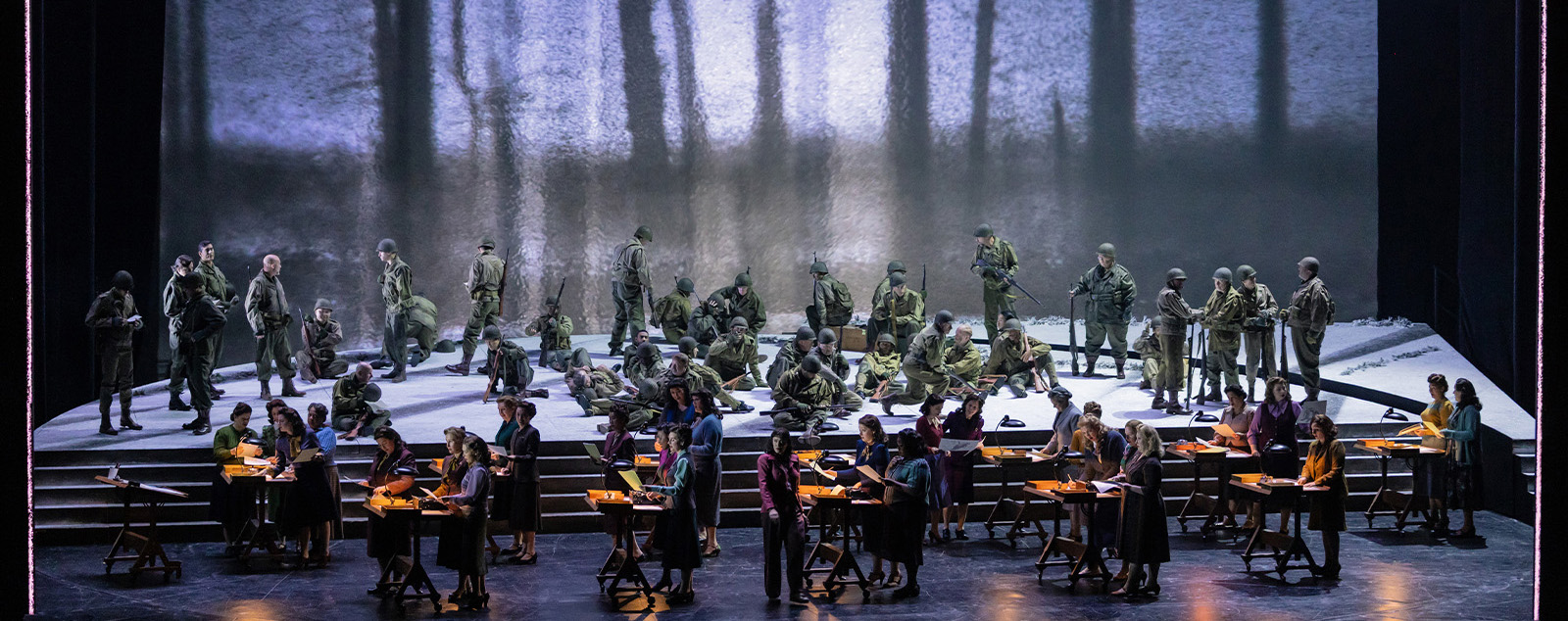
Three years later, Joe and Tracy are reunited by chance on the Western Front. As they rush to the aid of a fallen comrade, Tracy is fatally shot, while Joe laments “I can’t seem to die”. Joe returns home and reconciles with Rosa as Sam voluntarily decamps to California to write The Amazing Adventures of Kavalier & Clay. (It’s here that the libretto departs most significantly from Chabon’s original, which has Joe spending the war in Antarctica and only gradually reintegrating with his family afterwards.)
The story has all the trappings of a Hollywood wartime epic: danger, escape, romance, bigotry, combat scenes and self-discovery, not to mention a superhero who’s a cross between Batman and Houdini. Even the production is cinematic, with animations simulating the drawing of cartoon figures, telescoping curtains that resemble comic book panels, and the Met’s infamous “Machine” (rotating stage) enlivening the battlefield scenes. The mise-en-scène seems to have been specifically optimized for Live in HD (which will likely go down as the crowning achievement of Peter Gelb’s controversial tenure at the company), with carefully timed close-up opportunities—and subtle, camera-friendly makeup—built into the direction. Occasionally the narrative stumbles, as with a Salvador Dalí cameo that plays like a knockoff of the Pirelli character in Sweeney Todd, or Rosa’s Luna Moth comic character whose onstage portrayal is too derivative of Disney’s Tinker Bell. But the main impression is of an opera whose potentiality can only be truly fulfilled with the larger-than-life projection screen, intimate camera work and enveloping stereo audio that Live in HD delivers.
Given all that, it’s understandable that critics who’ve attended Kavalier & Clay inside the Met have been generally underwhelmed by the experience. It’s easy to dismiss Bates’ music as unoriginal, built from the hackneyed tonal harmonies, high-impact orchestration and underlying electronic beats that are ubiquitous in the film industry. The Prague scenes predictably feature an amplified mandolin to provide local color, while the New York social scenes recall 30s swing music, and the recuring martial music (with its reinforced bass underpinning rapid arpeggios in the strings) is practically a clone of The Dark Knight Rises.
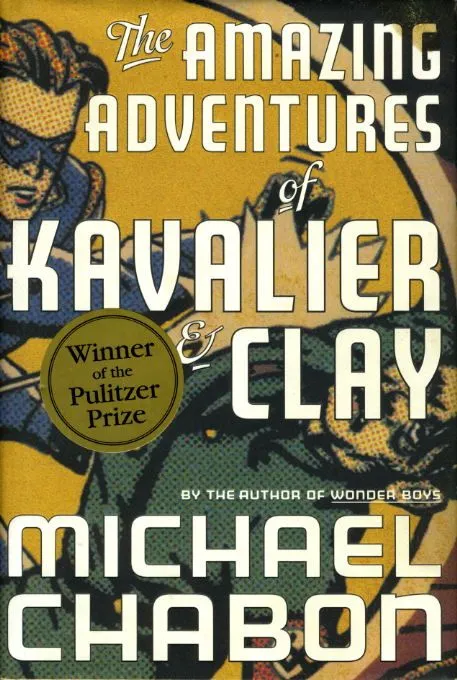 But Bates succeeds where most composers would fail at adapting this sound world to the operatic medium without drowning out the voices or drowning the narrative in irredeemable pretentiousness. The vocal writing is idiomatic both to the troublesome English language and to the demands of full-throated bel canto, while the chorus can be heard echoing the terminal words of principals’ lines in a fashion reminiscent of Gilbert and Sullivan. The Met has a conductor in Yannick Nézet-Séguin who’s particularly adept at balancing what Bates calls “symphonic electronica” with onstage voices, while the Met is probably the only opera company in North America with the resources to pull off this kind of Technicolor-scoped spectacle.
Kavalier & Clay may not be in the same class as Innocence, Hamlet or Eurydice (to name three recent and upcoming Met productions), but as North American opera companies seek to future-proof themselves by developing a middlebrow product that’s suitable for traditional singers and orchestras, it at least offers a more compelling and contemporary-sounding model than the post-Puccini vapidity that’s now the norm for commissioned work. And in contrast to the bludgeoning political activism of Blue or Lil Elbe, Kavalier & Clay relies on historical analogy to convey its message: just as the fictional Escapist’s heroics were intended to encourage America to mobilize for war, so does the opera endeavor to gird contemporary Americans to battle homegrown fascism. It shares a lineage with Eisenstein and Prokofiev’s Alexander Nevsky, whose recounting of a medieval Russian triumph over invading Teutonic Knights served to prepare its audience to fight the original Nazis.
Kavalier & Clay will be performed again at the Metropolitan Opera House on 17, 18, 20 and 21, and its HD video transmission will be reprised this week at selected cinemas around the world.
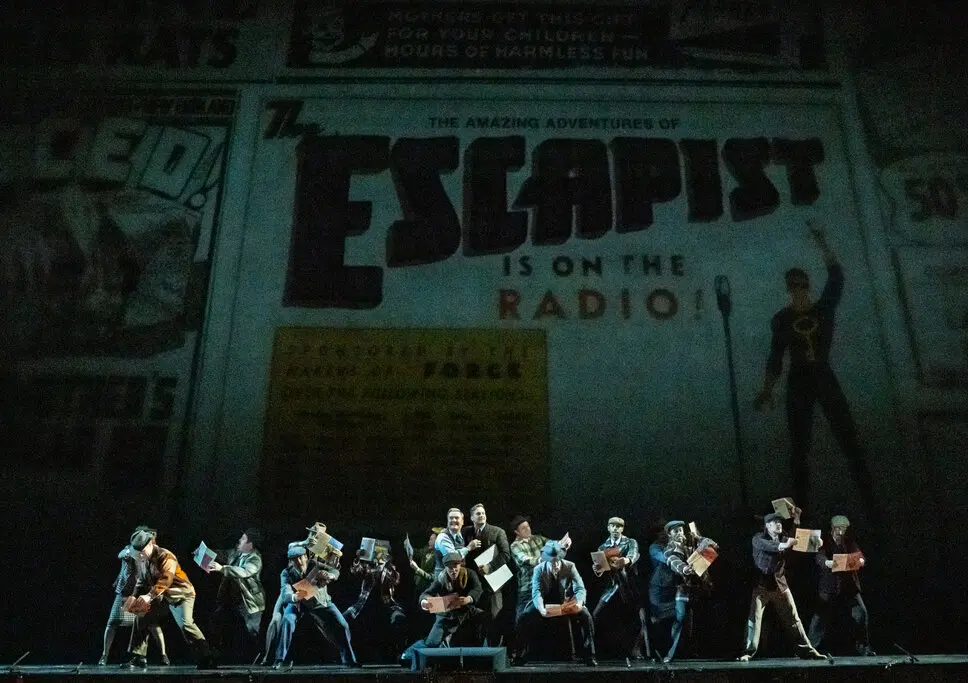
The Amazing Adventures of Kavalier & Clay was co-commissioned by The Metropolitan Opera and Opera Philadelphia, and was premiered in 2024 at Indiana University (after LA Opera cancelled its scheduled premiere there). The Metropolitan Opera debuted the opera’s first professional production on September 21, 2025. The Met in HD broadcast was recorded on October 2, 2025 and debuted in theaters on January 24, 2026.
-
- A politician in attendance is regaled with “Dick, Dick, Dick, Dick Johnson for Congress…of all the Johnsons he’s better than the rest…Dick Johnson will stick it to Washington”.↩︎
- In the novel, Joe’s sibling and child are both boys named Tommy, but Bates and Scheer sensibly decided that the opera needed a prominent soprano role to complement Rosa’s mezzo-soprano and the male principals.↩︎