Miako Klein/Jia Lim: Nova Atlantis
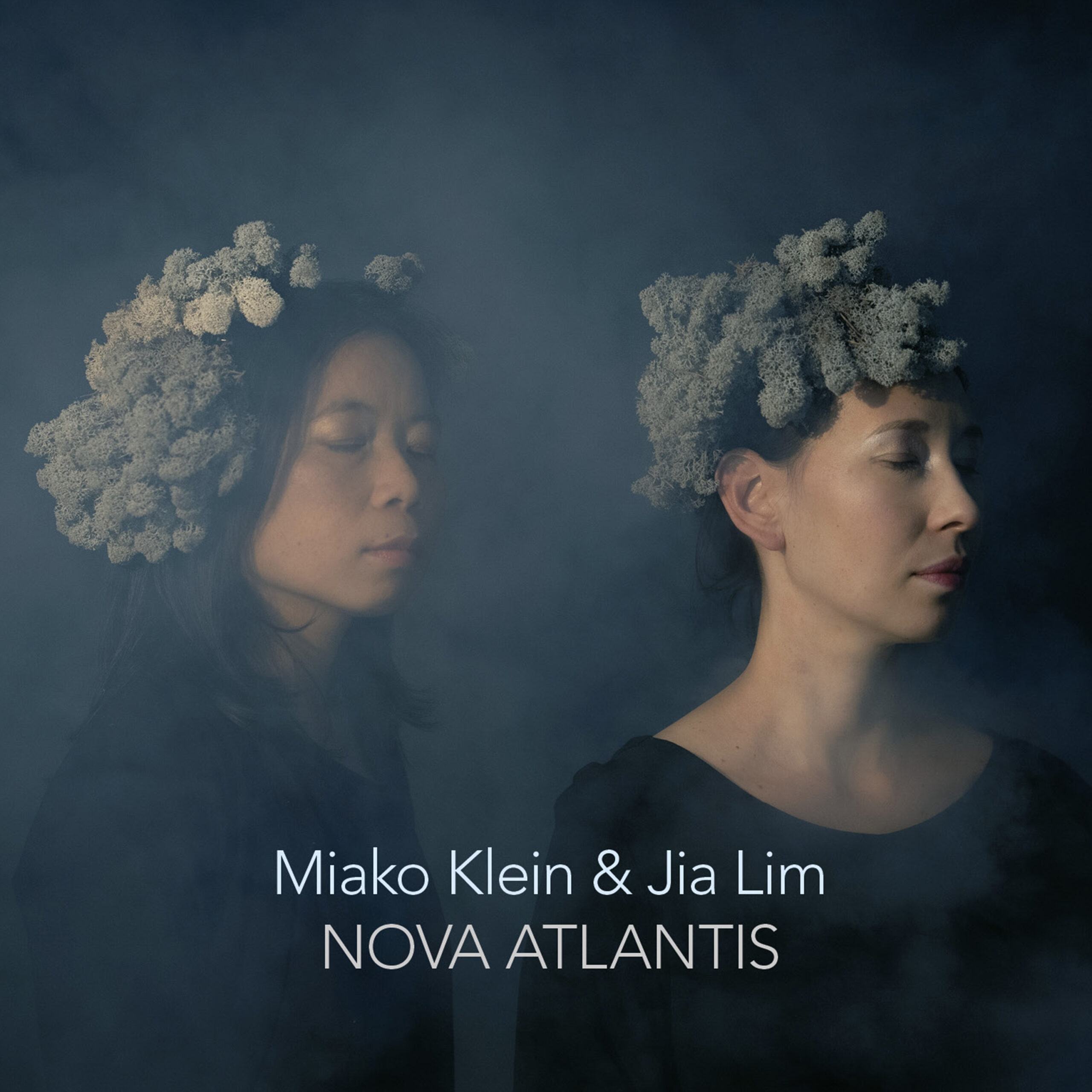
From its very first shimmer, Nova Atlantis feels like a threshold slowly brightening, a sonic coastline where centuries meet and dissolve into one another rather than remaining neatly on opposite shores. Miako Klein, moving between Baroque violin, recorder, and electronics, and Jia Lim, tending a replica harpsichord entwined with circuitry, do not merely revive the past or ornament the present. They braid them into a single breathing organism whose pulse is at once archival and prophetic. The album drifts outward from Francis Bacon’s unfinished 1626 vision of a knowledge-bound utopia, yet it refuses the posture of illustration. Instead, Bacon’s imagined “sound-houses” become a metaphorical workshop, a listening laboratory in which antiquity is experimented upon. What unfolds is a crossing of thresholds: ornate Baroque architecture rubbing shoulders with the hum of electricity, wood and gut shimmering against pedals, cables, and processors that murmur beneath the surface as a hidden nervous system. The listener inhabits neither museum nor studio, but a third zone where parchment conducts current and circuitry remembers dust.
Klein and Lim approach the Baroque “Doctrine of Affections” less as custodians than cartographers. They chart emotion as terrain, steering by the unruly compass of the Stylus Fantasticus. Improvisation becomes a vessel in which disciplined gestures loosen, scatter, and reassemble as contemporary texture. The result is not fusion but transmission, an intertemporal conversation in which antique melodies glow with electronic afterimages and history speaks in voltage. This friction between eras becomes the album’s central motor, a constant low-level tension that makes every familiar gesture feel newly unstable.
That tension is especially vivid when Heinrich Ignaz Franz Biber’s Mystery (Rosary) Sonata No. 1 in D Minor appears. It is not performed so much as reconstituted: the score opened, disarticulated, and aerated until its inner turbulence becomes audible, sin and sanctification wrestling inside a lattice of digital splintering. Nicola Matteis Jr.’s Fantasia in A Minor “Alia Fantasia” follows with a violin that seems to hover at the edge of embodiment, its tone flickering between presence and absence, a wandering soul negotiating with machines that can measure motion but never spirit, technology tracking movement while the music keeps slipping through its grid.
In Dietrich Buxtehude’s Chaconne in E minor, the recorder enters as a bent mirror: familiar ground gradually warping into a field of glitches, the theme accruing distortions until filtration feels less like processing than pressure, as if the instrument were being tested for how much it can carry before breaking into light. Girolamo Frescobaldi’s Capriccioleans inward toward its own undercurrent, harpsichord echoes surfacing as murmurs from a submerged psyche, reverberations that sound less ornamental than sacramental, as though seeking a postmodern baptism by signal. This introspection sharpens in the Toccata in D Minor of Matthias Weckmann, whose lavish decoration is stretched to the brink by digital intervention, embellishment becoming exposure. The sequence then culminates in Johann Heinrich Schmelzer’s Violin Sonata No. 1, where the line acquires a faintly folkish twang yet remains anything but nostalgic, sparks spiraling upward through the texture, tradition caught in a perpetual loop of becoming.
Threaded through these canonical works are improvisations that act as the album’s true gravitational field. Arpeggios ripple across expanses of shimmering resonance, neither foreground nor background but a suspended system. Violin harmonics drift into a liminal register where flesh and spirit converse without translation. Deep drones rise from below as if guided by submarine hands, dragging timbre toward the abyss of its own undoing, while pizzicato flickers with nocturnal brightness, tiny constellations refusing futility by simply existing. Each fragment glows on its own, yet together they form a stained glass window whose colors reveal their meaning only when seen in totality. The invisible architect behind this luminosity is sound engineer Sebastian Schottke, whose support was instrumental in this project’s fruition. He amplifies inner voices, sculpts spatial depth, and renders the electronic layer not as an overlay but as an interlocutor.
By the album’s close, Nova Atlantis has transformed from program into proposition. It suggests that antiquity is not behind us but circulating through us and that technology is not future-facing but time-folding. Thus, Klein and Lim let the Baroque mutate and think with wires, past and future blending in a single, restless sea.