Phaedra Ensemble, ‘Slow Change’ (Reich, Þorvaldsdóttir, and Coltrane at Kings Place London, March 20, 2026)
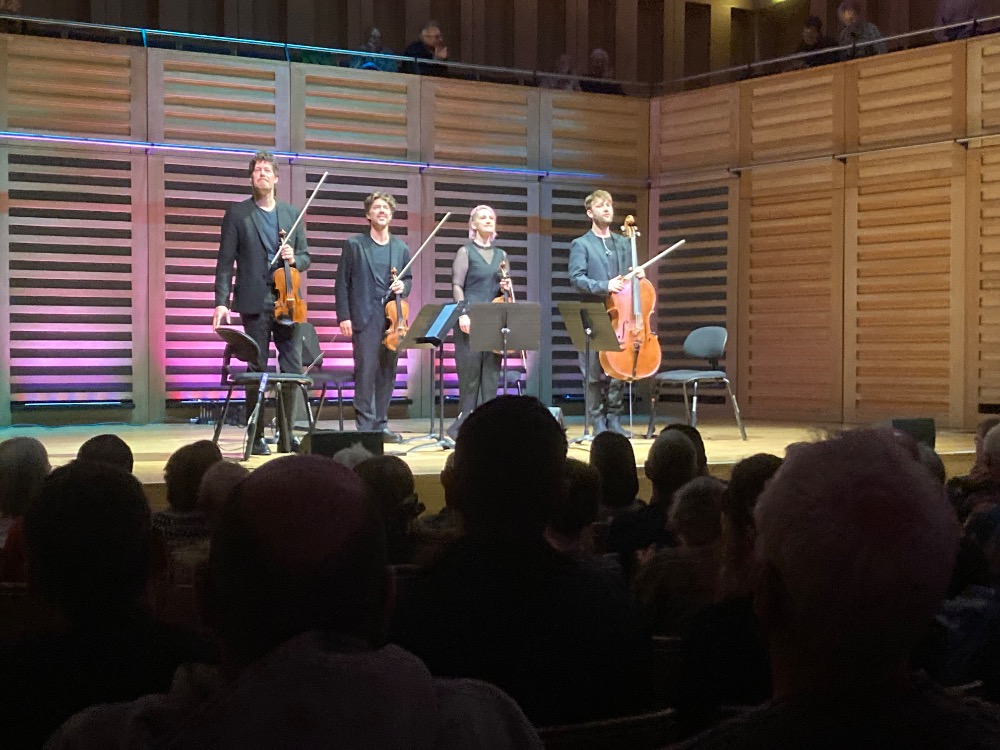
(Phaedra Ensemble at Kings Place)
Steve Reich’s ninetieth anniversary celebrations continued apace this month with two concerts at London’s Kings Place. Known for its creative buzz, lively atmosphere, and receptive audiences, the venue is an ideal setting for contemporary chamber music. Reich’s three major quartets were heard there within the space of a week: the Solem Quartet’s powerful performance of Different Trains on March 14th (see my review in The Strad) was followed on March 20th by equally compelling interpretations of WTC 9/11 and Triple Quartet by the dynamic Phaedra Ensemble. Both concerts formed part of Kings Place’s imaginatively curated ‘Memory Unwrapped’ series.
Subtitled ‘slow change’, Phaedra Ensemble’s programme opened with WTC 9/11—Reich’s sobering memorial to the attacks on the World Trade Centre and Pentagon on September 11, 2001. Like its predecessor Different Trains, the work employs prerecorded string quartet parts, speech recordings, and sound effects to create what Reich described as a form of ‘documentary music video theatre’.
A personal dimension runs through WTC 9/11. Reich’s New York apartment stood only a few blocks away from the World Trade Centre at the time of the attacks, and although he and his wife, video artist Beryl Korot, were in Vermont, his son Ezra—along with his granddaughter and daughter-in-law—were staying in the apartment. When the first tower collapsed, dense clouds of debris engulfed the area. Reich remained on the phone with his family for six hours, watching events unfold in horror on television—an experience that vividly informed the work’s emotional core.
The twenty-two years separating WTC 9/11 from Different Trains allowed for significant advances in sampling and digital technology, which shaped Reich’s compositional approach. He was able to edit and manipulate speech with greater nuance, most notably through his ‘stop-action sound’ technique, in which vowels and consonants are elongated to align harmonically with instrumental lines. This is evident at the opening, where the word “Boston” in the phrase “they came from Boston” becomes a compressed semitone shared between voice, cello, and viola.
Such integration of live and prerecorded material presents considerable challenges in performance. The work begins with the unsettling sound of a phone left off the hook—produced by two violins and a recording—which becomes a persistent rhythmic motif, akin to the locomotive paradiddle patterns in Different Trains. Its ominous character intensifies across the first two movements.
As Kronos Quartet’s David Harrington has noted, achieving the right bow articulation for this figure is crucial. Phaedra’s violinists, Thomas Gould and Phillip Granell, took a slightly different but nevertheless equally effective approach, using precise strokes in the middle of the bow rather than at the tip. Combined with minimal vibrato, this evoked a distinctly Baroque sensibility, reinforced by their bow hold.
The resulting ‘mechanical affect’—a controlled, almost mechanised expressivity—proved striking. Reich has encouraged Baroque-informed approaches among vocalists, but hearing it applied here was illuminating. When the ensemble shifted timbre in the third movement—adding warmth and a touch of vibrato to accompany a recording of a Jewish cantor singing The Wayfarer’s Prayer—the transformation in sound vividly conveyed the work’s spiritual trajectory, with string lines rising luminously from the melody.
An intriguing aspect of this year’s Reich celebrations has been the pairing of his music with that of other composers. At a Hallé concert last month, his work appeared alongside Jonny Greenwood (see my review here). At Kings Place, a more unexpected pairing came in the form of Anna S. Þorvaldsdóttir’s Enigma, given its UK premiere.
If Enigma presents a puzzle, it lies in its slowly shifting sonic landscape, which seems to function as a portal to interior, psychological spaces. Þorvaldsdóttir’s music inhabits a liminal zone between sound and noise, simplicity and complexity, abstraction and suggestion. These interactions often yield evocative results, though the most striking moments came when flashes of tonal colour broke through the work’s rugged, geological textures. A modal melody towards the end even hinted at the cinematic style of her Icelandic contemporary Hildur Guðnadóttir.
The second half offered further contrast with Reich’s early Violin Phase and the later Triple Quartet. In Violin Phase, Phillip Granell subtly brought out the folklike character of the opening motif, while carefully integrating the phasing patterns—the first systematic use of this technique in Reich’s output—with the taped violin lines.
Originally, Different Trains was to be titled Triple Quartet, making Reich’s later reuse of the name fitting. Composed for the Kronos Quartet, the three-movement work draws rhythmic and harmonic inspiration from Bartók, particularly his use of circular forms based on interlocking minor-third relationships.
One of the principal challenges in Triple Quartet is balancing the live quartet with two prerecorded quartets. Without speech or sound effects to mask discrepancies, the live players are more exposed and must closely match the timbre of the recorded parts to avoid the impression of ‘two quartets plus one’. Some ensembles, such as the Smith and Mivos Quartets, have recorded complete versions to ensure consistency, though this is not always practical in performance.
Phaedra met this challenge admirably, from beautifully intoned melodic passages in the second movement to a visceral account of the third. Their performance suggested that a fully self-recorded version would make a compelling future project.
The concert concluded with an arrangement by Phaedra associate and composer Jamie Hamilton of John Coltrane’s Africa—a key influence on Reich. Phaedra’s versatility was evident here, their Quatuor Ébène-like dynamism demonstrating ease in (and command of) both modal jazz and the ‘slow change’ sound worlds of Þorvaldsdóttir and Reich.
To mark Steve Reich’s 90th anniversary celebrations in 2026, Pwyll ap Siôn will be covering at least one concert of the composer’s music for every month of the year, with reviews appearing in Sequenza21, Bachtrack, and Strad.