Four New Releases on New Amsterdam Records
Zeelie Brown, the apocalypse is not the end but the unveiling (NWAM202)
Essvus, What Ails You (NWAM201)
Ruby Colley & EXAUDI, Hello Halo (NWAM200)
Travis Laplante & JACK Quartet, String Quartets (NWAM199)


Based on the evidence provided by this exciting quartet of recent releases, the sails on New Amsterdam Records’ windmill rotate with ever-increasing productivity, invention and creativity these days.
The two most recent recordings, the apocalypse is not the end but the unveiling by cellist and multimedia artist Zeelie Brown and What Ails You by Essvus, deal directly with social, political, and personal issues.
Part of NewAm’s new series of composer’s lab releases, Brown’s debut album offers timely and sobering reflections on the politics of race in American history. As stated in the opening track “let go, let god,” also featuring Sierra Leonean-American singer and composer YATTA, “this album is a prayer for anybody looking at injustice and just needing the inspiration to stand up and fight.”
Brown’s arresting yet compelling concept album speaks to these matters with clarity, compassion, conviction and some urgency. In “gossamer,” Brown’s voice is placed in passionate counterpoint to floating, silky-sounding chords, while in the anti-capitalist diatribe “i pray for this country,” electronically generated beeps intersect with a soulful Bill Withers-style harmonic sequence on piano.
Two instrumental interludes foreground Brown’s skills as cellist—the first a soaring, freewheeling improvisation, the second modelled on a descending Chopin-like lament bass. A similar chaconne-type sequence on piano echoes through the empty corridors of “in the waters between life and death,” whose lyric is located in the queer clubs of the 1980’s during the AIDS pandemic, and with the plight of its shattered and slighted communities.
Powered by restless African-inspired rhythms and pulses (as heard in “mbele”), perhaps it’s inevitable that comparisons will be drawn with contemporary cellists such as Sheku Kanneh-Mason, Abel Selacoe, and Vincent Ségal, who have likewise interrogated the chequered histories of their own cultural backgrounds in relation to race and political history. Nevertheless, Brown’s corporeal music emanates powerfully from within, inseparable from its (or their) own body and the physicality of sound.
This sense of self-presence manifests itself just as effectively in Brown’s vocal extemporizations, where swooping falsetto lines carry within them a striking authenticity. Brown’s falsetto is the antithesis of false-etto, its unique sound a mix of vocal styles and gestures—Nina Simone (who is quoted in “in the waters”), Sylvester, Earth, Wind & Fire’s Philip Bailey, Jimmy Somerville of The Communards, and Anohni (previously Antony and the Johnsons), spring to mind.
In comparison, the nine-track What Ails You by Essvus (aka Gen Morigami) projects more raw and edgy qualities. Brown’s polyrhythmic Latin-American percussion patterns are replaced with industrial metallic noises, pounding found objects, clanging alarm bells, and Hüsker Dü-type screaming guitars, as heard on the opening track “Inner Violence.” The album comes across as a drawn-out primal scream—Edvard Munch in freeze-frame slow-motion—which is hardly surprising given that What Ails You is the result of Essvus’s struggles with mental health and familial estrangement.
The most intense tracks mesh gritty rhythms with manipulated vocal gestures and phrases, as heard on the unbalanced and disorientated, Sonic Youth-like “To Not Think.” Treated vocal interjections also underpin the sound-collage-heavy “Warmth,” its percussive wall-of-sound and sped-up speech utterances suggesting the influence of experimental rock duo Battles. Dystopian drum and bass patterns rattle through the rhythmic rubble of “Moldsporing” and “Every Hope, A Dream, A Prayer,” while “Counterfactuals” sets off as a Joy Division homage before spiralling into space-age The Doors, trippy disco, and glitchy musique concrete.
Despite the tangle of seemingly incompatible styles and influences, the end result makes marvellous sense, albeit in a twisted, contorted way.
There are quieter moments, too, such as in “Anaesthetic Midnight”—whose sounds appear to have been fed through a giant reverb wormhole—or the dreamy opening to “Hell and High Water.” During these moments, Essvus almost flirts with beauty. In What Ails You, one is left not so much with a ‘Law of Diminishing Returns’ but instead a ‘Law of Increasing Returns’: the more one listens to the album, the more one is struck by the detail buried inside its strange, solipsistic sound world.
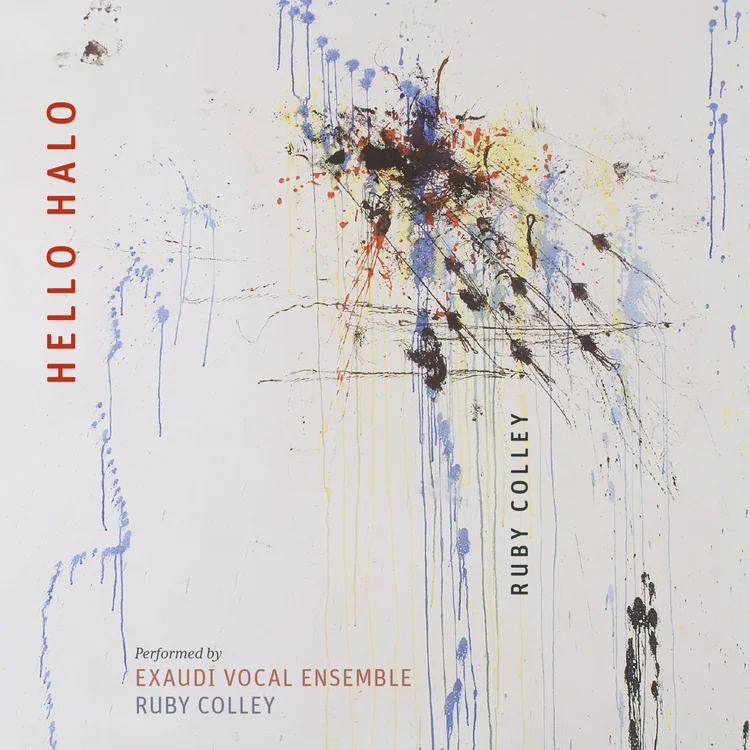
A far gentler world engulfs Ruby Colley’s six-track EP Hello Halo. The talented, versatile composer, violinist and sound artist teams up with the excellent Exaudi vocal ensemble to present a suite that explores the intersection between contemporary music and health and wellbeing. The idea behind Hello Halo came from Colley’s experiences of growing up with her brother, Paul, who is neurodivergent and non-speaking. Despite Paul’s inability to communicate via ‘everyday’ language, Colley recorded the rich range of sounds and gestures her brother makes, using his voice and other sonic fragments to provide a vocal map for the music.
The result works both on a purely musical and programmatic (i.e., extra-musical) level—musical in the way in which Colley marries her brother’s vocal gestures with extended vocal and string techniques, and ‘programmatic’ because the suite operates effectively as a kind of “day in the life” of Ruby and Paul.
Given the self-imposed limitations (six voices, solo violin, soundtrack), Hello Halo is surprisingly varied in scope. “What Is It” is almost madrigal-like, the two “Duets” more fragmentary and collage-like, “Echoes” blending hocket-like textures with a quote from “Twinkle, Twinkle, Little Star,” and the alphabet-inspired “Cosmology” more earthy and folk-like.
Perhaps unsurprisingly, the influence of Meredith Monk, Joan La Barbara, and Caroline Shaw comes across at various points—such as in the layered entries and stacked harmonies in the title track. Nevertheless, the use of such techniques in the context of the “non-verbal” world in which Paul inhabits yields a unique and different outcome. It’s as if Colley’s music has scraped away at the grain of the voice to capture the character of the person that lies behind it. If ever we needed reassurance that music is the perfect vehicle for communication beyond language and words, here it is.
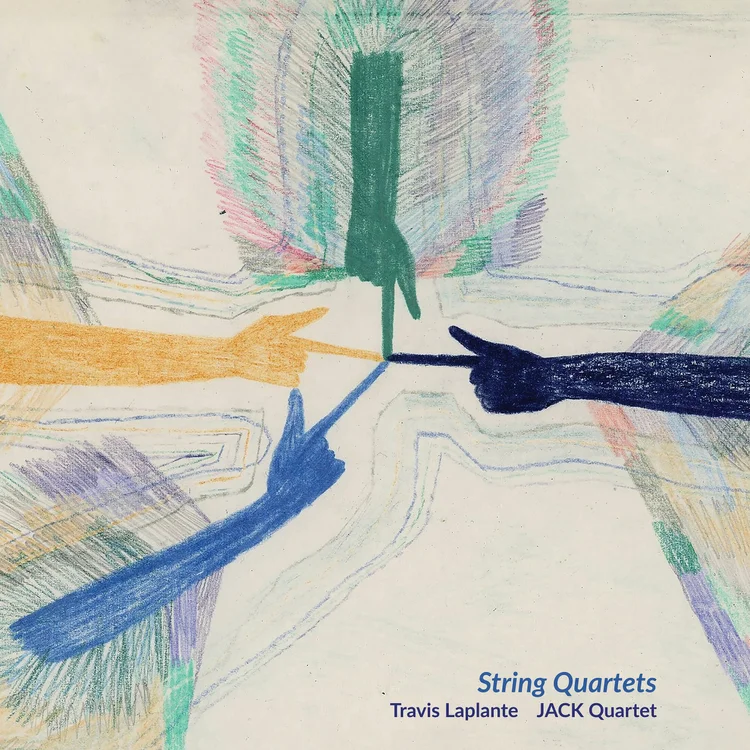
‘Quartet’ takes on added significance in the last of the four releases surveyed: Travis Laplante’s String Quartets 1 & 2, performed by JACK Quartet.
I had previously listened to, and enjoyed, Human—Laplante’s 2019 album of solo saxophone improvisations—but it hadn’t fully prepared me for his two string quartets. Both contain lyrical qualities, in addition to microtonality, yet these elements are more subtle and integrated in the quartets.
Folklike and wistful, String Quartet No. 1 begins with a kind of pure resonance of the string quartet sound. Subtle use of microtonality gives way to flowing ostinato patterns, suggesting Philip Glass and Michael Nyman’s string quartets but with the added heft of a late Beethoven opus. Part 1 ends with a surge towards a series of flickering, pulsing open fifths.
These buildups are aided by Laplante’s treatment of the quartet as a homogenous physical force. These moments often appear to contain the seeds of their own destruction, collapsing from within. This happens in Part 2 of the String Quartet No. 1, where the process of atrophy ends in a valedictory-style duet between the two violins.
In certain respects, String Quartet No. 2 follows a similar recipe, but the musical outcome is quite different. It opens with the grace, tenderness and beauty of a marriage ceremony, but soon enough the mood changes into something more unsettling. The first violin struggles to extricate itself from the prevailing atmosphere, causing a rift within the ensemble. As in the String Quartet No. 1, the middle section of Part 1 is more free-flowing, ostinato-heavy. Eventually it breaks free via a passage that sounds like neo-microtonal Bartók.
Part 2 begins with a Partita-like passage for solo viola, before being joined by the rest of the quartet. Subtitled “the spirit takes flight after death,” the final section exudes a similar transcendental spirit to the ending of the first quartet, offering a glimmer of hope amidst doubt and uncertainty. Laplante’s aesthetic may be partly grounded in theoretical and conceptual writings on resonances, alternate tunings, and microtonality, but this is not ‘paper music.’ His music has been imagined into being as sonic reality.
As expected, JACK Quartet apply themselves with the same level of interpretative understanding, nuance, accuracy, precision, dedication, and distinction to Laplante’s music as they would, say, a Ligeti or Lachenmann quartet. Laplante’s music draws in the listener, commanding attention and reflection.
Which leads us back to that famous windmill logo again. Established in 2008 by composers Judd Greenstein, Sarah Kirkland Snider, and William Brittelle, NewAm may not be exactly ‘new’ anymore, but the label is still blazing a trail in those fluid cross genre intersections between experimental and alternative rock, post-classical, post-minimal, and everything-in-between. Powered by the winds of change and innovation, NewAm’s mission has always been to transcend traditional and outdated genre distinctions, offering a home to music that’s stubbornly “outside” and unclassifiable … and new music is all the better because of it.