The Tallis Scholars at St. Mary’s (Concert Review)
Mother and Child
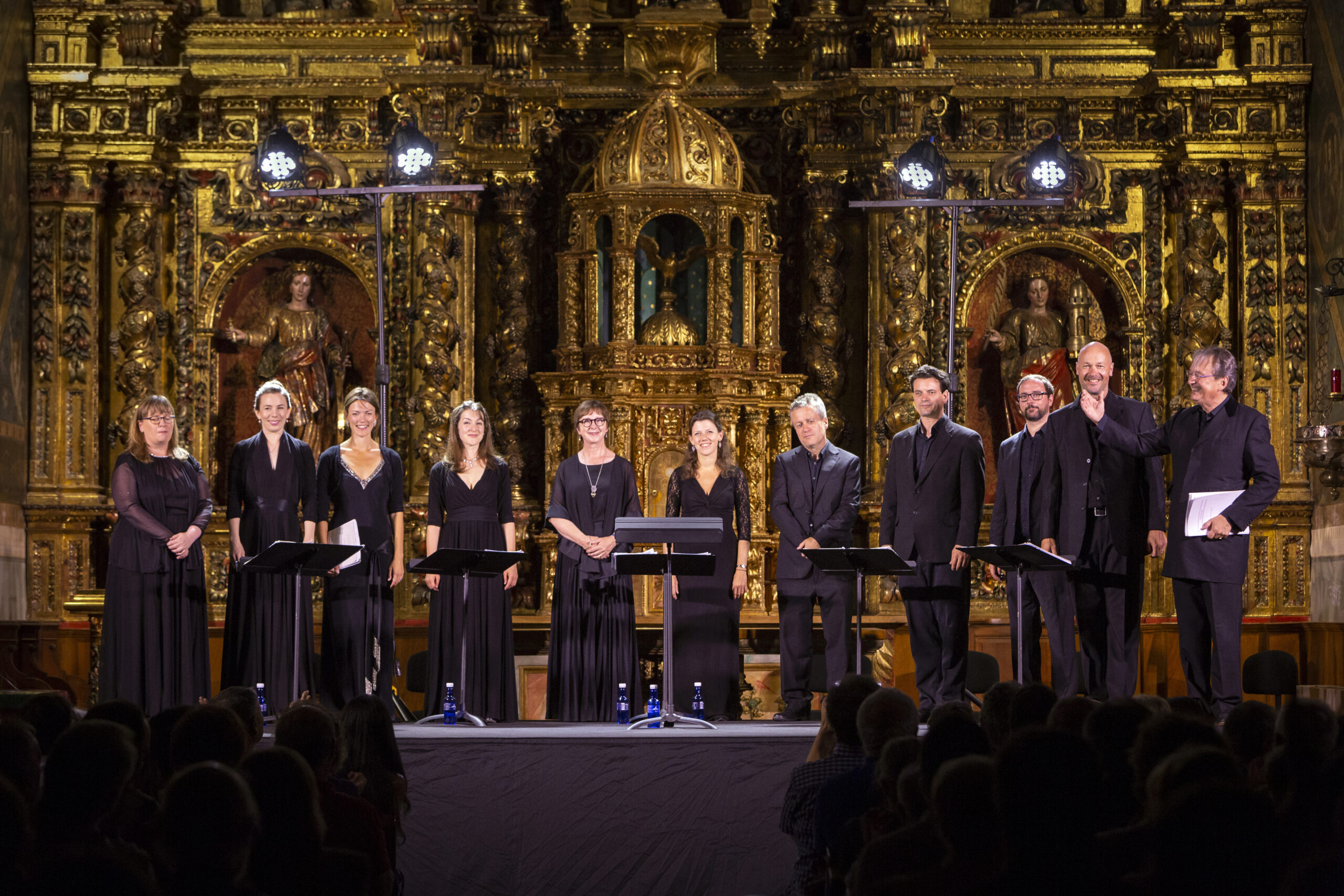
The Tallis Scholars, directed by Peter Phillips
Miller Theater Early Music Series, Church of St. Mary the Virgin
December 4, 2025
By Christian Carey
NEW YORK – The choral ensemble The Tallis Scholars, directed by Peter Phillips, are regular visitors to Manhattan, and their December concerts at Church of St. Mary the Virgin have a devoted following (pardon the pun). Often they perform a Marian-themed program appropriate to the space, and their appearance this past Thursday was no exception. In addition to pieces principally drawn from the English Renaissance, a new Salve Regina setting by the composer-organist Matthew Martin, was premiered.
The Tallis Scholars have a membership of ten, with three sopranos, three altos, two tenors, and two basses. Much of the music that they sing, including that of the Tudor composers Thomas Tallis and William Byrd, who were featured on the concert, was written for a setup with quintets at the front of a sanctuary on either side. At St. Mary’s, the voices were more often deployed in sections instead, although some alternate groupings allowed for the ensemble, or parts thereof, to explore the sonorous space in which they were singing.
The group is named after Tallis, who was the preeminent composer for the Tudor monarchs, and the program included movements from his Missa puer natus. William Byrd’s music was also well represented, with five of his motets presented in the framework of a Votive Mass of the Virgin. Alternating the sections of the mass with Byrd’s music highlighted the affinities between the two composers, whose Latin church music incorporates tightly knit imitative passages and, in places, dissonance created by spicy cross-relations.
Martin’s piece was a Miller Theatre commission, and it was both well written for the voices of the group while using crunchy added-note chords and intricate rhythms in keeping with the sound world of contemporary choral music. It was prefaced by the Salve Regina chant, a touching preamble to what was to be a moving work. Vivid text-painting detailed the sorrows and grief of Mary and the exhortations of the faithful, with hushed bass-register chords, the texture gradually evolving to be pierced by trumpet motives in the soprano voices and snug verticals in the rest of the ensemble. The middle section is declamatory, moving to a fevered climax in which suffering is depicted in a yawping tutti. The earlier ambience returns in a brief coda, which settles into sumptuous harmonies depicting the earnest plea for mercy that concludes the text. The Tallis Scholars have performed other contemporary music, notably that of Arvo Pärt, and they were accurate and ardent interpreters here. One hopes that Martin, who was not in attendance, gets to hear their rendition soon.
The program concluded with a Magnificat setting by John Nesbitt, taken from the Eton Choirbook, one of the rare remnants of a beautiful repertory of pieces from the fifteenth century. Most of the manuscripts of this music did not survive the Puritans’ destruction of Catholic liturgical materials during the seventeenth century. The piece alternated verses chanted by the tenors with full polyphony. Like many pieces in the Eton Choirbook, Nesbitt’s contained considerably intricate polyrhythms, with triplets set against duplets. Both chant and tutti passages were sung with dulcet-toned fluidity.
As an encore, Salva nos domine by the French composer Jean Mouton gave the audience a tantalizingly brief hearing of music from continental Europe.