Reich @ 90 (Steve Reich’s ‘Music for 18 Musicians’ at Kölner Philharmonie, 6 January 2026 (Ensemble Modern & Synergy Vocals)
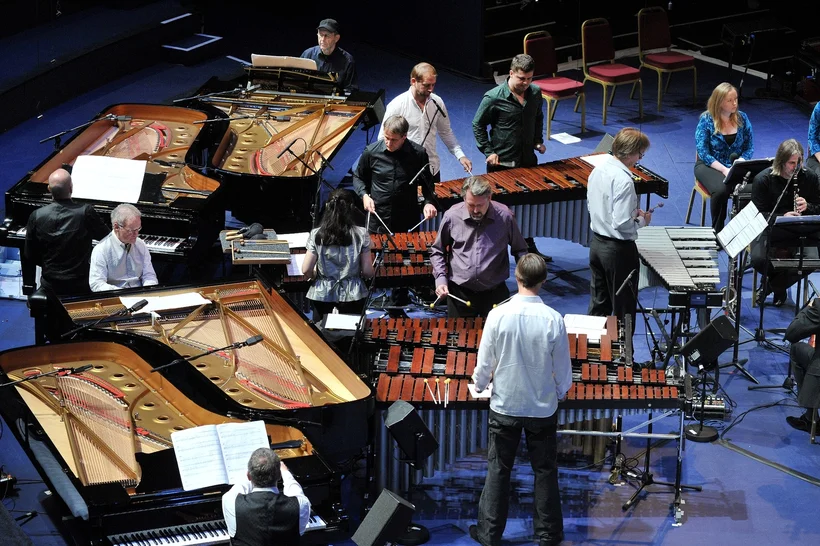
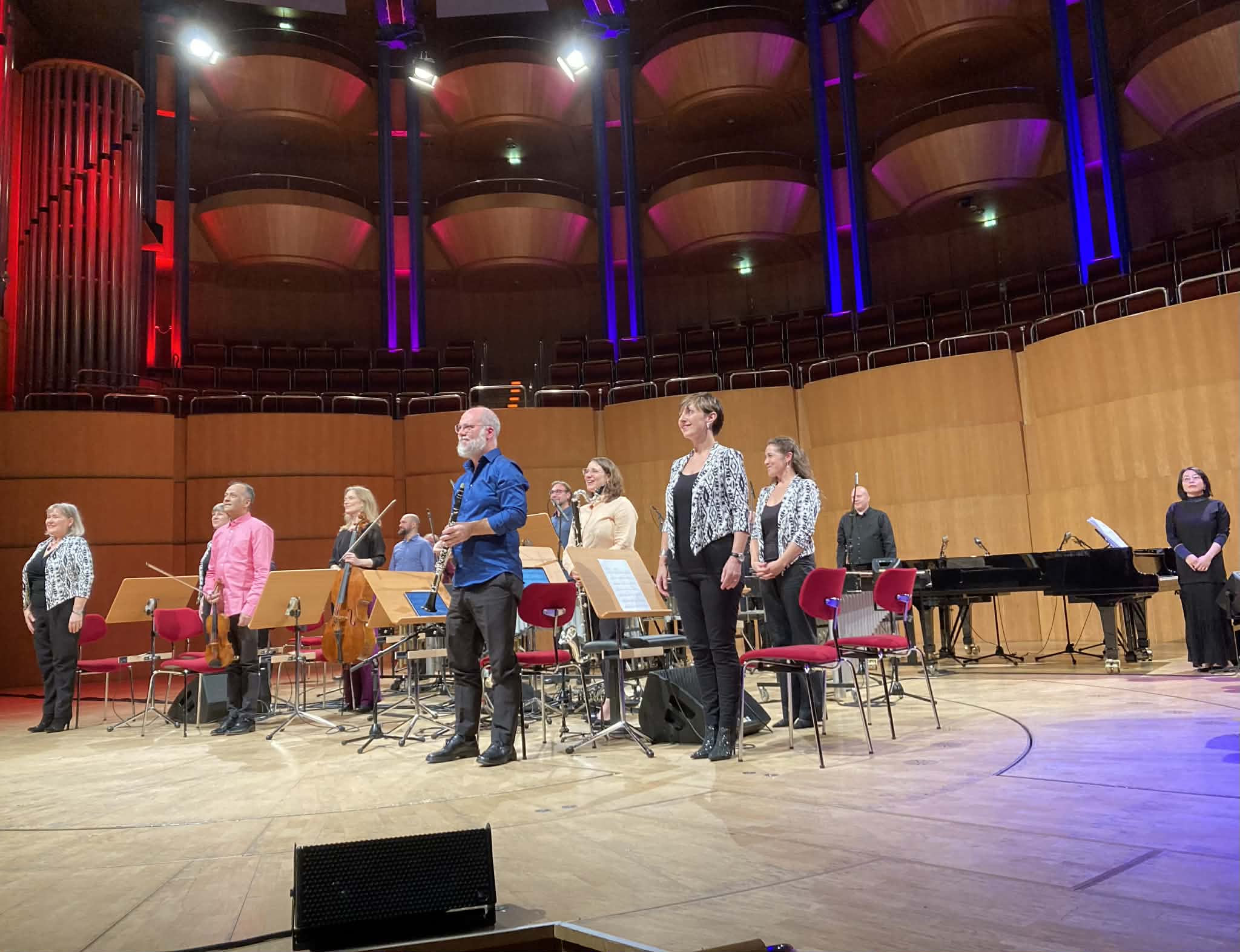
To mark the enduring impact and legacy of Steve Reich’s music on the music of our time in this his ninetieth anniversary year, my plan is to attend and review one concert every month featuring one or more of the great American’s compositions. And what better place to start this celebratory journey of discovery than a performance of Reich’s landmark Music for 18 Musicians at Kölner Philharmonie featuring the brilliant Ensemble Modern & Synergy Vocals.
There are probably only a handful of works I’d go to the end of the world to hear performed live, and Music for 18 Musicians is one of them. This year also marks half a century since the work’s premiere at New York’s Town Hall in April 1976, and almost three decades since Ensemble Modern’s first performance of the piece in 1997, made possible through composer Marc Mellits’ realisation of the full score from the performance parts used by Reich’s own ensemble. It was the first time that a recording of Music for 18 Musicians was released by a group other than Steve Reich and Musicians, with the sessions taking place in June 1997. Colourful, vibrant and dynamic, the album was released two years later on RCA’s Red Seal, opening the gates for further reinterpretations of this well-known work by groups such as Ensemble Signal and (more recently) the Colin Currie Group.
Unsurprisingly, of the twenty-one musicians credited on Ensemble Modern’s 1999 recording, only five were present for this evening’s performance—pianists Hermann Kretzschmar and Ueli Wiget, percussionist Rainer Römer, and string duo Jagdish Mistry (violin) and Eva Böcker (cello)—alongside the inimitable voice of Synergy Vocals’ founding member, soprano Micaela Haslam. Still, their presence formed a central spine to the ensemble, anchoring the performance with an assured sense of presence and continuity.
Listeners familiar with Music for 18 Musicians will know that the work is bookended by a series of eleven pulsing, interconnected chords, within which each of its distinctive eleven sections explore and develop the melodic, harmonic, rhythmic, coloristic, and even spatial potential of each successive chord. While most sections last around the same length, Section III is by far the longest (at around seven minutes long and divided in the score into two parts: IIIA and IIIB), while the short Section X functions as a kind of transition into Section XI, signalling a final return—full circle—to the opening Pulses section at the end of the work.
With Ensemble Modern and Synergy dovetailing the opening set of eleven chords seamlessly into one another, the overriding impression at the beginning of this performance was of the music’s mesmerising, floating qualities, vaulting high and circling above the concert hall’s resonant acoustics, cushioned by light harmonic featherbedding (aided by bass clarinettist Gaia Gaibazzi’s deft touch). This controlled and measured opening allowed just enough space to exist between the repeating notes and chords, enabling the music to breathe. From the start, Ensemble Modern and Synergy Vocals gently channelled the music’s flow instead of imposing their own pace and direction upon it.
One of the main challenges in performing this piece lies in negotiating the shifts between each one of its eleven sections, which are almost always cued by a series of chiming two- or four-note figures on vibraphone (the only exception being the shift from Section IX to X). With each section comes a slight change of mood, a shift in musical perspective. Capturing that moment from the get-go can be tricky.
This evening’s performance contained a few tentative transitions, such as at the beginning of Sections I and IV, but these were tiny blips in the grand scheme of things. After all, these slight imperfections imbue Reich’s music with expressively human qualities: in fact, they are almost built into the musical material’s very fabric.
Certainly, by the time Section II had arrived, the ensemble was in full flow, with the clarinet and xylophone entries packing plenty of zip and bite. A rich sense of interacting layers and unfolding processes (what Kristen Wallentinsen has termed ‘structural multistabilities’ in relation to minimalist music) was communicated strongly during this section—and later in the excellently executed Section IX, which stood out as one of the evening’s highlights—foreground and background dancing in harmonious choreography with each other.
In Section V, which draws on a similar melodic figure to Reich’s earlier Violin Phase, patterns were punched out on multiple pianos with the rhythmic precision of a Conlon Nancarrow player piano study. Above this, two female voices faded in and out with smooth—almost sensual—scat-like patterns, demonstrating Reich’s indebtedness to jazz.
The performance stepped up another gear in Section VI, with its shaking maracas referencing another early Reich work, Four Organs. While the momentum appeared to sag a little during Sections VII and VIII (those maracas needed to press forward with a bit more urgency), a sharper focus belonged to Section IX, bringing with it a clearer sense of direction homeward bound. With the transition towards the final set of pulses effortlessly negotiated, the performance’s ending provided an apt—and appropriately rapt—conclusion to a quite masterful performance of Music for 18 Musicians, cuing a standing ovation from the sold-out venue.
With the bar already set high, it will be interesting to see how other Reich performances compare with this one in the composer’s ninetieth year. Watch this space, as they say…