Thanos Chrysakis: Vita Morgana
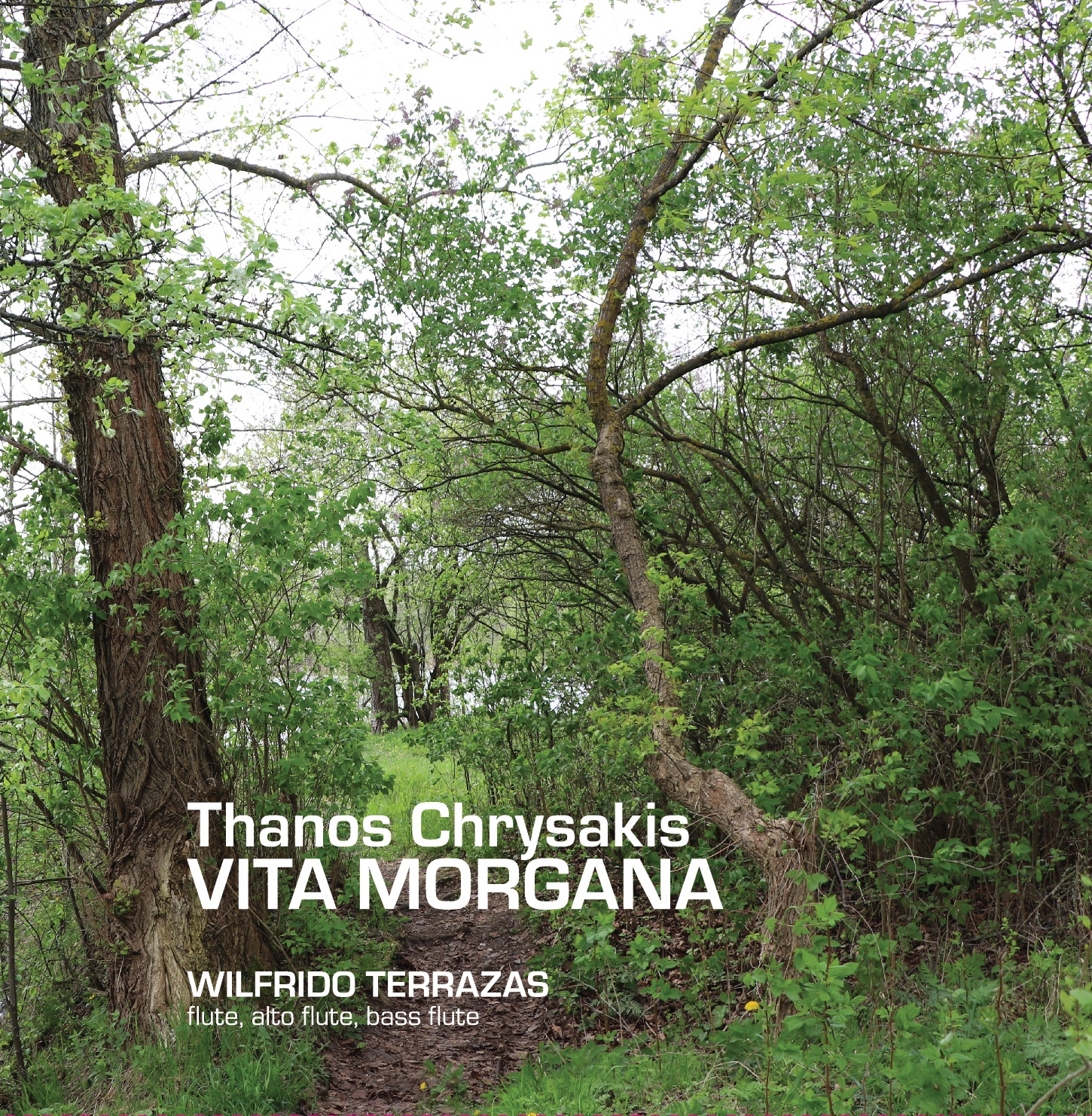
Vita Morgana is the latest album devoted to the work of Greek composer and producer Thanos Chrysakis, released on his own Aural Terrains imprint, a label name that already gestures toward topography, strata, and the slow intelligence of landscapes. The program gathers three earlier works alongside more recent compositions, most of them written for solo flutes in varied incarnations. Performed with unwavering focus and artistic integrity by Wilfrido Terrazas, this recording offers an experience that invites one to wander rather than to map. For listeners attuned to contemporary practices in which sound behaves as an ecology, Vita Morgana is essential.
The album opens with the paired works Eirmos I and Eirmos II, both composed in 2011, forming a diptych that functions as a root system from which the rest of the album quietly spreads. Eirmos I, for standard flute, is rich in extended techniques, yet nothing here announces itself as an effect in search of justification. Each sound feels embedded in a larger logic, arriving with the inevitability of growth rather than the arbitrariness of display. Melody persists throughout, not always as pitch but as latent direction. Even in moments when discernible notes dissolve, music remains present in the breath itself, carrying unrealized possibilities like seeds suspended in air. Whispering and humming introduce a fragile corporeality that softens the flute’s metallic spine, while harmonics and multiphonics open inward corridors, inviting the listener into layers beneath the audible surface.
Eirmos II, written for bass flute, deepens this descent. Its sonorous weight evokes a lineage that seems to pass through multiple instrumental ancestries at once, drawing on a wealth of overtones that feel ancient and uncategorized. Circular breathing sustains the sound, producing a sense of simultaneous tension and awe, as though time itself has been bent into a continuous loop. What distinguishes this piece most vividly is its capacity to summon vegetal forms. Tendrils of branches, vines, and leaves appear to proliferate in the mind, intertwining into dense networks that resist both repetition and resolution. These structures feel inevitable yet irreproducible, growing according to internal rules that no single hearing can fully grasp. There is a profound unease at work here, one that remains inseparable from beauty. Chrysakis offers a contradiction that does not seek reconciliation, a sonic koan that remains open, fertile, and unresolved.
The bass flute returns in doubled form in the 2012 title work, Vita Morgana, where the music acquires a hallucinatory density. Layers of sound hover and refract, creating an auditory phenomenon that envelops the listener rather than receding from approach. One is drawn inward, wandering through sonic chambers that feel both luminous and hostile, spaces that seduce even as they threaten erasure. Heat, distortion, and shimmer coexist, producing a dreamlike atmosphere that never becomes comforting. This is music that peers into the darker provinces of imagination, where desire and danger are no longer distinct territories but overlapping states of being.
The latter half of the album turns toward the present, beginning with Carved Continuum for alto flute, one of three works composed in 2024. The act of carving suggested by the title does not imply force or incision but accumulation and erosion. The music attends closely to infinitesimal changes, to grains of time and sound that gradually contour the whole. Listening becomes an exercise in microscopic awareness, as if the ear were tracing the slow rounding of form shaped by countless small pressures. There is a quiet luminosity here, a sense of something polished through patience rather than intention, awaiting recognition even as it drifts toward disappearance.
Night Ray, for flute, shifts the terrain once more. Its gestures suggest a song without words, emerging from a culture steeped in motion. The music communicates through posture and contour rather than syntax, offering a kind of prelinguistic intimacy. The program closes with Krama for bass flute, a work that seems to invert fractal logic and invite the listener inside it. Here, the recursive patterns that once unfolded at a distance become inhabitable. Sound wraps around the body, felt as much as heard. The music allows itself to be worn, unraveled, and finally released, its fragments carried away by an unseen current. What remains is a heightened awareness of continuity, of processes that persist beyond any single articulation.
Taken as a whole, Vita Morgana unfolds like a forest without a central clearing, its paths branching endlessly beneath the surface. Each piece functions as a node in a rhizomatic network, connected not by hierarchy but by shared subterranean impulses. The listener is not asked to follow but to inhabit, to become momentarily lost in the world’s own restless complexity. In this way, Chrysakis gestures toward a philosophy of listening that accepts uncertainty as generative, where meaning arises from ongoing transformation. The music disperses, continuing invisibly, like roots extending into dark soil, patterns repeating at scales too small or too vast to name.