Adés Conducts the New York Philharmonic
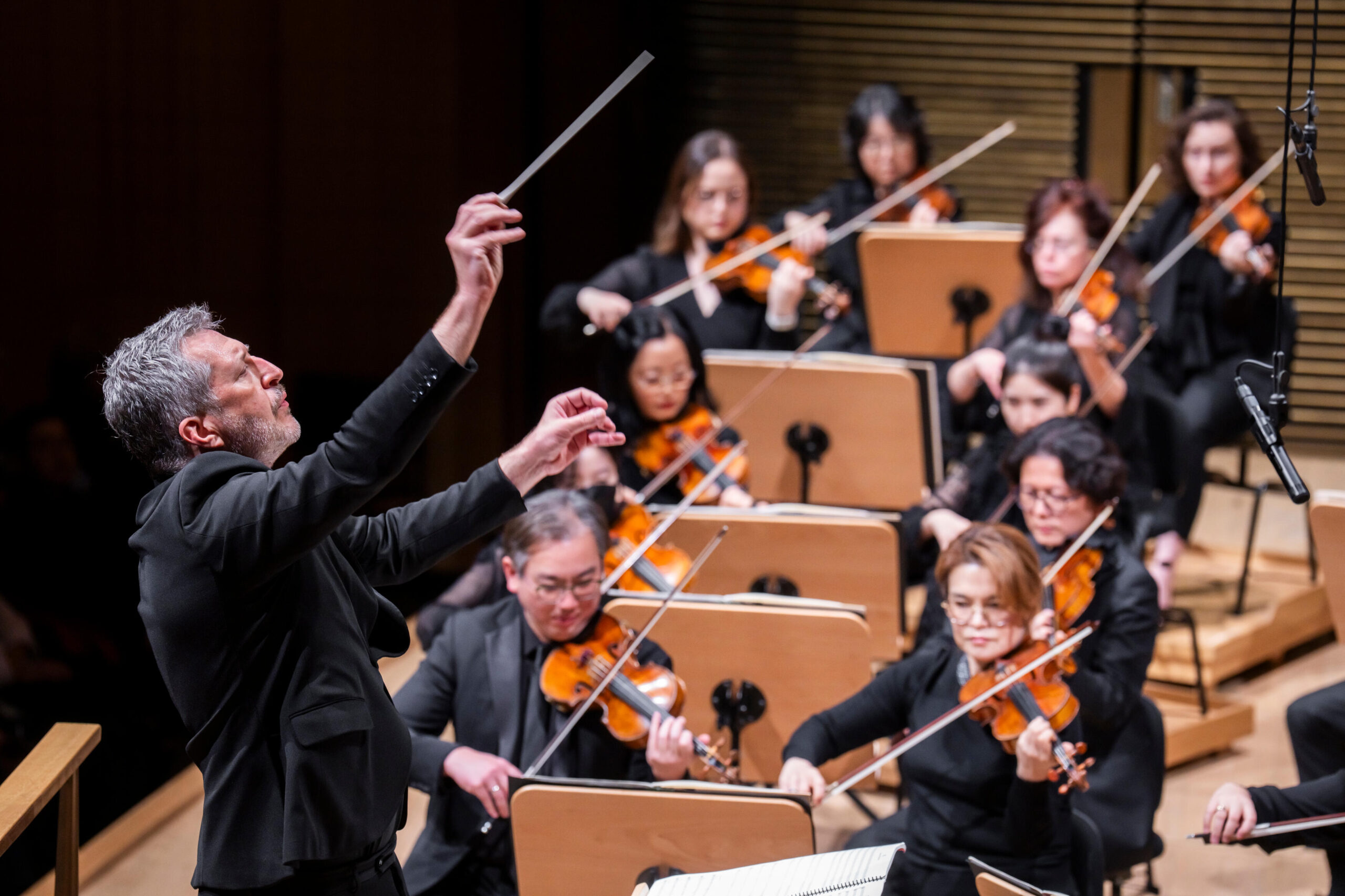
Adés Conducts the New York Philharmonic
David Geffen Hall
January 24, 2026
Published in Sequenza 21
By Christian Carey
NEW YORK – Thomas Adés is best known as a composer, but he is a talented conductor as well. Leading the New York Philharmonic in a program of recent works and a neglected early twentieth century piece, his approach was effusive and commanding, with a versatile and fluid gestural repertoire. The orchestra’s musicians always play at a high standard, but their performance on last Saturday’s concert was superlative, and given the challenges posed by the programmed pieces, all the more impressive. Adés seems to bring out the best in them.
The NY Phil has long served the music of Charles Ives (1874-1954) well, dating back to their time with Leonard Bernstein, and thus it’s hard to believe that they haven’t played a piece by him, yet this past weekend were the first performances by the orchestra of the composer’s Second Set for Orchestra. Composed over a decade and completed roughly in 1919 – dating music by Ives, who liked to revise, can be tricky – it is a fantastic piece, with quotations of hymn and folk melodies and even a section with jaunty ragtime rhythms, blending what were then old-time tunes with relatively recent stylistic markers. Another aspect of Ives’s music, complex polyrhythms and independence between parts, was also on display, and, abetted by Adés’s precise gestures, rendered with considerable clarity. The final movement included EXIGENCE Vocal Ensemble, offering a distant echo of the hymn tune “In the Sweet By and By.” One hopes it won’t be long before the Philharmonic plays it again.
Einojuhani Rautavaara (1928-2016) had a wide-ranging output. His Piano Concerto No. 1 (1969) is a byproduct of early musical postmodernism, encompassing a polystylistic palette of romantic gestures and virtuosic writing contrasted with tone clusters and polychords. Alongside soaring themes were elbow smashes to the keyboard. A lot of elbow smashes, more than you might see on an entire pro wrestling card of matches. The soloist Yuja Wang is a formidable pianist. She also has a flair for the dramatic, which accords well with this piece. The audience was enthusiastic in its reception, calling her back for three encores, a rare event.
EXIGENCE and the University of Michigan Chamber Choir, directed by Eugene Rogers, appeared in both of the works on the concert’s second half. They were well prepared for the challenging music, singing with accuracy and musicality. Near the turn of the century, the NY Phil’s then music director Kurt Masur commissioned several pieces to celebrate the turn of the new millennium. One of these was Oltra Mar (“Across the Sea,” 1999), by Kaija Saariaho (1952-2023). Reprised here, it proved to be a luminous example of the composer’s distinctive approach. In her notes on the piece, Saariaho indicated that, while some of the movements were about the sea, three of them treated, respectively, love, time, and death. Amour had an attractive arpeggiated harp part, out of which emerged mysterious wind melodies and impassioned vocal declarations.
Temps pitted a sustained, tense motive against ticking gestures indicating time’s passage. Mort was written in memory of fellow spectral composer Gérard Grisey, appropriately there was an emphasis on evocative chords built from overtones.
America, A Prophecy by Adés, originally composed in 1999 for the same Messages for the Millennium commissioning project as the Saariaho, was enlarged in 2024, adding a third movement to the piece. America is based on the brutal conquest in the sixteenth century of the Mayan people by conquistadors. The text is primarily made up of English translations of a book of Mayan prophecies, which foretell the civilization’s imminent destruction.
Anna Dennis sang the soprano part, the prophetess who shares a doomed vision of the Mayans’ future. Her intense, at times chilling, delivery in a wide-ranging part with many chromatic twists and turns was impressively commanding. The choir was on hand for bellicose, jingoistic conquistador anthems in the first two movements, as well the final movement’s more reflective music about the inevitable passage of time, from birth to death, creation to destruction. This last section was added in 2024, an attempt by the composer to balance the work. The piece was received as disturbing at its 1999 premiere, and, even with its more equivocal conclusion, is no less so in our current moment. Adés is able to craft eloquent explorations in music that are disquieting but also eloquently moving.
-Christian Carey