Lucy Fitz Gibbon/Ryan MacEvoy McCullough: here at the end of the world – art song of Pablo Ortiz
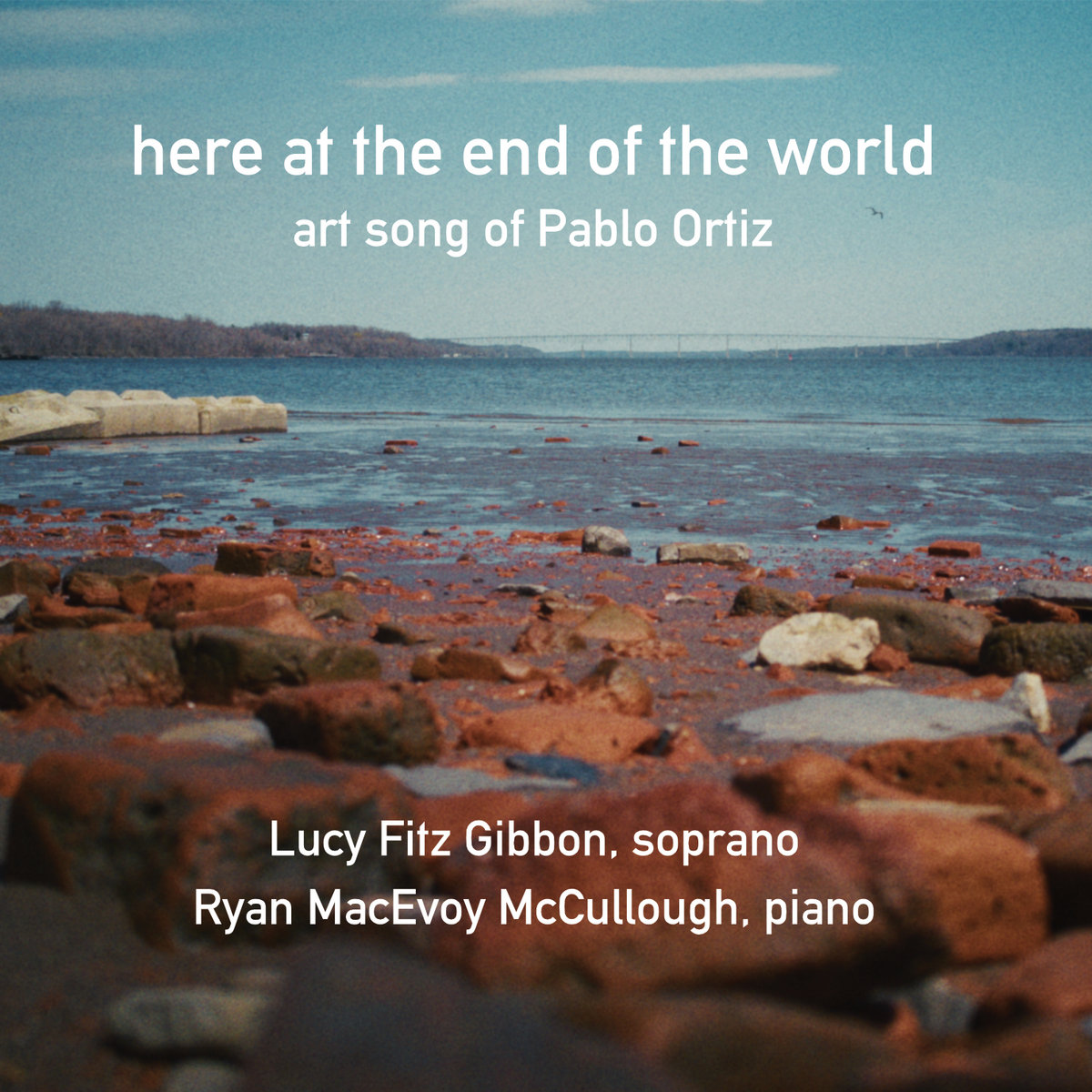
In this album, which gathers art songs by Pablo Ortiz (b. 1956), one encounters a coastline of sounds where fragments arrive through tides of memory: a piece of driftwood, a coil of rope, a shell whose interior still whispers of the sea that shaped it. Melody, rhythm, and dynamic inflection refract through the texture of the music, producing a spectrum that unfolds across the horizon, colors emerging through proximity. In Ortiz’s hands, words are not pressed into musical molds; the music grows from them. The poems breathe because the composer allows them space. In soprano Lucy Fitz Gibbon and pianist Ryan MacEvoy McCullough, he finds interpreters who understand that love—hovering over much of this repertoire—refuses a single definition. It is tidal, advancing and receding, leaving small relics that reveal its scale.
The program opens with three poems by Katie Peterson (b. 1974), whose attention to detail carries the precision of a camera shutter freezing the instant before motion dissolves. “Earth” opens girlhood through the discovery of a dusty box in an abandoned house facing the sea. Recollection appears in the manner of glass discovered along a shoreline, polished by time yet still capable of cutting. Near the close, a gentle pulse begins to knock at the threshold of consciousness, asking whether the dream of becoming what others expect can survive the erosion of self-perception. “From This House That House” introduces a bright undertow with a brackish bent. The song charts distance, relocation, and the geography of identity; one leaves a house only to find oneself in another. The piano moves with restless motion while Fitz Gibbon’s line rises and falls, life stretching and slackening in alternating breaths as entropy continues its patient mission. A tense piano introduction opens “Speech on a Summer Night,” creating an atmosphere charged with nervous droplets and hesitations. The voice then enters with stark clarity, cutting into memoir. The gesture wounds the past yet leaves it living. Confession operates through such injuries.
Two poems by Rosario Castellanos (1925–1974) follow. In “Elegía,” the body and its signs scatter outward through invisible currents. Resignation appears alongside tenderness toward dispersal. Identity travels across time and geography until its fragments recognize one another again. Eternity emerges not through revelation but through the gradual convergence of distant echoes. Its companion, “Nocturno,” unfolds with extraordinary patience. Absence becomes a second language.
Sidney Hall Jr.’s “McClure’s Beach” (b. 1951) presents the world eroding. The theme slowly releases its energy, the textures thinning without dramatization. Clarity arrives in subdued shades. McCullough shapes these textures with care, tracing each contour with close attention. Thomas Hardy’s “Neutral Tones” (1840–1928) continues this meditation on fragile states of being, its rhyme scheme dissolving into ambiguity, allowing the imagery to move with unsettling grace. Hardy’s landscape is drained of warmth, yet fascination percolates through its pallor. There is beauty in this indifference.
Two poems by María Negroni (b. 1951) follow. “chorus musicus” provides the album’s most chromatic moment, both linguistically and musically. Verses flash with unusual brilliance. The recurring image of a ship returns, though this vessel hesitates at the threshold of departure. It drifts near fire, suspended between ruin and buoyancy, water restraining the threat of combustion. “los cementerios de Paris” turns inward and unfolds with solemn foresight, opening a view onto the difficult terrain of the human heart, across which Fitz Gibbon sustains ethereal continuity. A reprise of “From This House That House” restores earlier ground, reinforcing the cycle of departure and return while revealing a changed shoreline. The album then closes with a setting of Yehuda Halevi (1075–1141), “When a long silver hair,” performed by Fitz Gibbon alone. Couched in intimate humor, it dots the “i” of aging with a flourish.
Remarkable about this collection is its sense of discovery. Each song preserves evidence of passage without insisting on final interpretation. The listener becomes a wanderer gathering impressions whose meanings lie open. Perhaps this uncertainty forms Ortiz’s deeper question. Human life unfolds through fragments whose origins are partly hidden. We inherit gestures, languages, memories, and desires without knowing the flows that carried them to us. Yet dignity emerges from that uncertainty. Recognition of the fragment acknowledges that meaning rarely appears in finished forms. Truth persists even in partial remains, luminous despite the missing edge.
here at the end of the world is available from False Azure Records.