John Luther Adams, Steve Reich @ 90, and Philip Glass at the Long Play Festival (May 3, 2026)
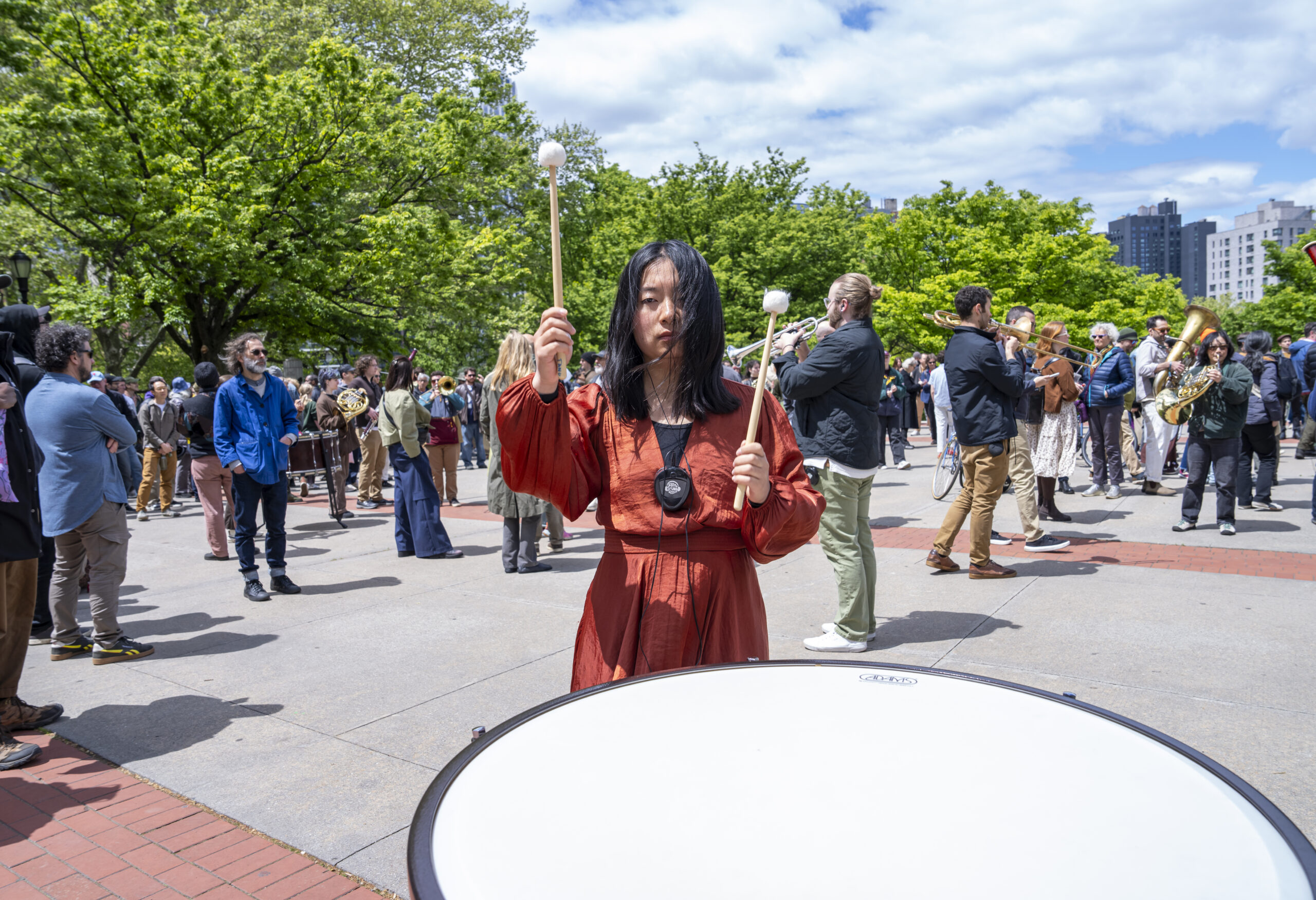
The final day of this year’s Long Play Festival appropriately began en plein air with a performance of John Luther Adams’ Crossing Open Ground – fitting for a composer whose music doesn’t simply reflect nature so much as exist within it. Led by percussionist and conductor Doug Perkins, the hour-long piece for forty musicians unfolded near the Prison Ship Martyrs Monument in the tranquil surroundings of Brooklyn’s Fort Greene Park. As with several other Adams works – including his Pulitzer Prize-winning Become Ocean – Crossing Open Ground emerged from the margins of silence, its opening sounds indistinguishable from the environment to which they belonged. What began as subtle sonic reverberation had, by the midpoint, expanded into swelling sustained brass lines punctuated by crashing waves on tam-tam and other percussion: music that embodied the power, force, resilience, and presence of nature itself.
Back in the urban environs of BAM Fisher, this year’s Steve Reich at 90 celebrations continued apace with a compelling double bill featuring electric guitar ensemble Dither+ and Sō Percussion. Electric Counterpoint is typically performed by a live electric guitarist playing alongside a pre-recorded tape of up to twelve guitar parts and two bass guitars. As one might expect in the hands of a single player – be it Pat Metheny, Jonny Greenwood, or Sean Shibe – the result is a relatively uniform sound and consistent playing style. With fourteen live players, however, Dither cast the piece in a different light. The ensemble had clearly agreed beforehand on a shared sonic profile – slightly edgier than Metheny’s, a little cleaner than Greenwood’s – yet this still allowed space for subtle variations in colour both within and between each player. The fully live setup also introduced a greater sense of immediacy and nuance, resulting in a performance that felt far more present and alive. I had heard Dither perform an all-live version of Electric Counterpoint ten years ago at the Barbican Centre in London, but this account carried noticeably more energy, vitality, and conviction.
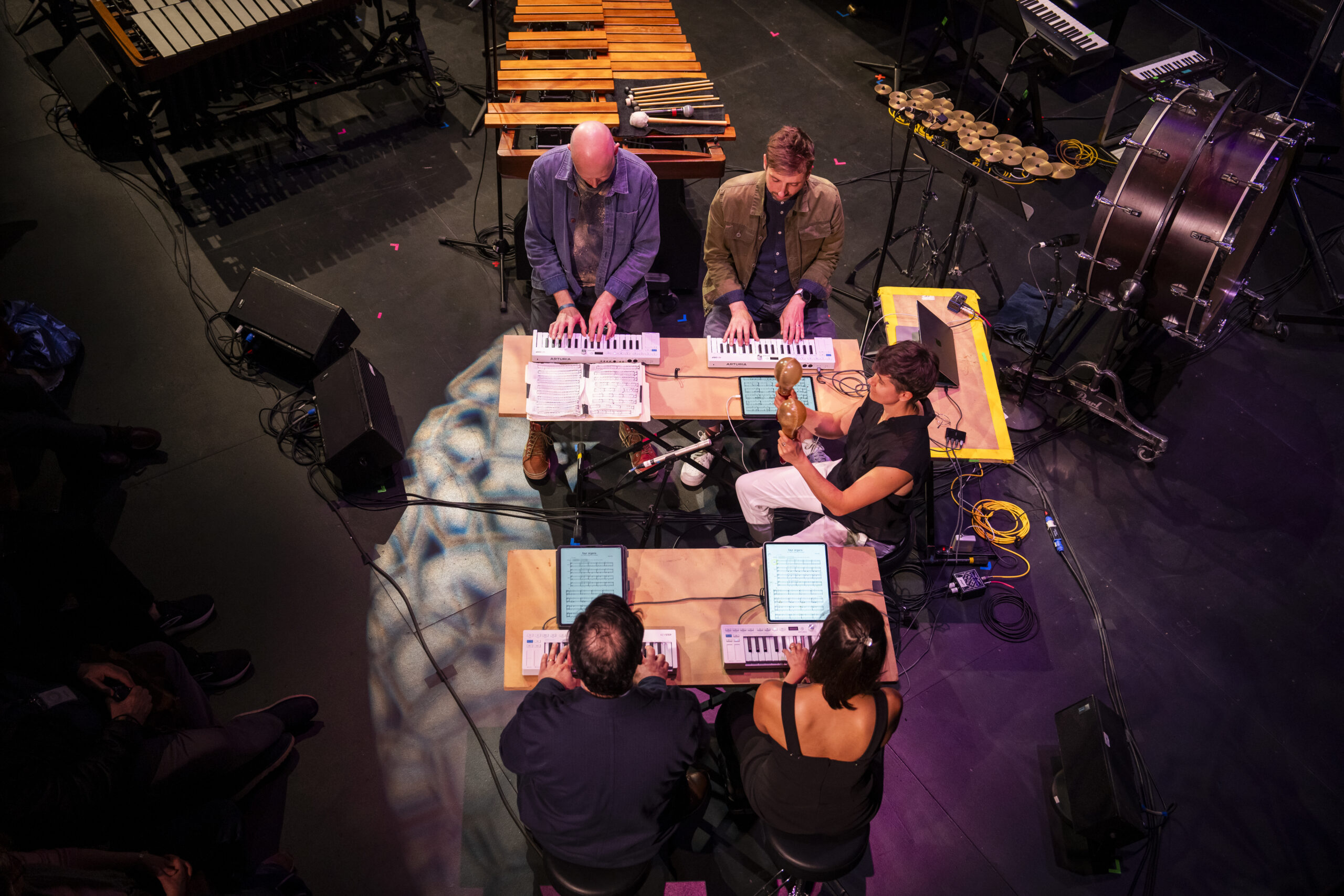
The second half belonged to Sō Percussion, whose pairing of early Reich works – Piano Phase and Four Organs – proved highly effective. Eric Cha-Beach and Jason Treuting navigated Piano Phase’s intricate phased transitions with impressive ease, while Four Organs – with fellow Sō-ists Adam Sliwinski and frequent collaborator Ji Hye Jung, alongside the rock-steady Amy Garapic on maracas – was among the day’s highlights, its kaleidoscopic shifts in sound and colour ineluctably unfolding with striking clarity. It’s difficult to imagine how a work of monumental poise and impassive power could have provoked such outrage among audience members, as famously took place at Carnegie Hall in January 1973. The final piece in Sō Percussion’s programme, the ever-popular Sextet (featuring Cha-Beach, Garapic, Jung, Sliwinski, Treuting, and Cristina Altamura) delivered plenty of excitement, even if the results were a little mixed. The final fast section in particular was somewhat helter-skelter – certainly better suited, tempo-wise, to the marimbas and vibraphones’ sharper and more incisive articulations than the close canons exchanged between the two pianos in their lower ranges.
A palpable sense of occasion and anticipation often accompanies performances of Glass’s ‘classic’ works these days – especially on those rare occasions when the composer himself is present. This was certainly the case when Bang on a Can All-Stars took to the stage at Roulette Intermedium to perform Glassworks in a new arrangement by long-time Glass collaborator Michael Riesman. The original score’s homogeneous blend of flutes, saxophones, horns, and synthesizers was here replaced by a more varied timbral palette, incorporating electric guitar, percussion, cello, and double bass alongside saxophone and synthesizer.
Some movements proved more convincing than others. Vicky Chow’s flawless account of the ‘Opening’ movement only reinforced her standing as one of the finest interpreters of Glass’s music (I could listen to her playing his music all day long), while Ken Thomson’s haunting soprano saxophone in ‘Facades’ would surely have drawn a knowing smile from the late Jon Gibson, whose enormous impact on minimalist music has yet to be fully measured and appreciated. Even so, while Reich’s syncopated rhythms feel naturally suited to marimba, vibraphone, and xylophone, Glass’s more fluid patterns do not always translate to these instruments with the same ease and conviction. As a result, ‘Floe’ lacked flow, and ‘Rubric’ was at times in danger of skidding off the tracks. That said, Glassworks 2.0 remains a largely convincing and compelling version, which works on its own terms. It will be interesting to see how a future recording might develop with a few tweaks and refinements.
Whether post-minimal, maximal, experimental, environmental, electroacoustic, post-classical, improvisational or any/none of the above, Long Play / Bang on a Can continues to set the tone and redefine the narrative of new music in New York City and beyond. Judging from the long lines of festival goers cueing for these events, its pulse has never been stronger. And, at least for a few days in May, Brooklyn becomes its beating heart.