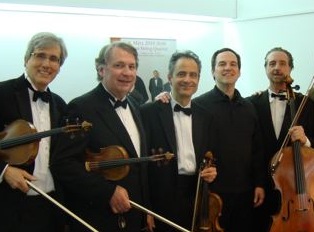
My friend Danielle Belén has lined up quite an event this coming Sunday, and no, it’s not the Super Bowl. It’s a couple thousand miles west of Indy.
She’s organized a benefit concert for Center Stage Strings, the summer music camp she started herself a few years back. Headlining the concert is cellist Lynn Harrell, and the featured event is the world premiere of Multiplicity, a work I composed last summer while at Wintergreen. Here is the program note:
Multiplicities abound in our daily lives, countless duplications, each of which we strive to personalize, to distinguish with our personal touch, our page, our device, our moment. The sheer number of individualities at times seems to swallow all distinctions into a burbling mass. But now and again a single voice emerges, is heard and can be celebrated. We are what each of us does; we are what all of us do.
The concert is in Thayer Hall at the Colburn School in Los Angeles at 3 pm; weather forecast is calling for a high in the mid-70s. Wish I could be there.
I also wish I could be a couple thousand miles north of LA on Sunday for the latest performance of Poke by Low and Lower. This one will be at the University of Alaska in Fairbanks. If you find yourself that close to the Arctic Circle, check it out. As I write this, the current temperature there is -28F. How can you resist?
No Comments »
On Friday, poet Joe Mills was our guest in Composition Seminar. Joe has secured solid footing in the free-verse narrative terrain, with poems that speak to our collective struggles with identity. He hails from the Midwest, and his use of the language reflects the reticence of his roots. As he put it, while Eskimos have fifty words for “snow,” his family has one word for fifty emotions. No matter how high or low things get, the question “How ya feelin’?” could always be answered by “Fine.”
As he described his upbringing, I found myself imagining him with a pitchfork and a pair of spectacles, his piercing eyes fitting nicely into a Grant Wood painting.
Joe’s economy with language enables him to make rich, direct connections between the felt moment and the imagined eternity, as in this excerpt from Somewhere During the Spin Cycle:
Drive long enough
and mile markers skitter
across the road
like rabid shadows,
the “winding curves”
snake
from their signs,
the pavement itself
shrugs, stretches, twistsuntil you’re convinced
you’re riding
the back of a living thing.
As he described his approach to composition, I found myself nodding in recognition at almost every turn. It’s a certain kind of wonderful to hear an artist from another discipline speak of his work in words that resonate powerfully with ones own experience — and how much better when that artist is a poet, someone who can make experience come alive with a sure grasp of the peculiar weight of each word.
Joe talked about how often poetry comes from painful experience, while stressing the importance of transcending the experience, being true to the poem. He described the familiar sensation of having to express oneself after an intense event, likening it to the need to grab a barf bag when overcome by a nasty stomach bug. As he put it, that kind of relief is important and valuable – “but please don’t show me the bag and say ‘Look what I made!’” A poem has to find its own way, apart from the initial impetus.
Joe also addressed the challenge of identifying what makes a poem good, describing an assignment he gives his students: write a bad poem in five minutes. He says his students have no trouble with this assignment – coming up with elements of bad poetry is easy, much easier than defining its opposite.
After the seminar, I managed to commit an artistic misdemeanor when I tried to tell Joe how a particular poem of his had resonated powerfully with me. I paraphrased his poem, essentially obliterating it. My brain stood by in disbelief, listening to my mouth fumble for words. It was a potent reminder of how difficult it is to speak to artists about their work, how irresistible that need can be, and the patience we need to muster when others speak to us.
No Comments »

This week, Low and Lower takes off for an Alaska tour, with Poke in their baggage. They have promised to hit “every concert hall, mountaintop, igloo and hollowed-out snowbank in the great state.” They’ve also promised to create a mockumentary of their travails. They start up this weekend with Kenai and Anchorage. Click the links for more info.
A couple of pages of Poke, to send them on their way:


No Comments »
Tonight, premiere of Poke, tomorrow night, performance of Child’s Play. But the majority of my attention is focused on this coming Tuesday night, when our students will unveil nine new pieces:
A Thousand Pictures – Alicia Willard
First Snow – Kenneth Florence
The Devil and Tom Walker – Colin Laursen
Mystic Willows – Bruce Tippette
The Degradation of the Orchestra – Lucas Grant
Duo – Noah Ferguson
Burning of the Sky – Zachary Polozune
Wormhole – Michael Anderson
Reign-Man – Ted Oliver
The rehearsal process has been full of the requisite leaps and stumbles one expects in the process of any premiere, times nine. If most of the elements fall in place for tomorrow’s dress rehearsal, we’ll be in good shape.
Meanwhile, Poke. Subtitled a bagatelle on anti-social media, it’s scored for cello and double bass, with a running (spoken) dialogue between the two musicians as they play, an argument taking place across various technological formats. Over the course of the piece, the two “text”, “friend” and “like” one another with increasing fury, as their virtual exchanges completely obliterate their real lives in a comic turn on the dark underbelly of our online politesse. For the performers, it’s a virtuosic tightrope walk — I’m looking forward to seeing Low and Lower keep it aloft tonight.
And Child’s Play, from five years ago, will surely give me a wave of nostalgia tomorrow night. It was composed when my first son was a toddler. At the time, I was astonished by the way he could veer from being quietly charming one moment to downright dangerous the next. The piece shifts gears the way a toddler walks — in fits and jerks, wobbling uncertainly, then suddenly careening off the walls. Nice write-up about it in the Winston-Salem Journal here. I’m expecting the Carolina Chamber Players to put it safely to bed.
No Comments »
“Learning is experience. Everything else is just information.”
- Albert Einstein
No Comments »
Paid a visit to an audiologist the other day. I’ve felt like my hearing might be worsening over the past year or so, and I hadn’t actually had it checked in some forty years, so I googled the closest ear doctor and paid him a visit.
Thought I might be in for an interesting visit when the last question on the sheet the receptionist handed me was, “Have you ever studied a musical instrument?”
Then she gave me a bio sheet for Dr. Mills, and I have to admit I was ready to walk out, because I don’t think the doctor’s personal life is something I should have to trouble myself with. But I refrained from bolting and read it anyway. The sheet gave a few standard facts about him, then described the profound stutter he had gone to great lengths to overcome, establishing in him the gifts of patience and willingness to listen.
Dr. Mills came out to the waiting room to greet me – another surprise – then walked me back to his office. He spoke slowly and carefully, probing my history and current circumstances, and I was happy I had read his bio, so I could restrain myself from my ugly habit of interrupting people who don’t speak as quickly as I might like.
But that’s all almost beside the point — I wouldn’t be writing about any of this if it weren’t for the results of the test. I was put in a closet-sized chamber with tiny speakers inserted in my ears. After playing me a lovely assortment of sine waves, Dr. Mills fed me some white noise, and asked me, from the adjoining room, to repeat the words he was saying. When the test was complete, he showed me the results, which indicated that my right ear has a minor hearing loss in the medium-high register – so minor, he said, that most people wouldn’t notice it. The fascinating thing, though, as far as he was concerned, was the way I discerned speech through noise. Most people, he told me, begin to lose the ability to understand words as the volume of noise approaches the volume of speech. When the volume of noise equals the volume of speech, the average person is able to understand about 25% of the words. In my case, however, he increased the noise level above the speech level, and I was still able to discern 90% of what he was saying.
He attributed these results to my musical training, which I have to admit was a nicely scientific affirmation of something one always assumes. Turns out he is a big supporter of the local symphony, and had attended the percussion ensemble concert I wrote about last month, so he clearly has more than a passing interest in the subject. Very odd that I’ve had two interactions with medical personnel in the past month (see here for the last one) that introduced me to people who have an active interest in what I do, when I had become accustomed to doctors who found my profession at least uninteresting and at best mysterious.
The whole thing gave me food for thought, especially as it raises issues of the trained vs. the untrained ear. Training, I suppose, is only one part of the equation – a more crucial ingredient may simply be a lifetime of daily close listening, keeping the wax away.
I remember a class I took years ago in which a student defended his analysis of a composition by saying, “this is the way I hear it” – to which the teacher responded, “you can train yourself to hear it any way you want to hear it.” I always liked that idea, and my experience the other day confirms its plausibility. The human organism is astounding, we can teach ourselves to hear the things that matter most to us. If you want to hear noise as music — just practice. If you want to hear a clear distinction between noise and music – again, just practice.
No Comments »
Last August, I began work on a fairly large, complex piece for actor and chamber ensemble. I took a few breaks from it over the course of the last few months to write some other pieces, each time returning to it refreshed and with a deepened perspective.
Among other challenges I set for myself in this piece was to create an innocent, wide-eyed narrator for the story I was composing. Through the course of the journey of this story, I wanted the narrator, which was not human, to maintain its sense of wonder, avoiding the clichéd route of innocence crushed through bitter experience.
Upon completing a performable draft of the piece this month, I had a surprising realization: the story I had written could work equally well with a world-weary — even cynical — narrator, a personality in complete opposition to the one I had initially imagined.
How far apart are worldliness and innocence? How comfortably could they co-exist in the same person? This week I’ve been measuring the difference, trying out various balances in tone, trying to create just the right level of cognitive dissonance, much in the way I would explore varying shades of intensity in a harmonic scheme. In the process, I’ve been getting a fascinating lesson in character development, making me feel ever more sensitive to the implications of my artistic choices.
No Comments »
Attended a symposium recently at which a creaky old question was asked: “Is it possible to shock the audience anymore?”
With one exception, the panelists agreed that it was no longer possible to shock the audience. The one exception felt that it could still be shocking to present extreme situations in a matter-of-fact way.
Here’s my opinion: shocking an audience is easy – too easy. Here’s how you do it: wire the seats with enough voltage, then flip a switch. I guarantee your audience will be shocked.
Seem like a silly answer? As far as I’m concerned, if your main objective is to shock your audience, then it’s silly to try anything less than what I’ve suggested. Why pretend you have any other agenda?
If, on the other hand, you have other aspirations in mind, then forget about superficial goals like shocking your audience. Respect your listener and say what you have to say as clearly and convincingly as possible. Shock tactics are for destroyers, not creators.
No Comments »
Time to start my seventh year of blogging (old-fashioned, eh?) with a review of the sixth. Here’s where I was in 2011.
JANUARY
Eye on the horizon with Shadow on the Sun and Terranean Meditation.

FEBRUARY
Devotion across the ocean.
MARCH
NPR, The Juilliard Journal, Gramophone and American Record Guide have me covered.
APRIL
Naxos releases my violin music. Does that mean it was in captivity?
MAY
Pecorsi musicali says ciao.
JUNE
Lauren Flanigan and Le Train Bleu whip out my music at Galapagos.
JULY
Terranean Meditation takes off in Wintergreen.
AUGUST
Just working on my jumper.
SEPTEMBER
Youtubing is about as close as I get to participating in an extreme sport.
OCTOBER
Come on down, Italo Calvino.
NOVEMBER
Sparkling in the Dark, in a bar and in a hall.

DECEMBER
Composer on wheels.

So now on to 2012, which promises much, but guarantees only to take my old-fashionedness to new levels.
No Comments »
Though I’ve been observing radio silence the past week, I’ve been doing just fine. Well, not true, but in the grand scheme of things, close enough. The laptop that is responsible for the core of my daily life went down for the long-count last Monday, so I have been splitting my core among three other computers that are accustomed to propping up my peripherals. All of which is to say that I’ve been functioning a little more in the real world and a little less online, which is mostly a good thing. Except for one problem: my little hack of a cough turned into a full-blown sinus infection, which meant I was getting even less sleep than usual, and fattening up on even more meds than usual.
Excuses, excuses. But here I am now, with a new computer, and more to say than reporting on the health of my hardware.
As I wrote last time, we had Missy Mazzoli visiting our seminar online this week. The discussion worked out beautifully, a tribute to Missy’s intelligence and professionalism, and to our students’ preparation. Here is a snap of the faceless composer on wheels:

In person, her features are far more distinguished, and distinguishable. The seminar was wide-ranging, flowing evenly between artistic and practical matters. Missy was candid, supportive and enlightening, as I had hoped she would be. Asked about whether she ever crosses the fine line between her Classical and Pop leanings, she responded by pointing out the limitations of pop music, citing her preference for the Classical context, within which, as she says, “anything can happen.”
As an example of “anything can happen,” I’ll evidence the UNCSA Percussion Ensemble concert I attended last Tuesday night, which included premieres of two works by students of mine: Bruce Tippette’s Escaping Rapture and Alicia Willard’s Spool. Both pieces were wonderful – taking full advantage of the instrumental resources and carving out an attractive way of listening within our particular coordinates in space-time. The program also included a sizzling rendition of the first movement of Zivkovic’s Trio per uno and concluded with a visit from veteran bones player Mitch Boss from Rhythm Bones Central who, before launching into some rags with the students on a couple of cow tibias, informed us that “Music soothes us physically and relieves our minds of pesky internal dialogue,” something I’ve noticed a time or two.

Which brings me back to my checkup yesterday, and the Romanian nurse who presided. After getting more pertinent information out of me, she asked me what I do. When I told her I was a composer, she asked if that’s why I didn’t notice when I was getting sick. I laughed, and asked her why ever did she think composers drift through life without noticing obvious things right in front of their noses, or even behind their noses. She replied, “What, do you think I have no training?” and she proceeded to grill me on how many Romanian composers I knew.
I was relieved to satisfy her questions — especially since she was getting ready to take my temperature.
2 Comments »
|