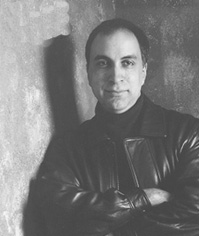
Composer Anthony Cornicello (born in Brooklyn, New York, 1964) writes music that blurs distinctions between performers and electronics, timbre and harmony, composition and improvisation, and explores the boundaries of what may be considered post-classical concert music. His music is vibrant and visceral, full of rhythmic energy and harmonic sophistication, and his forays into live electronics have led to exciting combinations of instruments and processed sound. Cornicello’s background as a jazz pianist is evident not only in the rhythmic activity of his music, but also in his constant investigation of the rich sonorities available from a variety of instruments.
He has been commissioned to write music for the Scorchio Electric String Quartet, ModernWorks! (funding from Meet the Composer/ Commissioning Music USA), the Auros Group for New Music, the Prism Saxophone Quartet, the New York New Music Ensemble, David Holzman, the Group for Contemporary Music, and the InterEnsemble of Padova, Italy. His work has also been featured on the Guggenheim Museum’s “Works and Process” series. Cornicello’s works have also been performed by the Chicago Civic Symphony, Parnassus, ALEA III, Composers Concordance, Madeleine Shapiro, Robert Black, among many other outstanding groups and solo performers. His music has been presented as part of the Darmstadt International Festival of New Music as well as the June in Buffalo Festival.
Cornicello’s Second String Quartet has been recorded by the Atlantic String Quartet; the Second Sonata for Piano by David Holzman (Centaur). More recently, his Post-Modern Waltz was recorded by Eric Moe for Albany Records. A portrait CD of Cornicello’s works is scheduled for 2006 release on Albany Records.
As a performer, he has conducted or played piano in his own works on numerous occasions. While a graduate student at Rutgers, he formed and directed the Janus Ensemble, a group dedicated to contemporary music. More recently, Cornicello has begun performing on the laptop, using a variety of interfaces and the Max/MSP program. Those performances, mostly with EEE!, have had a notable impact on his music, as EEE!’s music ranges from hip-hop to experimental noise. EEE! is based at Eastern Connecticut State University, where Cornicello is an Associate Professor and Director of the Electronic Music Lab.
Cornicello received the Ph.D. from Brandeis University, where he studied with David Rakowski, Eric Chasalow, and Martin Boykan. His teachers also include Charles Wuorinen, Gérard Grisey, and Richard Beirach.
His current fields of interest include developing unusual interfaces for live computer music performances, as well as continuing to investigate resonance and spatialization. His recent and current projects (mostly for string instruments and electronics) have been exploring the latter two, and the series of experimental works ReZenant Garden, performed by EEE! have operated on all three areas of interest. Future projects will include works for instrumental groups or soloists and electronics, as well as turntablists.
Cornicello's works are published by C.F. Peters Corporation and APNM, and he is a member of BMI.
|
|

|
|
|
|
Sunday, December 09, 2007
Stockhausen: an appreciation
 I think Stockhausen was the composer most responsible for getting me into the whole European avant-garde scene.
I remember coming across his music when I took my first 20th Century music course as an undergraduate. I'm sure I dismissed it, as I did most of the other things I heard then. I do recall, however, secretly liking Webern's music, even though on the outside I had no idea what it was all about.
Fast forward a few years; I'm still an undergraduate, this time as a composer. I'm learning all I can about the 20th Century, and so I'm saturating myself with as much music as possible. Stockhausen's name comes up; some of the other students say how his music scares them. I say "cool!", and go listen. The electronic pieces impressed me, but Kontakte just blew me away. I listened, over and over to that piece! I'm not sure exactly what it was: the blend between ordered and somewhat random elements, the way the electronics and instruments mesh so well, or the cool-looking manuscript score. Or maybe it was the booklet that accompanied the score, showing how much work went into making the tape part (including, making the sounds spin in space using a speaker mounted on a turntable, as shown on the right). The work is a masterpiece - I even wrote a piece using similar instrumentation in 1986 (Serigraphs, which was played on the Florida State New Music Festival in 1987, and has been withdrawn). I firmly believe that this piece was a beginning, a new fertile ground.
Of course, I've enjoyed Stockhausen's other works as well. Hymnen remains another masterpiece of the electronic tape era. There's even an almost post-modern moment, when we're suddenly in the studio with Stockhausen and his assistant, wondering how we're going to get across the Atlantic. Try listening to that piece with the lights off!
More recently, I had a wonderful experience with programming Kontakte, on a concert sponsored by SEMI in Hartford, CT. We invited the now-defunct Auros Group for New Music, to play a concert of electro-acoustic works: two Davidovsky pieces, Kontakte, and the premiere of my own "I'll Have an Electric Mahabharata, Please". The concert started off horribly, as sound was not set up for the planned dress rehearsal. The musicians were pissed! However, when it came time to play, I had never heard them play better! Hearing Kontakte live was an unbelievable experience! I remember getting the tape part going, and standing in the back, thinking I'd sit down as soon as things settled down. Instead, I was riveted to my spot, by the power of this music. I stood for the entire piece, in the back of the hall, with the sound moving all around me. It was an amazing experience, one I'll never forget. I'll also never forget how well that piece has aged, especially since it was the oldest piece on the program!
You can't be a composer of electronic music without feeling some bit of indebtedness to Stockhausen. I think Holger Czukay called him the first "mixmeister", in reference to Hymnen. His work paved the way for the way a lot of us approach electronics, as a sound object in and of itself - not trying to replicate an instrument or even act like one!
One closing thought, which has also remained with me since I first heard it. When talking about musical analysis, Stockhausen once remarked that we are always searching for ourselves in the music. It's an interesting thought.Labels: electro-acoustic, electronic music, Stockhausen
posted by Anthony Cornicello
Wednesday, November 07, 2007
Bad Plus Babbitt, SEAMUS, and other links
Sorry, I but I couldn't continue the alliteration...
Recently, there was an event for Alex Ross's book The Rest is Noise. (Do I really need to link this book?) The event involved EthanIverson, the pianist from The Bad Plus, performing a number of 20th Century works. You can read his comments and rehearsal notes on his blogsite Do The Math. It seems like one of those events that make me miss New York.
The real surprise, however, is the impromptu recording of Babbitt's Semi-Simple Variations, performed by The Bad Plus. They're talking about doing an actual recording of it, and the version online is fantastic. Listen to it here.
=============================
A few other items, relating to the above. I'm not sure how many of you know this, but Milton did start out as a jazz musician - playing clarinet (and some saxophone, I think). When I found this out, I asked him what he thought of LennieTristano ; I figured Lennie's 'cool, intellectual' approach would have appealed to Milton. Instead, the response was something like "What, those whippersnappers? No, I preferred Jack Teagarden: he's the real thing." (I'm sure he through in a typical "my dear boy" somewhere in that sentence.) For those of you unfamiliar with jazz history, Teagarden was a Dixieland trombone player. So, of course, someone from the bebop-influenced "cool school" would seem entirely unintelligible to a Dixieland fan.
On the other hand, he did write All Set, and from what he told me, for Bill Evans. According to Milton, Bill had met with Milton a few times - analyzing Schoenberg and other 20th Century composers. I don't think it was actual composition lessons, from what Milton told me. But, Bill Evans did write Twelve-Tone Tune and Twelve-Tone Tune Two, and was good friends with Donald Martino (according to the Don). Interesting little world we live in...only a few degrees of separation from Miles to Martino.
====================
Two links of note: SEAMUS, the Society for Electro-Acoustic Music in the United States. It's a good resource for information about electronic music (as the organization's title suggests). Furthermore, they publish a quarterly newsletter (clicking the link will give you a PDF file) which is freely available to all. It's full of informative articles, interviews, and news about electronic music. Kurt Stallman has done a wonderful job editing the newsletter, and we all look forward to future issues.
Roger Linn (the instrument designer who brought you the Linn drum), has a web page devoted to unusual MIDI interfaces. I'm a fan of this kind of stuff - I think you can be quite expressive with non-keyboard interfaces. As a keyboardist, I know that my improvisational work eventually starts to fall into patterns familiar to my own personal vocabulary - whether it is certain chords or phrases. It's hard, but not impossible to avoid these kind of things. However, using unconventional interfaces, there is little to 'fall back on'. You're constantly creating something new, as there is no 'old'.
I have a few favorites on this page, namely the Lemur and the stuff from Starr Labs. What's yours?
ADDENDUM: I'm not sure why, but there were an unusual number of formatting goofs in my original post. I was writing my post using Firefox on my PowerBook, and it seems to have introduced a number of odd errors. For instance, all of my lines seem to have ended with a 'hard carriage return' (okay, I'm showing my age), so the original version looked like poetry. Unfortunately, really bad poetry. Also, it seems to randomly paste in the contents of the clipboard. When I made all my corrections, I found quite a few times where spaces had been removed between words: instant Joyce. Alas, also bad Joyce. I hate typos, especially in the stuff I write!Labels: Babbitt, Bill Evans, electro-acoustic, electronic music, instrument design, jazz, SEAMUS
posted by Anthony Cornicello
Saturday, May 12, 2007
Electronic Music in CT, week 3 (final events)
Okay, this was more than a week ago, but I thought that I should post on this, if not just to complete the trilogy. We had two events on the final week of concerts. On May 3, Gray Code gave a performance at Central - a freely improvised set lasting around 45 minutes, followed by another slightly shorter one. The group is a trio of Butch Rovan on clarinets (including the contrabass!) and electronics, Fred Kennedy on percussion, and Kevin Patton on guitar and electronics. The music ranges from 70s Miles-inspired jazz to ambient noise, and there's an impressive amount of technology integrated with the instruments onstage. Nothing seemed too effected or out of place, and it was all quite flowing - quite impressive for an improvised group. It took me a while to realize there was no bass player - they produce music so full and interesting that you don't notice it.
Because of the lack of babyistting on a Thursday evening, Sophia came along. Sophia, who just turned three, is already enjoying music, and her current tastes include Bach and minimalism. She loved the music, and she sat there with a look of amazement on her face. When I asked her what she liked best, she said the saxophone (okay, it's a clarinet, but she's 3!!). In addition to the webpage listed above, you can check out Gray Code's MySpace page, which has musical clips. They've got a CD coming out soon, and I'm looking forward to it.
The other event was on May 5 (my 43rd birthday!), and featured ModernWorks (sorry, no MySpace page). They're another trio, this time Madeleine Shapiro, cello, Airi Yoshioka, violin, and Bill Schimmel, accordion. First of all, I need to say that I really like working with these people - they're wonderful musicians, and great people to be around. They played, amongst other pieces, my Spiral Jetty, which sounded great. I need to tinker with the electronics some more. But, for me, the highlight was an accordion solo piece by Bill, A Portrait of Harry Lime, with all it's film noir references. You know, when I told some friends that I was writing for the accordion, they snickered. I'm now enthralled with the instrument - I'm going to write some more for it. One other piece on the program was Tania Leon's Aixon, which although wonderfully played, seemed a bit long. The electronic component (programmed by Mari Kimura) was a bit disconnected from the live performer, in a sonic sense. It reminded me of the Davidovsky pieces, where the two elements (live performer and electronics) co-exist, sometimes interact, but never really mesh.
Sohpia came to this one too, and enjoyed it. This time, she loved the cello as well as the accordion.Labels: Connecticut, electro-acoustic, electronic music
posted by Anthony Cornicello
|
| |