Decoda Celebrates “American Renaissance”
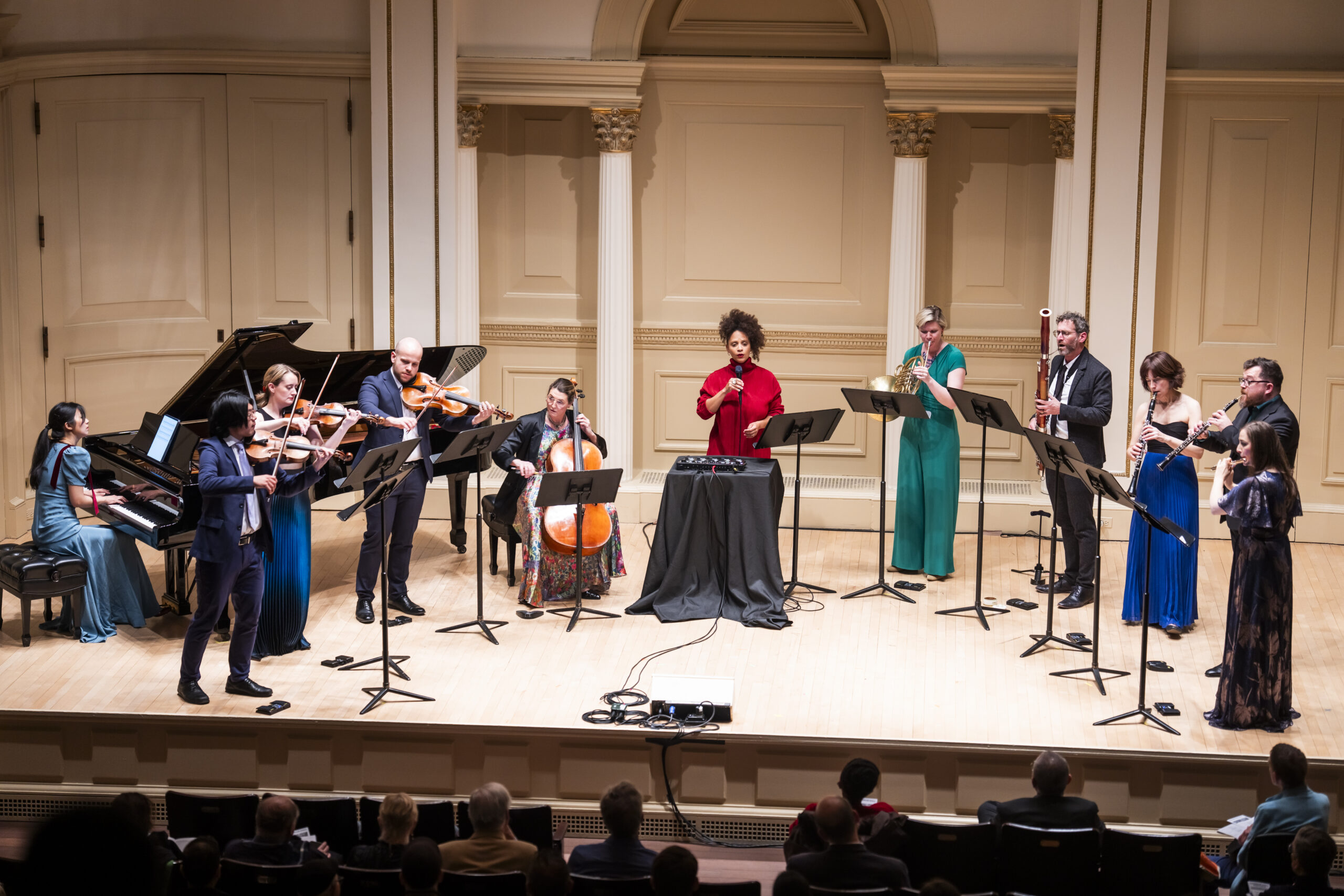
Decoda Celebrates “American Renaissance”
Decoda
Weill Recital Hall – Carnegie Hall
May 12, 2026
By Christian Carey
Published in Sequenza 21
NEW YORK – Founded in 2012, Decoda is an ensemble, composed of a wind quintet, string quartet, and piano, whose members had worked together in Ensemble Connect, a fellowship program at Carnegie Hall and the Juilliard School. This season the musicians continue that relationship with Carnegie Hall. Their concert last Tuesday at Weill Hall is part of the season’s 250th American anniversary celebrations. Titled “American Renaissance,” it featured composers who had relationships to the Harlem Renaissance, either through association with the movement themselves, or their selection of texts to set.
The evening’s outlier, Charles Ives’s The Unanswered Question (1935) opened the concert. It was written in Danbury, Connecticut, which is about as far, ambiance-wise, as you can get from Harlem. Still, Ives is as American a composer as they get, and The Unanswered Question is one of his best pieces. The strings, who embody the ever changing world, were onstage and winds, whose parts signify an existential Greek chorus, in the balcony. The version performed had the titular questioner, instead of played by a more spatially distinct trumpet, enacted by Stuart Breczinski playing the English horn, doing double duty with the rest of the winds. It doesn’t work as well, but was given a sterling performance; no conductor in a piece that has been done with two.
Summerland is one of William Grant Still’s Three Visions (1936), and based on its luminous performance by the string quartet – violinists Clara Lyon and Doori Na, violist Andrew Gonzalez, and cellist Claire Bryant – I would have happily heard the other two as well. Carlos Simon wrote the piece Giants (2023) for the group’s winds: Catherine Gregory, flute, Breczinski playing oboe, Carol McGonnell, clarinet, and Laura Weiner, French horn. It highlights his personal heroes, each movement in a different style serving as a brief impression of each of them: Bessie Smith, Maya Angelou, Ronald F. McNair, Cornel West, and Herbie Hancock. Blues and jazz were pivotal components of the piece, but the Angelou movement had a stately grandeur that provided eloquent contrast and befitted well the poet’s gravitas.
The latter part of the concert’s first half featured vocalist Sarah Elizabeth Charles in arrangements of works by Harlem Renaissance composers. Charles has an appealing stage presence and lithe voice, which she sometimes augmented with amplification and reverb, providing resounding echoes in Zenobia Powell Perry’s Life (1983). This piece was performed in an expansive arrangement by Brad Baliett for voice, strings, and piano. Here as elsewhere, pianist Elisabeth Joy Roe displayed musicality and supple phrasing. Dream Variation (1959),by Margaret Bonds, arranged by Xiaobao He for voice and winds, is harmonically sumptuous, its wide-ranging vocal part delivered passionately. Charles’s own composition, Discover This Country (2024) was based on the poem “America” by Angelou, treating the text emotively, with the phrase “I beg you, discover this country,” declaimed with great intensity; intensity that matched the urgency of the current circumstances in the United States. Margaret Bond’s Troubled Water (1967), arranged by Jeremy Ajani Jordan, incorporates the spiritual “Wade in the Water,” and here Charles demonstrated her melismatic gospel bona fides.
The concert’s second half was devoted to Florence Price’s Piano Quintet in A Minor (1936). A half hour long piece cast in four movements, it connects a classical structure to the vernacular music of the United States. Its first movement combines a sturdy sonata format with folk and gospel-tinged thematic material, which in places is imbued with signatures of early jazz and, elsewhere, with an impressionist shimmer that recalls Ravel. The second movement has a poignant gravity, in which American folk melodies are garbed in the gestural and rhetorical language of late Romanticism. The third movement is titled “Juba,” which is an African American dance that dates back to the days of slavery. Fiddle dances and ragtime were touchstones in the buoyant realization of the juba. The piece’s final movement is a whirlwind of a scherzo topped off with a dramatic, emphatic and, here, authoritative coda. Price’s Piano Quintet is an important exemplar of the genre, and should be programmed often. It was a strong conclusion to a thoroughly compelling concert. Decoda has a distinct identity and strong curatorial direction. This program would make a great recording project. Dare we hope they will get it into the studio?