No Room For Error (Redshift Records)
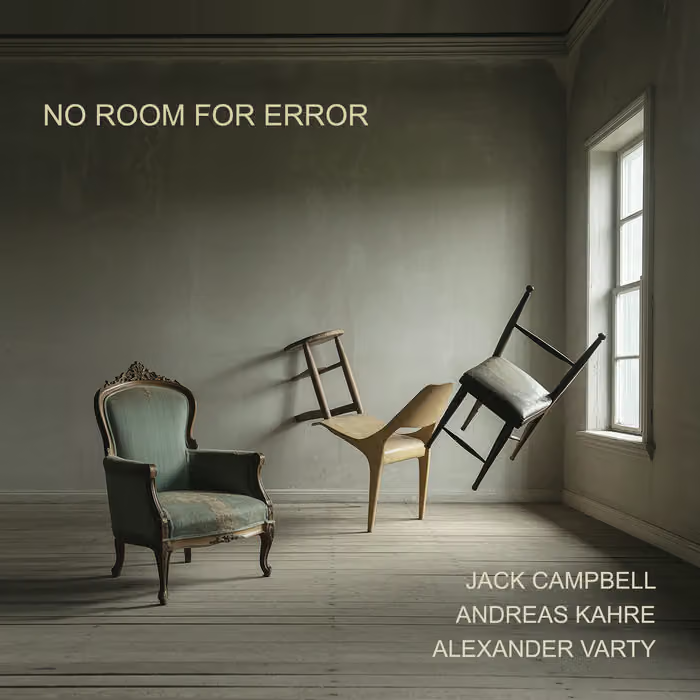
Improvisation, especially of the largely unplanned and entirely freeform variety, can be a bit hit-and-miss, particularly when it becomes apparent that the performers aren’t singing (or playing) from the same hymn sheet. Nevertheless, when collective interactions click into place—as on this seven-track mini-album by Alexander Varty on guitar & electronics, Andres Kahre on percussion and electric cello, and violin virtuoso Jack M Campbell—the results can be truly striking and illuminating.
No Room For Error came about through a serendipitous encounter between Campbell and longtime collaborators Varty and Kahre on Gabriola Island (which lies in the Strait of Georgia in British Columbia), where Varty and Kahre reside. Campbell visited the island last summer on an artist’s residency funded by the Tommy Flowers Foundation to record his first solo album, Sounding Bombe: Enigma Project. The talented violinist soon teamed up with the two musicians, with sound engineer Jordan Koop taking care of mixing and mastering, and No Room For Error was born.
One becomes immediately aware of a sense of place on any island, and one of the album’s strengths is the way it conjures a particular environment, climate and atmosphere. This is never presented in a programmatic way, however, but rather sensed through the music—leaving what’s heard open to the listener’s own interpretations.
For example, the uneasy, unsettling ambience evoked in the three Haar-entitled tracks relates to the Scots word for a chilly, foggy easterly wind. However, low rumbling guitars, nervously shuttling strings, glitchy sound effects, and sudden jump cuts in Haar I hint at something more sinister. Think Helmut Lachenmann trapped in a Saw movie. Haar III almost made me jump out of my skin. No room for terror would have perhaps been a more appropriate title.
Meanwhile, the opening of Smir (another Scots word, this time meaning ‘fine rain’) projects a lament-like quality, eventually building to a keening Ur Schrei of powerful proportions.
Not all the tracks are dark and disturbing. As its title suggests, Nightswimming is surrounded by floating, suspended lines and shimmering timbres, its subtly immersive impact aided by Varty’s use of Trope software (developed by Brian Eno and Peter Chilvers). Meanwhile, Cosmophony feels like entering inside a futuristic spaceship’s generator and experiencing its pulsing hum.
No Room For Error clearly benefits from Varty and Kahre’s intuitive understanding of each other’s aims—and how best to achieve them—shaped over time through a shared Alt Jazz aesthetic and projects involving the Gabriola Microsynth Orchestra (GMO). Equally impressive is the effortless way in which Campbell fits into the ensemble’s creative dynamics, his remarkable agility tempered by an innate musicality whose instincts tell him when, or when not, to play.
This special synergy is heard especially in Haar II, throughout which Campbell shines, and in the brilliant Rumbledethumps, where each member of the trio is presented in turn—tremolando-like sweeps on violin and resonant percussive patterns by Kahre, followed by gritty Robert Fripp-meets-Derek Bailey punctuations on Varty’s processed guitar. No wonder Rumbledethumps has already gained traction amongst radio stations, including BBC Radio 3’s Late Junction. It’s almost the experimental music equivalent to a Taylor Swift song.
What’s more, the album’s tracks never outstay their welcome, with only Nightswimming and Smir exceeding the five-minute mark.
Whether intended or not, No Room For Error hints at the title of Hank Mobley’s seminal 1963 album No Room for Squares, which featured—in addition to the trailblazing saxophonist—a veritable who’s who of jazz luminaries, such as Lee Morgan, Andrew Hill, Herbie Hancock and Philly Joe Jones. No Room For Error may not sound like Mobley’s hard bop masterpiece, but its bold, innovative improvisatory approach and boundless creativity draw on its spirit. Experimental music du jour, and endlessly creative at that.