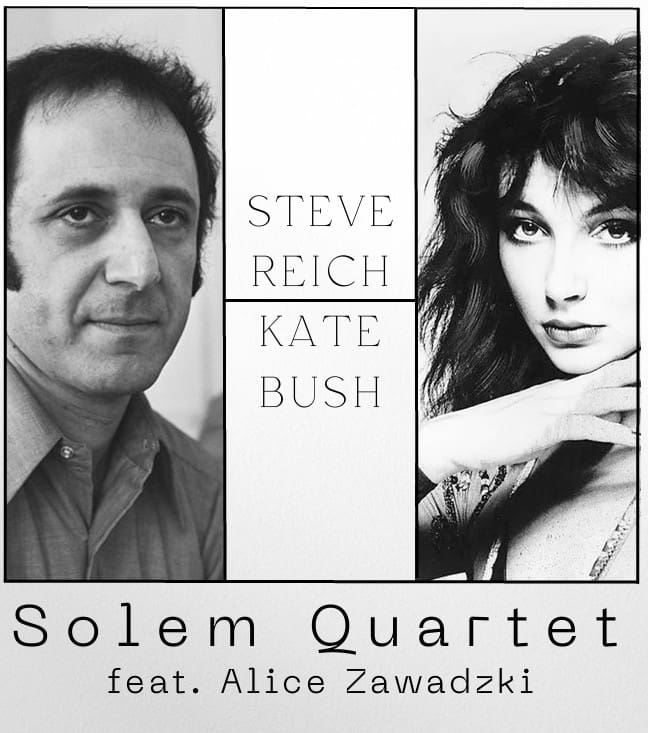
Solem Quartet feat. Alice Zawadzki: Steve Reich and Kate Bush (Musicfest Festival, Aberystwyth, 7/23/26)
My Steve Reich odyssey has taken me to several cities so far this year, including Liverpool, Manchester, London, Cologne and New York, so it seemed fitting that at least one event marking the composer’s ninetieth anniversary year should happen closer to my doorstep, in Wales.
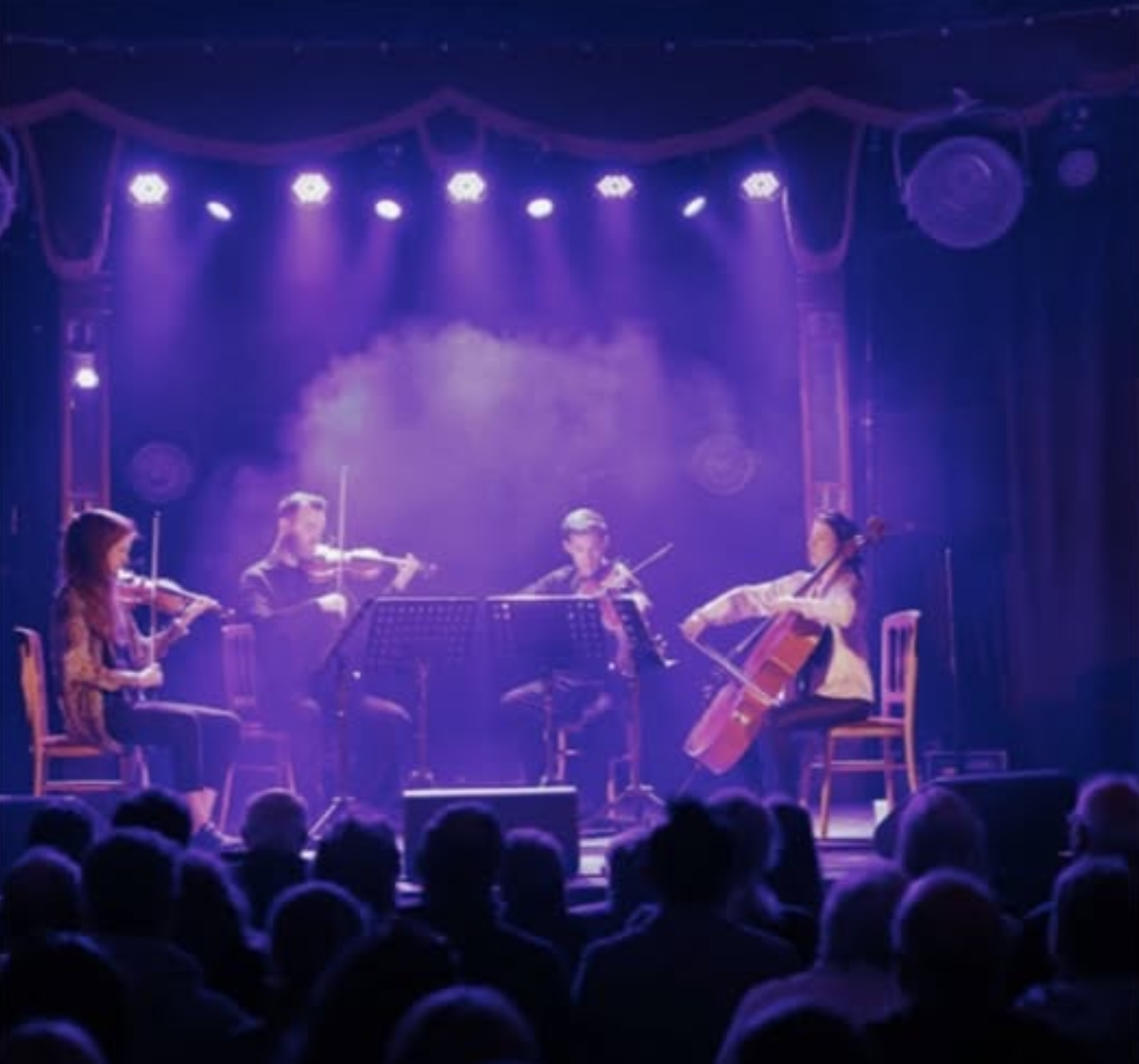
In fact, it’s a two-hour drive from where I live to Aberystwyth, where Solem Quartet and singer Alice Zawadzki were performing as part of this year’s Musicfest Festival.
Driving down the northwest coast of Wales towards Aberystwyth (through some astonishingly beautiful scenery, where the mountains tumble into the sea), it struck me that perhaps Reich’s music appeals to a more urban demographic. Wrong! Despite the venue’s small size, with Arad Goch Theatre’s stage (which means ‘Red Plow’ in Welsh) only just large enough to accommodate five performers and a couple of large floor monitor speakers, the auditorium was packed to the rafters. It made for an intimate and direct experience, especially given the nature of the programme.
Which brings me to Reich’s Different Trains. That work, alongside the later WTC 9/11 (2010), ranks among the composer’s most powerfully resonant statements. Personal, political and historical elements converge in the thirty-minute piece written in 1988 for live string quartet and prerecorded tape. It marked a departure for Reich in its synthesis of speech phrases, Holocaust testimonies and personal biography.
Divided into three uninterrupted movements, the first (‘America—before the war’) draws on two sets of recorded interviews: the first between the composer and his governess, Virginia Mitchell—who accompanied Reich as a young boy on his journeys from New York to Los Angeles during the late 1930s and early 40s after his parents separated—and the second featuring retired Pullman porter Laurence Davis, who worked on the train lines during that period.
Violinists Amy Tress and William Newell’s imitation of locomotive rhythms, train whistles and clanging bells in the opening half reflected the excitement, anticipation and adventurousness of Reich’s childhood journeys. It captured Noel Perrin’s assertion in a New York Times article written around the time Reich composed Different Trains that ‘Trains and railroads haunt the American mind altogether.’ A sense of nostalgia clung to the air, supported by violist Stephen Upshaw and cellist Stephanie Tress’s imitation of Virginia and Laurence’s clipped speech phrases.
Solem captured the shift in mood halfway through the first movement by adding intensity and urgency to Virginia and Laurence’s sequence of dates—’in 1939’, ‘1940’ and ‘1941’—directing the listener’s gaze away from the romantic journeys of Reich’s innocent youth towards the dark clouds of war hovering over central Europe.
The horrors of identification (to use Naomi Cumming’s expression) were laid bare in the second movement (‘Europe—during the war’), with the optimistic train rhythms of the first now weighed down by Holocaust testimonies. Upshaw and Tress added a more mournful tone on viola and cello to Rachel and Rachella’s stark statements (‘The Germans walked in’, ‘No more school’), while violins and cello projected sharp piercing crescendos to the phrases ‘into those cattle wagons’ and ‘for four days and four nights.’ The sustained chord at the movement’s close possessed the sensory overload of a blank wall of white noise.
The third movement (‘After the war’) offered hope with its return to America and some semblance of normality. Reich’s rhythmic patterns were exchanged between members of the quartet with the precision of a Swiss watch. One of the most striking aspects of Solem’s nuanced performance was the way they conveyed the idea that, although the world had returned to normal after the war, everything had changed. Memories could neither be erased nor forgotten. This came across most poignantly in the work’s conclusion, where a Jewish girl ‘who had a beautiful voice’ is told to sing to the German soldiers—a moment suffused with bittersweet pathos.
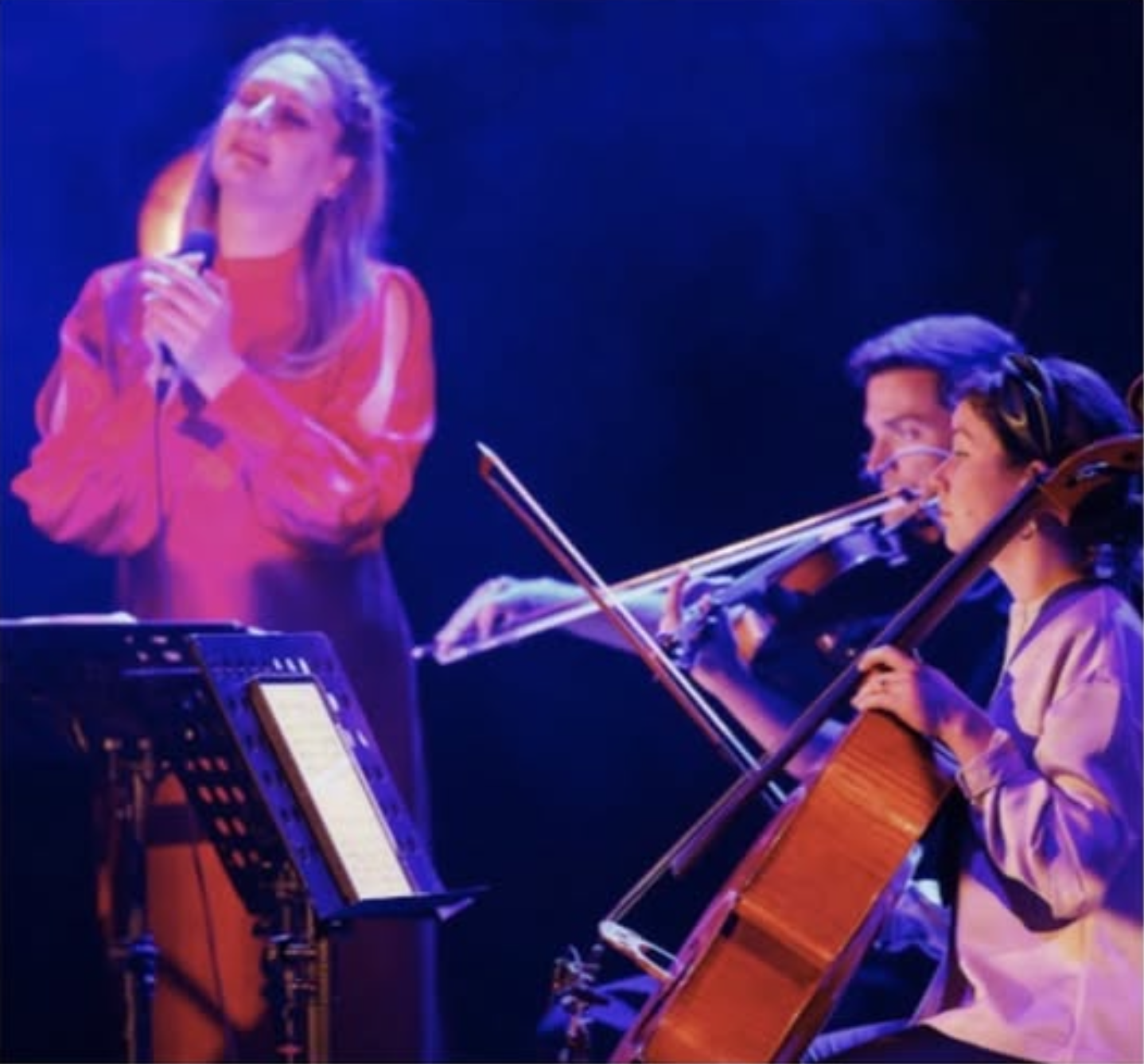
Although dealing less with themes of loss and trauma, the songs by Zawadzki and Kate Bush heard after the interval were compelling in their own way. Of Zawadzki’s three songs, a bluesy, bacchanalian spirit animated ‘Ring of Fire’, while consonant and dissonant elements foregrounded the dual nature of a bipolar person in the folksy ‘My Boy of the Birds’. Astringent Bartók-like bitonalities surfaced in ‘Pragnienie’, the viola’s ruminative ostinato resonating with the Polish concepts of desire and longing.
The evening ended with five picture-perfect arrangements of Kate Bush songs by Solem violinist William Newell, whose emotional range extended from the innocent expression of ‘The Man with the Child in his Eyes’ to the steely vulnerability of ‘This Woman’s Work’, the latter enhanced by Zawadzki’s subtle characterisation and impressive vocal control. Expressive exchanges were heard between Newell’s violin and Zawadzki’s voice in ‘Running Up That Hill’ and ‘Hounds of Love’. It reminded me of something Kronos Quartet violinist David Harrington said when I interviewed him about Different Trains, which could have been applied to the concert as a whole: ‘You know, when you think about the history of the string quartet, it’s a very personal medium for composers. They can really internalise their sound through it. That’s what has always attracted me to it.’