The Forest Beneath Language: Entering the World of György Kurtág in Marlboro
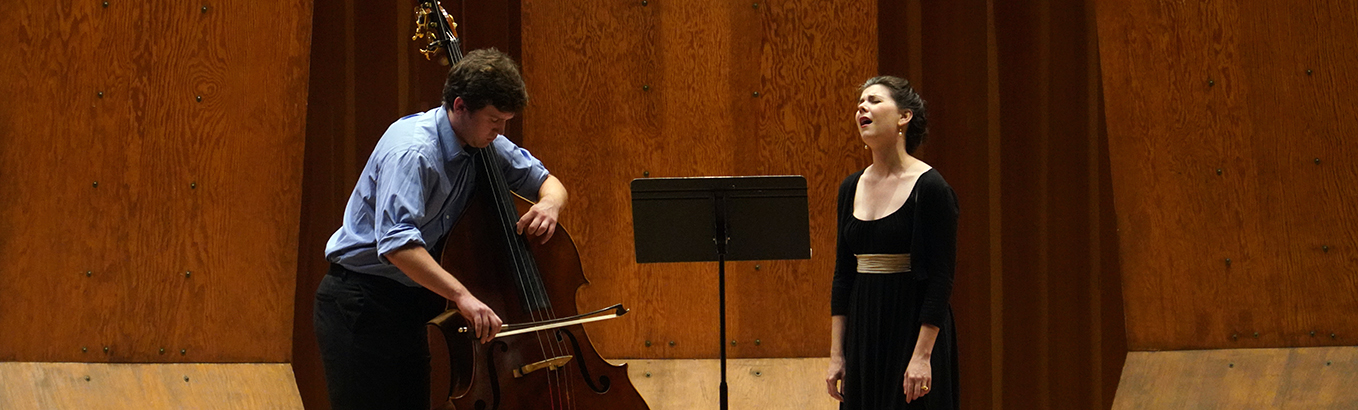
Reaching Marlboro requires a gradual surrender of scale. Roads narrow, familiar coordinates loosen, and the forest exerts its own editorial influence, stripping away whatever feels extraneous until distance becomes a form of concentration. On September 20, 2026, that concentration gathered inside Ragle Hall at the Serkin Center, where the Marlboro Music Artist Residency Program presented The World of György Kurtág, an arresting sequence of works composed or arranged for soprano and double bass. Beyond the hall stood the wooded seclusion of southern Vermont; within it, soprano Lucy Fitz Gibbon and bassist William Langlie Miletich moved between Sprechstimme, art song, extended technique, and charged silence.
Seclusion mattered because Kurtág’s music alters the proportions of attention. The claim embedded in the program’s title was stranger than its apparent simplicity suggested. The phrase “world of” ordinarily announces breadth, an oeuvre surveyed from above. Kurtág offers no such cartographic comfort. His world emerges through radical compression, forming under pressure between a sound and its possible disappearance. A few pitches can contain the moral weight of a dramatic scene. A pause can bend duration until time folds inward, secreting another time inside itself. His miniatures remain small only to the clock. To enter them is to accept unfamiliar laws under which fragments carry the mass of vanished wholes and inhalation behaves as active matter. The surrounding forest supplied an uncannily precise grammar for this experience. Every trunk concealed years in concentric script; every root continued a sentence underground. Kurtág’s art operates within a related economy of the imperceptible. A phrase ends, yet its pressure travels elsewhere. Music becomes the audible extremity of processes occurring beneath language.
The sequence approached that hidden economy gently through Lembit Beecher’s With Grandchildren, drawn from his 2014 cycle Looking at Spring: Meditations on Aging. The larger work grew from interviews librettist Liza Balkan conducted with senior citizens in Toronto and central Vermont, making its appearance in Marlboro feel almost homeward. Their voices had passed into text and music before returning to the region transformed, bearing traces of their speakers without claiming to preserve them intact. Harmonics in the bass courted a rocking motion whose comfort never became secure, while Fitz Gibbon searched amid the delicate failures of memory. The soul became an unfinished sentence poised beneath scissors, family albums reduced to particles of touch and chronology. Bone creaked as marrow acquired a secret literacy, becoming a divining instrument for the inaccessible past. Beecher respected recollection as an unstable act in which forgetting shapes experience as decisively as retention. Miletich’s pale overtones gave the bass an elderly nervous system of its own. The final word escaped capture, suspending language where recognition touches disappearance.
John Cage’s The Wonderful Widow of Eighteen Springs opened another passage into that borderland. Composed in 1942, its text comes from a nocturnal passage concerning Isobel in Finnegans Wake, a book of sleeping consciousness and linguistic mutation. Cage answered that abundance with severe economy. The voice circles within three pitches, while the original accompaniment is played on a closed piano tapped by the player. In Marlboro, those impulses migrated to the double bass, where Miletich turned his instrument of choice into a hollow nocturnal chamber. What had once been struck wood surrounding dormant strings now came from an assemblage held against the player’s body, each impact becoming a coded knock from somewhere inside itself. Fitz Gibbon sustained Cage’s narrow compass with remarkable intensity. Repetition wandered in place, circling a road inferred from every failed attempt to leave it. James Joyce’s words acquired the phosphorescence of objects glimpsed among trees. Isobel became a consciousness translated into the landscape, as identity passed into leaf matter and the boundary between a sleeping mind and the forest dreaming it lost authority.
Amy Beth Kirsten’s yes I said yes I will Yes followed as a second excavation of Joyce, drawing on Molly Bloom’s concluding monologue in Ulysses. Written in 2012 for soprano and contrabass, with the bassist also vocalizing, it entered an illuminating dialogue with Cage. Both composers extract a concentrated vocal world from Joyce’s literary machinery. Whereas Cage cools language toward incantation, Kirsten restores its heat while fracturing the body that generates it. Isobel’s suspension yields to Molly’s consciousness in bed, where memory moves through eros and resistance before reaching the irrevocable “Yes.” Fitz Gibbon and Miletich rendered that sensuality as a condition divided against itself. Pizzicato entered beside Miletich’s droning hum, while glissandi bent the music from stable coordinates. Fitz Gibbon inhabited desire while observing its mechanisms from afar, consciousness hovering above its own flesh. The deeply inflected conclusion unfolded as slow-motion blues, each pitch bearing the drag of pleasure becoming memory before experience could have its say.
These works prepared the ear for Kurtág’s Einige Sätze aus den Sudelbüchern Georg Christoph Lichtenbergs, Op. 37a, begun in 1996 and expanded for soprano and double bass in 1999. The cycle arose from his encounter with the private notebooks of Georg Christoph Lichtenberg, the 18th-century physicist whose intellect moved between experiment and satire. Never intended for publication, these “waste books” gathered observations whose brevity sharpened their reach. Lichtenberg’s scrutiny ranges across provincialism and religion, colonialism and literary history. Each joke becomes a trapdoor opening onto centuries of vanity. Kurtág began setting the aphorisms while ill, initially for solo soprano. Singer Maria Husmann encouraged the addition of double bass after experimenting with improvised accompaniment, a genesis audible in the finished cycle. Voice and instrument discover one another without settling into fixed roles. The bass accompanies before interrupting, then places a dark question mark beneath Lichtenberg’s wit.
Fitz Gibbon and Miletich inhabited these relations with theatrical aptitude. The opening “Die Kartoffeln” (“The Potatoes”) was oddly beautiful in its evocation of slumbering tubers and their potential afterlife. “Kirchtürme” (“Church Spires”) rose through lovely pizzicato, its aspiration destabilized by the plucking that produced it. “Koan” became a fervent prayer edging toward cognitive seizure. Kurtág exposed the nervous system inside each of these, revealing the involuntary twitch beneath polished intelligence.
That method reached sardonic clarity in “…und eine neue Welt…” (“…and a New World…”), where Fitz Gibbon sang through her teeth: “The American who discovered Columbus made a nasty discovery.” The reversal compresses colonial history into a grammatical ambush, exposing discovery as a story power tells about intrusion. Here, as elsewhere in the cycle, language appeared to turn against the assumptions concealed within its own syntax.
Beecher’s stop-motion films, still a work in progress and therefore accompanying only selected aphorisms, extended this instability into a visual register. His reappearance as animator also gave the program a satisfying circular architecture. Having entered through his own music in With Grandchildren, he returned within Kurtág’s, translating acts of listening into movement and matter. Objects advanced through minute discontinuities, their apparent motion created by absences between frames. The art form therefore proved uncannily suited to Kurtág, whose music repeatedly asks the listener to construct continuity across charged gaps. Both forms make disappearance part of their syntax.
The most persuasive union of image and sound came in “Ein Liebhaber der klassischen Philologie” (“A Classical Philology Aficionado”), concerning a man so enamored of Homer that he reads the German angenommen as “Agamemnon.” Books towered behind drifting clouds while statues looked on as thought acquiring mineral flesh. Beecher let the visual analog unfold slowly, giving the words time to expose the strange pathology hidden inside cultivated learning. Erudition became a benign haunting, a possession so complete that antiquity rewrote the present from within. The sequence clarified what the animations contributed to the cycle as a whole: they gave Kurtág’s microscopic dramas another surface upon which to misremember and mutate.
The closing “Ein merkwürdiger Gedanke” (“A Strange Thought”) brought Kurtág’s humor to its darkest edge. Miletich and Fitz Gibbon allowed laughter to reveal its ancient kinship with fear. By then, one work had entered another through hidden roots. Cage’s knocks survived inside Kirsten’s tapping, while Beecher’s elderly voices continued inside Lichtenberg’s posthumous sentences. And through it all, Joyce’s sleeping forest returned in the Vermont woods surrounding the hall. The program cohered through subterranean recurrence, with each composition sending material below the surface for another to absorb.
Marlboro’s seclusion ultimately changed the concert. Isolation became an acoustic form of relation, concentrating distant minds into one chamber. Beneath our feet, roots continued their exchanges without witnesses, each message altered by the body carrying it. The afternoon suggested that memory follows the same obscure traffic. We imagine ourselves as its custodians, although the reverse may lie closer to the truth. Memory could be the larger organism, ancient and unfinished, using each of us as a temporary organ through which to migrate. For one hour in Ragle Hall, voices became gills in that organism.