Schanzer/Speach Duo with guests: Live in Brooklyn, 1992-2002
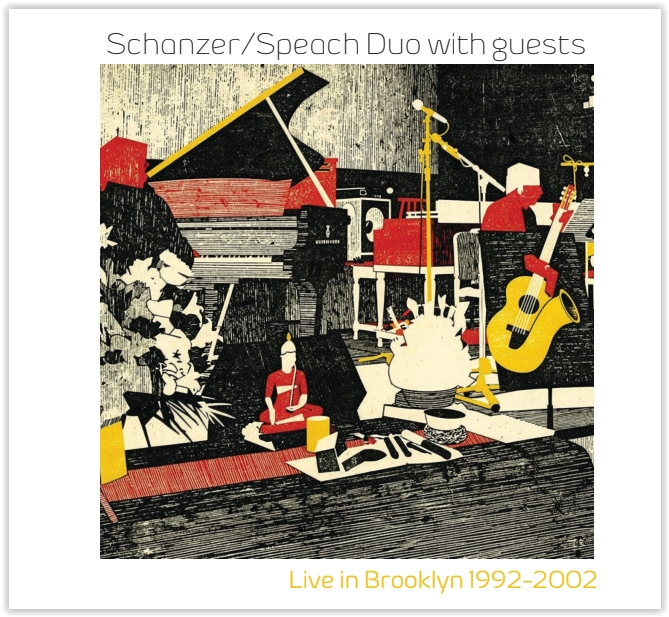
Live in Brooklyn, 1992-2002 opens a decade-long aperture through which sound flees its dates and resumes its unfinished conversation with the present. Guitarist Jeffrey Schanzer and pianist-composer Bernadette Speach turn performance into a social form where individual voices ply dreams that are startlingly alive. The duo began collaborating in Buffalo in 1982, joining free jazz and global traditions to the post-Cagean avant-garde. After moving to Brooklyn two years later, they entered an artist-led culture sustained by collective labor. Schanzer served as president of the Musicians of Brooklyn Initiative, founded by Lester Bowie and Oliver Lake with Cecil Taylor; Speach worked as a producer and organizer. When MOBI closed, the pair co-founded MusicVistas, Inc., presenting concerts at Lafayette Presbyterian Church and the Brooklyn Society for Ethical Culture.
The guests of those concerts, generously represented here in a selection spanning two discs, reveal a breadth of talent that includes Bowie and Lake, Wadada Leo Smith, Joseph Jarman, Leroy Jenkins, Mark Dresser, Fred Lonberg-Holm, and Alva Rogers. Yet the album resists becoming a parade of illustrious names. Its deepest subject is relation itself, the difficult art of remaining singular while entering another person’s orbit. The open improvisations expose that ethos, each encounter inventing its laws while obeying the fragile discipline of listening.
With Lake on alto saxophone, Schanzer and Speach establish a fractured pulse as the horn slips through apertures between intention and reflex. Calls arrive already altered by their responses as the music sheds one skin, only to discover another consciousness underneath. Dr. David Pleasant’s appearance takes a more tactile route. Schanzer strikes the guitar into an ancestral ambiguity while Speach plucks the piano’s interior with aqueous precision. Pleasant’s flute wanders as a spirit negotiating the burden of embodiment, and percussive impacts press against the music’s transparent membrane until fracture becomes illumination.
The improvisation with Dresser descends into darker psychic matter. His arco bass draws a vibrating inquiry from an immeasurable well, while scraped textures worry the border between injury and knowledge. Pizzicato attacks bend ordinary hearing. Another improvisation, with Bowie and cellist Fred Lonberg-Holm, replaces abrasion with guarded tenderness. The musicians circle one another through reverb, protecting the work’s secrets from interpretation’s blunt appetite. Jenkins brings ferocious motion. His violin becomes the charged intelligence of a hive mind, agitating guitar and piano into radiance and unease. Beauty here carries no obligation to console.
The composed works give these energies names without containing them. On Bowie’s “The Villager,” piano and guitar form a deep foundation for a trumpet voice at once incisive and grief-stricken. Bowie cuts through self-doubt by uncovering the harder question beneath it: What kind of survival leaves the soul intact? His tone pierces without cruelty, and the duo follows its eastern-facing thread into a region where mourning acquires sinews.
Smith’s “Rain Flowers, Vertical Spears and Diamond Sunrays,” stretching beyond 24 minutes, is the collection’s vastest chamber of metamorphosis. His koto extends touch itself, entwining with Schanzer’s guitar until chronology folds in on itself. Speach’s toy piano releases tiny constellations over the full instrument’s historical resume. Smith’s muted trumpet seems peeled from an antique surface, its metallic cry approaching a bowed gong’s resonance.
Alva Rogers’s “Foreign Affair” turns the album toward the politics of the body. Over Schanzer and Speach’s lush harmonic ground, the composer moves between speech and song, granting each word a physical contour. Her urban narrative of encounter and self-possession refuses the body’s reduction to currency. Desire becomes sovereign, alert to every mechanism that would classify or discard it. In “Glove Quartet,” Holland Hopson’s soprano saxophone and electronics meet John J.A> Jannone’s circuitry and Schanzer’s aggressive electric guitar. The surfaces grow harder, but lyricism keeps opening hidden doors in the machinery.
Jarman’s “Hollows Five: II – Sincere Words. Can’t Compromise or Overpower” offers the most immersive ritual. Bells and bowls summon depth without exoticizing it; piano and guitar locate pressure points within the surrounding network. Jarman’s flute and alto saxophone carry a restless human shade through recurring figures.
Brooklyn’s so-called second renaissance took material form. It required rooms, organizers, trust, and the stubborn conviction that art could build forms of civic life unavailable elsewhere. Schanzer and Speach hoped these recordings would transport listeners to that place and time. They accomplish something stranger. The album makes the past responsible to the future, asking whether listening can become a moral practice rather than private consumption. Within these performances, freedom means the exacting effort of making space for another consciousness without furnishing that space in advance. Perhaps the archive ultimately exceeds remembrance and becomes a score for communities that do not yet exist, waiting inside us for the courage to become audible.