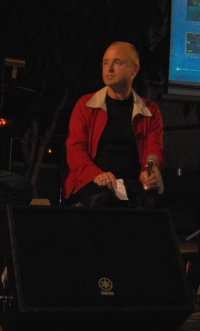
John Schneider and his group “Partch” gave their annual REDCAT concert of Partch’s music last night. The program included Partch’s film of U.S. Highball: A Musical Account of a Transcontinental Hobo Trip (1958, film completed in 1968). The program began with the eight hitchhiker inscriptions of Barstow (1941/1943/1968); this interesting site provide clips of different performances of the first inscription. The second half of the program included rousing performances of Ring Around the Moon (1950) and Castor & Pollux (1952), both involving the seven instrumentalists in the group. The audience jumped up and called their approval at the end.
There were ten Partch instruments (in addition to the voice): the Adapted Viola (1930), the two Adapted Guitars (1935 and 1945), the Kithara (1938), the Chromelodeon (1941), Harmonic Canon (1945), Diamond Marimba (1946), HypoBass (1950), Cloud Chamber Bowls (1950) and Bass Marimba (1950).
Two of the instrumentalists, Vicki Ray and David Johnson, were key in Tuesday night’s concert by Xtet at the County Museum. For me a high point was The Four Seasons of Futurist Cuisine for orator, piano, violin and cello by Aaron Jay Kernis. (Amazon’s sound clip doesn’t include the oration, so it lacks the flavor of the piece.) The program began with three songs to Shakespeare by Stravinsky, and included three songs by John Cage and Morton Feldman’s lovely The Viola in My Life 2. Phil O’Connor, Xtet’s frequent clarinetist/saxophone, presented the premiere of his new work War Again(st) ? (T)error!, a work of several episodes which didn’t seem linked to the title but which kept active.
 Born in Boston and a product of Berklee, the New England Conservatory and Bard, Amos now makes his home in Tel Aviv. He was one of the brave few “serious” composers that took the online plunge early; I first bumped into him and his music way back in 1999 or 2000 on the old MP3.com. His work has a touch of the modern Romantic, chromatic and sharp, though the lyrical is never too far away.
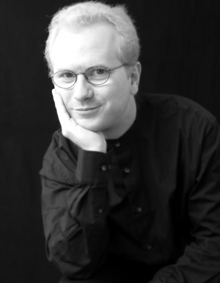 Attention Boston (and NY) shoppers! The world-premiere run of David Salvage’s String Quartet No. 2 is at hand. The
  “But he, Siddhartha, where did he belong? Whose life would he share? Whose language would he speak?” These words of Hermann Hesse depict Siddhartha Gautama (Buddha) at a pivotal point in his quest to find purpose in the world. He will soon find it, seeing one where he once saw many, finding that the seemingly unrelated are related.
 Composers, painters, writers, the whole motley lot–have always depended upon the kindness of strangers. Timely financial interventions of the Lorenzo de’ Medici here, the Nadezda von Meck there, the Paul Sacher over there have greased the skids for the makers of many of the world’s great masterpieces. Alas, those sort of patrons aren’t that plentiful nowadays and so a new “community” model of patronage has sprung up in which arts organizations pool their resources to commission new works. I call it the “Biegel” method after S21 blogger and pianist