(I think I’m going to switch to mid-week from here on; people seem to like it.) Our regular listen to and look at living, breathing composers and performers that you may not know yet, but I know you should… And can, right here and now, since they’re nice enough to offer so much good listening online:
Tom Rojo Poller (b. 1978 — Germany)
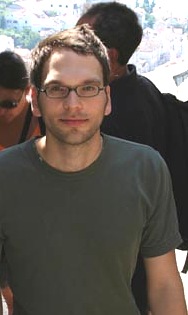 Born in Osnabrück, Poller began his composition studies in 1996 at the Hochschule für Musik Detmold, continuing with Prof. Walter Zimmermann at the Universität der Künste Berlin (UdK). After an exchange year at the Royal College of Music London in 2003, he received his diploma and returned to Berlin where he’s just finished his postgraduate work. Since 1999 he’s also been studying German Literature, Philosophy and Musicology at the Humboldt-University in Berlin. Last year, as participant of the Global-Interplay-project, he attended conferences in Accra, Ghana.
Tom is especially interested in the temporal aspect of music (including polyrhythmical/polymetrical music); music theater — or more generally, various forms of musical representation; the relation between music and language; the philosophy of music (especially music and the emotions, music and understanding). His music is deeply rooted in the western European musical tradition, but is greatly influenced by its lesser known aspects (e.g. medieval and renaissance music, rhetorical aspects of baroque music).
His website shows off all of these interests; his music page there is especially generous about providing quality listening to his already-amazing pieces (the recordings and performances are generally top-notch). This is someone to keep an eye on in the coming years.
………………….
Tristan Fuentes (b. 1951 — Mexico), Joe Holmquist (b. 1951 — US)
The official word is:
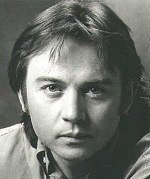 Tristan Fuentes, born 1951 in Mexico City, is the son of a school teacher and barrister. His first ensemble experience was “Cherub Choir” as a five-year-old, and piano studies followed at age six. In the fifth grade he had the opportunity to join the class band. It was denied that he play trumpet but firmly suggested that he play drums. At age fifteen he organized his first combo and started playing professionally.
As a university student he pursued a dual track of classical music and rock & roll. In his mid-twenties he studied percussion, music theory, and composition at the New England Conservatory and suffered under the tutelage of Gunther Schuller. Upon his liberation with a Master of Music degree, he set upon a diverse life of people, places, languages, and art objects. His main compositional influences have been Terry Riley, John Cage, and Frederic Rzewski. His works are primarily for small instrumental ensembles, often including exotic percussion.
Fuentes describes his music as “liberated minimalism”. As a theory and composition student he was trained in the tradition of Paul Hindemith and the later serialists, while outside of class he was listening to and playing rock, jazz, and minimalist music. His works are characterized by catchy melodies and strong rhythms. Harmonically the music is tonal, with dissonance as the main device for creating tension between compositional elements.
Or…
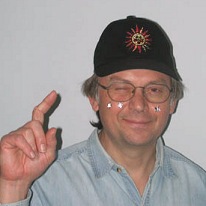 Joe Holmquist was born in 1951 in Benson, Minnesota, a medium-sized community out in the west-central part of the state (in this case, medium-sized means 3,000 souls). There wasn’t much along the line of organized activities for kids, so it was common to participate in music organizations both at school and at church. “…At the time, I didn’t think I was learning anything in particular from those music activities, but I was!…”
His first ensemble experience was “Cherub Choir” as a five-year-old, and piano studies followed at age six. In the fifth grade he had the opportunity to join the class band. It was denied that he play trumpet but firmly suggested that he play drums. At age fifteen he organized his first combo and started playing professionally.
As a university student he pursued a dual track of classical music and rock & roll. In his mid-twenties he studied percussion, music theory, and composition at the New England Conservatory and suffered under the tutelage of Gunther Schuller. Upon his liberation with a Master of Music degree, he set upon a diverse life of people, places, languages, and art objects. His main compositional influences have been Terry Riley, John Cage, and Frederic Rzewski. His works are primarily for small instrumental ensembles, often including exotic percussion.
Holmquist describes his music as “liberated minimalism”. As a theory and composition student he was trained in the tradition of Paul Hindemith and the later serialists, while outside of class he was listening to and playing rock, jazz, and minimalist music. His works are characterized by catchy melodies and strong rhythms. Harmonically the music is tonal, with dissonance as the main device for creating tension between compositional elements.
Hmmm… The truth is what we will, right? And the truth is that Joe’s site, besides highlighting his excellence as a percussionist, kindly hosts a wealth of Tristan Fuentes pieces in MP3. Bright, propulsive and non-cheesily tuneful, They’re well worth getting to know.
 New York, NY, March 29, 2007. I’ve been a fan of Evan Ziporyn’s music since six or seven years ago when I first heard his work in a concert of piano music at Dartmouth College. (I think it must have been “Pondok,” in a recital by the fabulous Sarah Cahill, but I can’t seem to find evidence to support that conclusion. Sarah, if you’re out there. . .) Ziporyn is a fixture at Bang On A Can, and a member of the Bang On A Can All Stars where he plays a mean clarinet; he’s also a member of the music faculty at MIT and the founder of Gamelan Galak Tika. Last Thursday, Ziporyn teamed up with cello-percussion duo Odd Appetite (Ha Yang Kim and Nathan Davis) and bassist Robert Black (another Bang On A Can All Stars member) for two sets at The Stone, John Zorn’s Alphabet City new music dive.
 If you know this gentleman or his work and have some original thoughts about same,
 Next to the Mountaineers winning the NIT (okay, so it’s the tournament of losers…we won), the most exciting news in the world today is that our lil’ buddy Ian Moss is having his second annual
 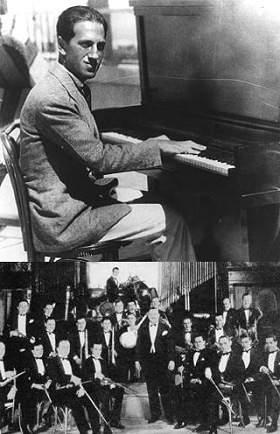 Made shortly after the premiere performance, and a year before the electric microphone came into use. The two records are on different pages: record one is
 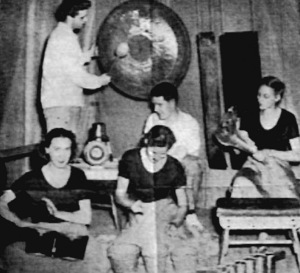 An absolutely fascinating audio document,
 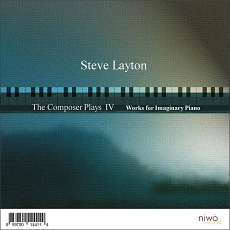 On a personal note, I’ll mention the release of my own new CD,