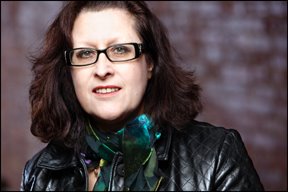
Composer/keyboardist/producer Elodie Lauten creates operas, music for dance and theatre, orchestral, chamber and instrumental music. Not a household name, she is however widely recognized by historians as a leading figure of post-minimalism and a force on the new music scene, with 20 releases on a number of labels.
Her opera Waking in New York, Portrait of Allen Ginsberg was presented by the New York City Opera (2004 VOX and Friends) in May 2004, after being released on 4Tay, following three well-received productions. OrfReo, a new opera for Baroque ensemble was premiered at Merkin Hall by the Queen's Chamber Band, whose New Music Alive CD (released on Capstone in 2004) includes Lauten's The Architect. The Orfreo CD was released in December 2004 on Studio 21. In September 2004 Lauten was composer-in-residence at Hope College, MI. Lauten's Symphony 2001, was premiered in February 2003 by the SEM Orchestra in New York. In 1999, Lauten's Deus ex Machina Cycle for voices and Baroque ensemble (4Tay) received strong critical acclaim in the US and Europe. Lauten's Variations On The Orange Cycle (Lovely Music, 1998) was included in Chamber Music America's list of 100 best works of the 20th century.
Born in Paris, France, she was classically trained as a pianist since age 7. She received a Master's in composition from New York University where she studied Western composition with Dinu Ghezzo and Indian classical music with Ahkmal Parwez. Daughter of jazz pianist/drummer Errol Parker, she is also a fluent improviser. She became an American citizen in 1984 and has lived in New York since the early seventies
|
|
|
|
|

Friday, May 22, 2009
Nick Hallett's Whispering Exercises
Yesterday I was at the New Museum on the Bowery in the all-white (from seats to walls) auditorium downstairs, enjoying the sounds of Nick Hallet’s Whispering Exercises which staged four singers and a harpist (all young women) as if sitting on a cloud, surrounded by quickly evolving and contrasting light projections all around the theater’s inviting walls. With some of the tunes, one felt surrounded by nearly angelic sounds but there was an edge in the occasional slight dissonance, or the directness and simplicity of the vocal work, or the constrasting passages where the roar of an old analog synth or quietly cycling arpeggiator brought a man-machine element. In Nick Hallett’s through-composed world, the sweetness and the rumble get along and share the same universe, which adds a spiritual dimension to the statement; and one is aurally delighted and comfortable within a clearly defined, accessible esthetic. The piece, a work in progress to be completed by next year and presented at The Kitchen, weaves the stasis of whispers and breathing sounds that recur throughout, with short tunes with tonal vocal harmonies, sometimes reminiscent of early music, but beyond the purity of the voices there was the memory of rock music. The performers, Daisy Press, Rachel Henry, Katie Eastburn, and Rachel Mason (voices) and harpist Shelley Burgon were compelling and so were the visuals created by Seth Kirby and Brock Monroe. The music was wonderfully refreshing and reaching for its very own language beyond tonal minimalism.
Nick Hallett is continuing his residency at the New Museum for one more week with Voice and Light Systems Part Four: Auroville on Thursday May 28 at 7pm, a multimedia “ritual” inspired by Sri Aurobindo featuring Seth Kirby and Ana Matronic.
Visit: Newmuseum.org/eventsLabels: http://www.newmuseum.org/events
posted by Elodie Lauten
9:49 AM
Sunday, May 10, 2009
Weird inventions and dawn of the Terpstra
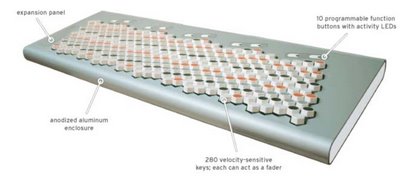
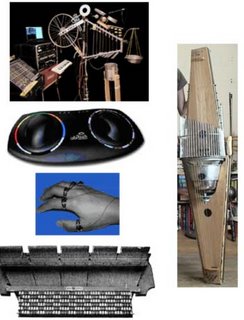
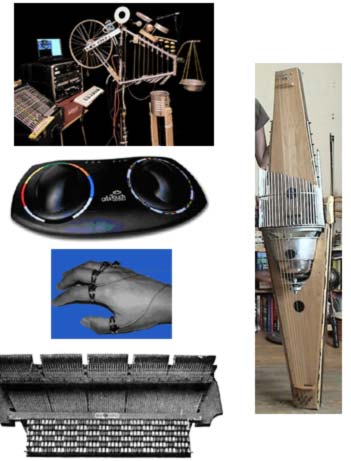
Legend: top to bottom: Terpstra, Bikelophone, OrbiTouch, FingeRing (hand), Jankó keyboard, Bowafridgeaphone (right).
People have been inventing new instruments ever since the beginning of time, but it is almost frightening how lately people are thinking up alternatives to the ever-present keyboards we use: the piano keyboard and the QWERTY keyboard.
The OrbiTouch is a “keyless” keyboard that integrates the mouse and the keyboard According to the manufacturer, ““The orbiTouch creates a keystroke when you slide the two domes into one of their eight respective positions. You type the different characters by sliding the domes to create letters and numbers. The orbiTouch also has an integrated mouse, so moving the domes gives you full mouse and keyboard capability!”
The FingeRing is a wireless wearable keyboard invented by NIT Human Interface Laboratories in Japan. It is the prototype of a full-time wearable device for the input of commands and characters. A small accelerometer is worn on the base of each finger to detect the typing shocks generated by tapping the finger on any typing surface such as the thigh, knee or desk (called "finger-tip typing"). Commands and characters are generated from combinations of finger-tip typing actions. Each accelerometer is small and the finger-tip is not covered so they can be worn continuously in everyday life without trouble. In addition, no take-up action is needed for use, so immediate start of operation is possible.
I also found some weird musical instruments interesting: for the Bowafridgeaphone, instrument maker Iner Souster used refrigerator grates, violin bows, a broken old speaker, a cake pan, a metal salad bowl, and the few other spare pieces of metal. There are 36 strings along the body to help with its resonance, and pick up a few sympathetic tones; the Bikelophone, originally constructed in 1995, is a palette of sonic exploration, with magnetic pickups attached to amplify the sound, anything connected to the bike becomes amplified. The current configuration includes bass strings, scrap wood and metal, metal bowls, telephone bells, a mechanical foot pedal and a touch sensitive tone generator.Using a loop-based recording system and outboard signal processors (reverbs, delays, pitch shifts, etc.), sound compositions can include acoustics and electronics.
The Terpstra keyboard, brainchild of engineers/designers Dylan Horvath and Siemen Terpstra (in collaboration with artistic director Garnet Willis, advisor Joel Mandelbaum and executive director Reinhard) has been out of the box for a couple of years now, a full-capacity microtonal keyboard with a non-piano interface, i.e. 280 velocity-sensitive keys that can be assigned various micro-tunings with a maximum of 55 notes per octave. It is a control surface for microtonal music which requires a) software to run the tuning (such as Scala) but also b) a timbre module or sampler or sound library. I had a chance to play the Terpstra once and enjoyed the keyboard action as I didn’t find it difficult to adapt to the key layout and got some entertaining sounds out of it even though they weren’t pre-planned – you kind of have to move the hands vertically as well as horizontally.
For a keyboardist though it is a question of losing virtuosity at the piano keyboard in exchange for acquiring virtuosity on this unusual keyboard. Will the Terpstra, despite its undeniable creative possibilities and microtonal options, take off or will it be rejected by the players as was the Paul Jankó keyboard at the beginning of the 20th century – it offered a stack of six keyboards one above the other, which changed the entire action to make it more accessible to play with less of a stretch for the hand. And that was actually truly brilliant because for some people especially women with smaller hands, the stretch of the hand which barely goes to the 10th, precludes from playing material that requires very extensive chords as in Liszt, Scriabin, Rachmaninoff, etc.
The Terpstra has already found its enthusiasts: Aubrun Schect says “When a key is depressed, the entire change in position is monitored and translated to a very accurate and nuanced velocity by the time the key hits the bottom. Every key is easily re-mappable and if mapped to a continuous controller, then slowly depressing any re-mapped key sends out continuous data like a fader in real time. It does all of this with no latency.” Meanwhile, The Gizmodo web site calls the Terpstra "an instrument for musicians from another planet". We’ll see what the future holds, but I am eager to hear some of these new sounds.
posted by Elodie Lauten
2:12 PM
Reason Producers’ Conference
Shamelessly retreating from a beautiful sunny day I spent Saturday afternoon watching the new and newsworthy of the Reason 4 software, presented by its makers, Propellerhead. The event took place at Clinton Studio on 10th Ave. According to an informal survey of the participants, most users of this production tool are in advertising, television and film, hip hop, country, rock – but not in experimental or classical music although in my experience it works just as well in these styles.
I got hold of an earlier software package by Propellerhead as early as 2003 and before Finale had the capability to play back with the Garritan sound library, I used to export my Finale midi files into Reason to demo and mix the orchestral tracks. Reason has come a long way since then.
The current Reason 4 package works in a similar fashion as a modular synthesizer to offer powerful desktop production possibilities in sampling, synthesis, sequencing, with particularly efficient drum programming tools. The new “Thor” virtual synthesizer seems to offer infinite flexibility because any of its various modules can be routed to control another, in other words allows the users to practically build their own virtual synths. In addition, as was demonstrated at the workshop, the multiple effects in Reason can be combined to afford mastering-level precision.
The only thing that Reason does not do is: audio recording… but all you have to do is get the latest Pro-Tools (version 7 and 8) and from that program choose the Reason plug-in and both programs can be used simultaneously.
I really enjoyed the unpretentious and informative presentation by producer Chris Petti, who is about to start a New York Users Group for Reason… something to follow closely; Also presenting were Chris Griffin, Aaron Albanoand Ben Weinman. I hope we can get more of these events in New York.
posted by Elodie Lauten
12:08 PM
Richard Kostelanetz: Openings
On Thursday evening at the AC [Institute Direct Chapel] (sic), a gallery in Chelsea, I watched, along with a few privileged viewers, the unfolding of Openings by Richard Kostelanetz. In this time of mainstream predominance, it is refreshing to see an informal event in a gallery setting, without any of the expected performance parameters; when the piece started Richard was sitting on the floor near the performer and I didn’t know if he was going to be in the piece or if that was his participation to the performance, which actually did not matter. It was just very relaxed.
I own two books by Richard, signed by him, and they are among my favorites: John Cage and Soho: The Rise and Fall of an Artist Colony. Born in New York, he has written for hundreds of magazines and published over fifty books. He ironically calls himself “Earl of Wordship”, but the remarkable fact is that he also creates equally valuable pieces as a composer, filmmaker and holographer.
Openings – inasmuch as I am able to comprehend – is an experiment in performed text, a very oblique reading, where four women, one after the other, improvise with voice and/or musical instruments and choreography; then a male trio, two musicians and a visual artist doing live projections, present a free-form interpretation of his text.
Laura Barger, Holly Crawford, Margaret Lancaster and Paige H. Taggart were all really involved and interesting to watch; through the performances, the meaning of the text was somehow made purposely chaotic and possible hidden or unintelligible, in other words, as far as possible from a television commercial. The trio included flutist Robert Dick playing wild textures with an added vocal microphone and electronic musician Morgan Packard working from his laptop, facing Joshue Ott also with a laptop creating moving shapes in sober hues following the music, projected on the gallery wall.
posted by Elodie Lauten
11:43 AM
Thursday, April 02, 2009
Women's History Month Ends
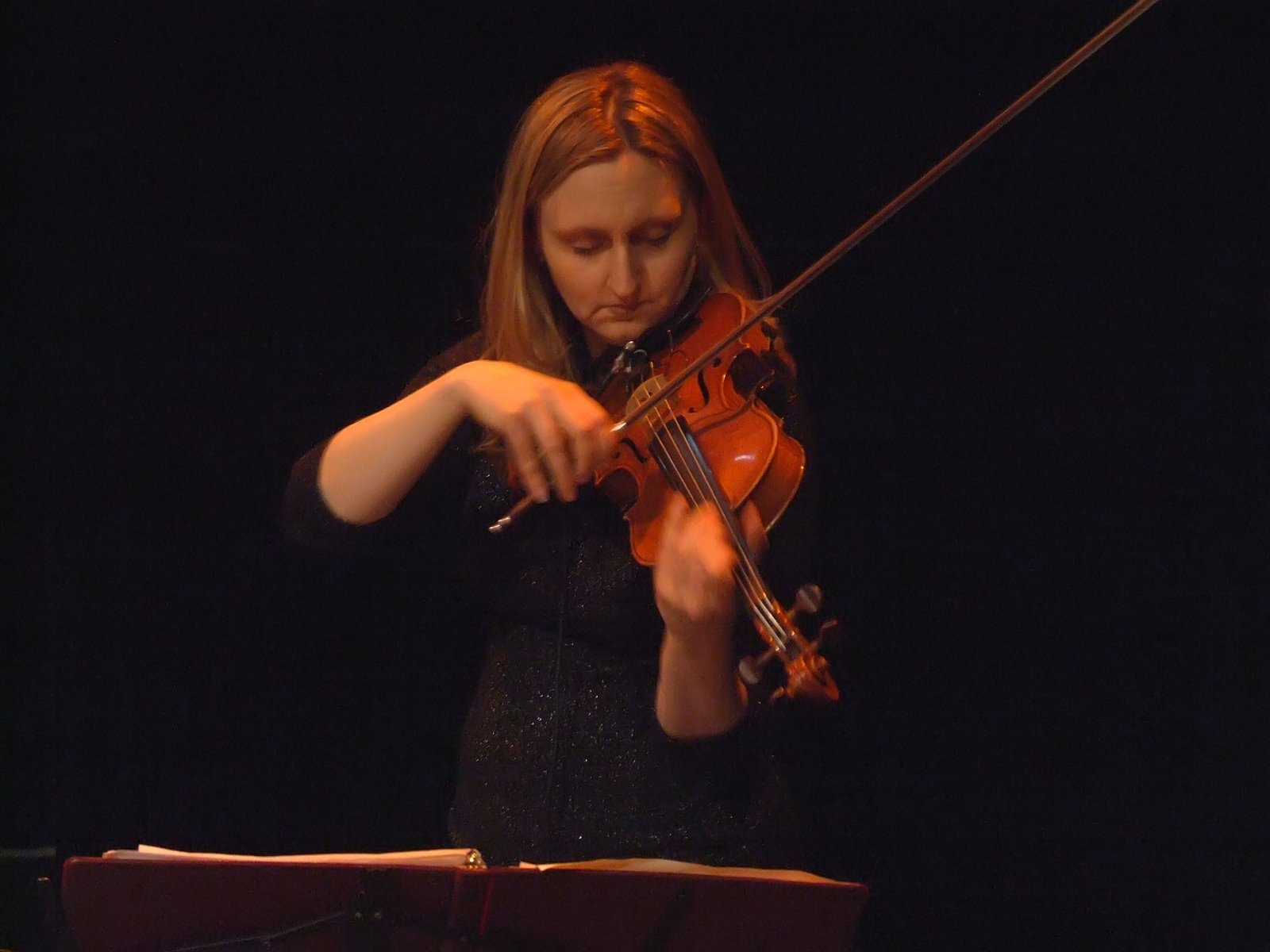
 As March comes to a close, I wanted to mention a couple of events involving the New York Women Composers organization. On February 14, the Light and Sound ensemble, a new trio formed by violinist Julianne Klopotic with Jennifer DeVore on cello and Elaine Kwon on piano performing on a regular basis at the wonderful Old Stone House in Brooklyn, a quaint historic residence where the wood paneling and floors provide great acoustics and a "fireplace", warm atmosphere, presented works by Margarita Zelenaia from Russia, Beth Anderson, Rain Worthington, Svjetlana Bukvich-Nichols from Bosnia, Judith Zaimont and myself. As March comes to a close, I wanted to mention a couple of events involving the New York Women Composers organization. On February 14, the Light and Sound ensemble, a new trio formed by violinist Julianne Klopotic with Jennifer DeVore on cello and Elaine Kwon on piano performing on a regular basis at the wonderful Old Stone House in Brooklyn, a quaint historic residence where the wood paneling and floors provide great acoustics and a "fireplace", warm atmosphere, presented works by Margarita Zelenaia from Russia, Beth Anderson, Rain Worthington, Svjetlana Bukvich-Nichols from Bosnia, Judith Zaimont and myself.
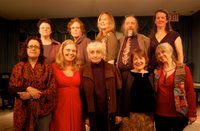 On March 25, at the Greenwich House, a program entitled Women's Work, curated by Beth Anderson and the New York Women Composers, was performed by Mimi Stern-Wolfe on piano, Andrew Bolotowsky on flute and Mary Hurlbut, soprano. It features pieces by Lucy F. Coolidge, Judith Sainte Croix, Sorrell Hays, Lenore Von Stein, Anne Tardos, Tamara Bliss and myself (for the living composers) as well as Tui St George Tucker and the interesting Cecile Chaminade, one of the few French female composers being rediscovered (1857-1944). The auditorium a Greenwich House Music School was packed. This location also boasts excellent acoustics. On March 25, at the Greenwich House, a program entitled Women's Work, curated by Beth Anderson and the New York Women Composers, was performed by Mimi Stern-Wolfe on piano, Andrew Bolotowsky on flute and Mary Hurlbut, soprano. It features pieces by Lucy F. Coolidge, Judith Sainte Croix, Sorrell Hays, Lenore Von Stein, Anne Tardos, Tamara Bliss and myself (for the living composers) as well as Tui St George Tucker and the interesting Cecile Chaminade, one of the few French female composers being rediscovered (1857-1944). The auditorium a Greenwich House Music School was packed. This location also boasts excellent acoustics.
I haven't seen much coverage of these well-organized and exciting events. It appears to me that the media have generally been somewhat reluctant to promote women in March this year... or maybe the whole idea of women's history month has lost its gloss - it is old news by now? I'll miss it. I used to think that women's events were reinforcing the ghettoization of women and therefore avoided them somewhat. I believed that women's music should be presented along with men's music without any discrimination based on gender, and that one should not have to go to a women's music event in order to hear music by women composers. Women still have to go a long way to be equally represented on the music scene. I once had an idea of a program entitled "Is there women's music" where pieces by men and women would be played and the audience would be invited to guess who wrote them. It would be an interesting expreriment. I don't believe that women's music is in essence different than music written by men: a composer, either female or male, has a developed a strong individuality through the "trenches" of the composing process.
posted by Elodie Lauten
7:16 AM
Saturday, March 21, 2009
Free Panel Discussion on The Two-Cents Opera Today
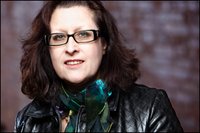
The panel discussion on The Two-Cents Opera will take place today, Saturday March 21 at 5PM - it's free...first day of Spring - to hear Kyle Gann, Yuko Nii (curator of the Williamsburg Art & Historical Center where my work will be shown in April 25-May 1st as part of the Women Forward exhibition that hosted Yoko Ono in March), violinist Julianne Klopotic and other performers of The Two-Cents Opera, at Theater for the New City (First Avenue between 9th and 10th St).
The Two-Cents Opera came about as a follow-up to the ideas outlined in a blog on sequenza21 from April 18, 2005: "Ten reasons to stop composing". I guess you could call that a very acute case of the glass ceiling. I felt that some of us were being suppressed especially women (I still do even now). In particular, people would deny me the liberty to call my work an opera. They would say, but it is not really an opera, because of this and that: "It's very nice but it's only a song cycle", with the now obvious subtext reading "as a good lady should write; ladies don't write operas they only write song cycles." whereas Philip Glass or Robert Asley whose work can be more unconventional than mine, were left at liberty to call their works operas. The Two-Cents Opera does not even intend to be an opera other than by name, it is a multimedia musical. Technically speaking however, I had been taught that a piece where everything is sung is an opera. Go figure.
Here are again the Ten Reasons to Stop Composing in short:
- too many composers exist
- people want music for free and I can't blame them
- too many limitations on artistic freedom within structures
- composing is a luxury we can no longer afford
- lack of encouragement is a euphemism
- too much emphasis on conventional methods and results
- making a great piece requires too much free time
- it really makes no difference one way or another
- being a woman does not make it any easier
To which I will add: in my experience, women composers are not as supportive of one another as one would assume; the competition is fierce.
Here is the link to revisit if you wish...
http://www.sequenza21.com/2005/04/ten-reasons-to-stop-composing.html
That's how I began wanting to write another opera, even though I struggled for a couple of years with issues of "no one wants another opera especially from me" but somehow felt a calling to do it. Then there was the long search for an adequate subject which turned out nothing. The only story I could relate to in a tangible and effective manner was the experience at hand, with its immediacy. This very same feeling is musically expressed in the introductory a cappella section of The Two-Cents Opera, The Desire and the Doubt.
I went through many different versions of the story. I recalled my childhood traumas and experiences with a score of therapists and psychoanalysts - which led to the Shrink Number 8 scene. However the piece is not just autobiographical. I combined some imaginary elements with the realistic elements - such as the characters of the Young Beethoven, and the Trickster who brought with him the playful element of dance.
Now four years later, I have not stopped composing - I just went multimedia with the writing and visuals in addition to the music. I guess that was one solution to the problem of composing - placing the activity in a different context - not classical music with its arcane commmissioning structure, but musical theater and art. I have many friends in the visual arts and I find that I am more comfortable with them than I am with many strictly classical musicians. I love crossover musicians that can go from opera to jazz to microtonality to heavy metal. And that requires a special personality as well. That's what I found in the band I put together for The Two-Cents Opera - Jonathan Hirschman on guitar, Bill Ruyle on drums, Steven Hall on bass guitar and Andrew Bolotowsky on flute (son of the well-know painter of the same name). That band experience alone can make up for a lot of things.
Also what tremendously helped remove the block is the acquisition of new recording equipment in 2007 which I used to compose and produce the piece in demo form at home with my vocals and electronics, gradually developing vocal and instrumental parts. And then, paradoxically, what helped even more was to lose my day job with the recession. The free time was immediately invested in the piece and The Two-Cents Opera was composed in less than two years which is record time for me. Other operas such as Waking in New York took twice as long when I was struggling to keep a job. And even if The Two-Cents Opera is some kind of a swan song, or alternatively if this leads to other work and there is life after it, it is at least the statement that I needed to make at this time.
posted by Elodie Lauten
10:58 AM
Friday, March 13, 2009
Putting in my two cents...
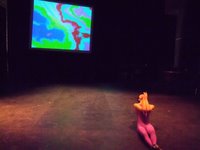
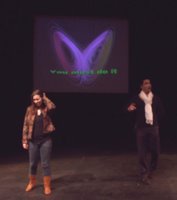
Well that's it, we're right in the middle of it - premiere was yesterday but nobody noticed... and is running Thursday through Saturday and even on Sunday afternoons... until the end of March. It's been great working at the Theater for the New City and I have some photos (photo credit: Joe Bly). You can more about The Two-Cents Opera on my web site using the link under the picture at left.

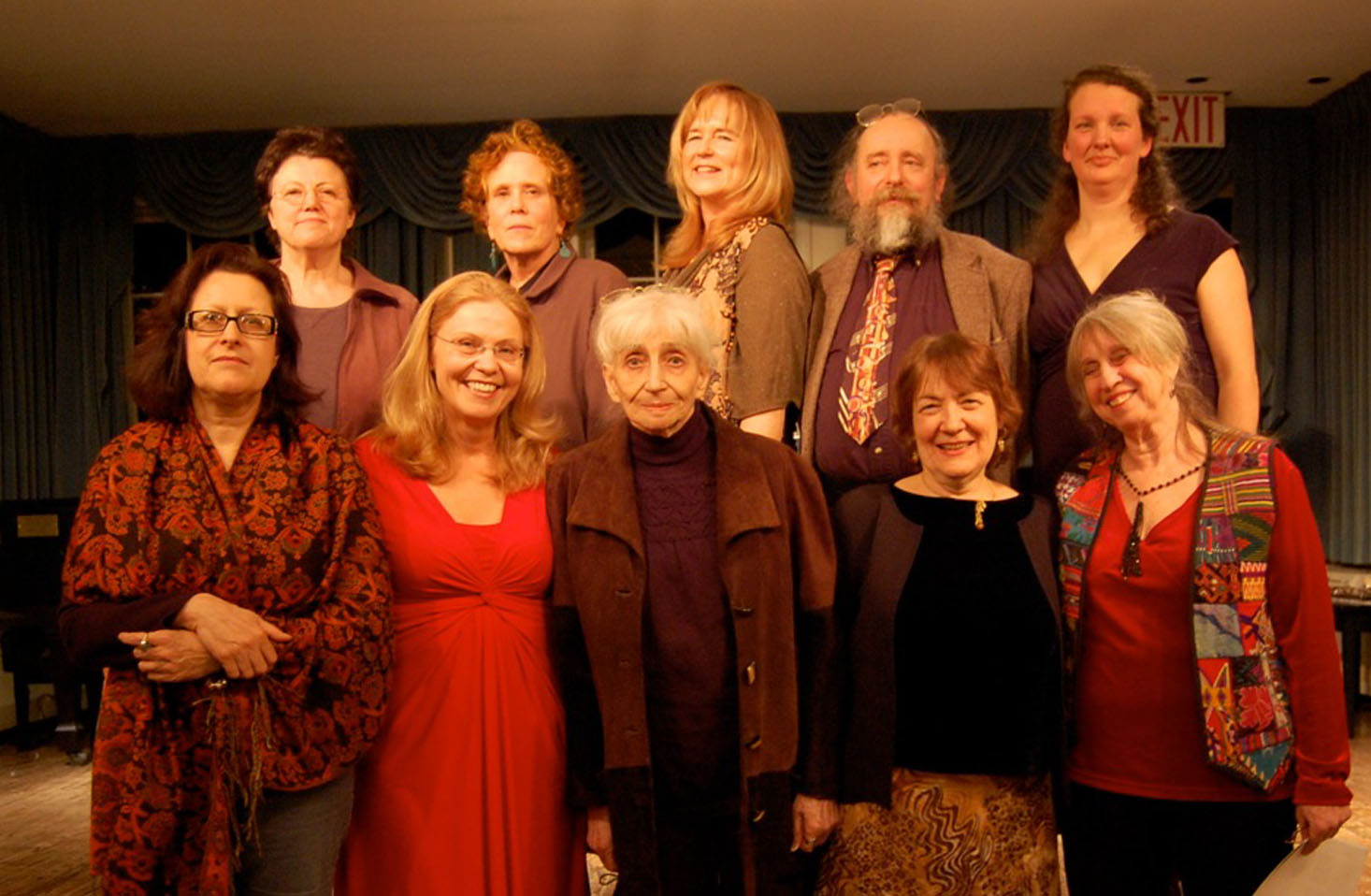
Left to right, back row, standing:
Gregg Lauterbach, Mary Hurlbut, Khoi Bao Le, Karmen Kluge, Ulysses Borgia, Jennifer Greene, and stage manager Carolyn Ratcliffe, and TNC's audio-visual technician Richard Reta and lighting designer Alex Bartenieff. Front row, sitting: Musicians: Bill Ruyle,drums; Andrew Bolotowsky,flute; Elodie Lauten, piano; Jonathan Hirschman, guitar; Steven Hall; bass guitar.
posted by Elodie Lauten
12:13 PM
Tuesday, February 24, 2009
Cool Machine
Why did I suddenly crave to hear once again the sounds of the band Soft Machine? I hadn't listened to that music since the early seventies. I was able to locate the album "Soft Machine Third" authored by Ratledge (keyboards), Wyatt (drums) and Hopper (bass) and as soon as I hit the play button it took off like a Marcel Proust "madeleine" (you know.... how in Remembrance of Things Past, the writer suddenly recalls the very mood of his childhood contained in the taste of a certain kind of cookie dipped in tea). In my case, it was not a taste but a sound: the beginning of the album, a textured architecture of minimalist patterns on the synthesizer, took me right back to the days when I heard the star-spangled banner played by Jim Hendrix at the Isle of Wight Festival – and mind you, it wasn't even that much fun as I remember suffering from the bitterly cold Atlantic summer night as well as lack of sleep as we were struggling with large sheets of brown paper as all-weather coverage. It may have been one of the most uncomfortable moments I have ever experienced, but comfort isn't everything. Soft Machine's trebly, melodic bass lines took me from the bold, early minimalism of the keyboard work through modal grooves and free form improvisations. Uniquely, this album blends three styles
I really enjoy: layered synch textures, modal jazz grooves and melodic songs – especially Wyatt's very own Moon in June. Much intensity and well-ahead-of-its-time inspiration in this forgotten 1970s album, found at last.
posted by Elodie Lauten
5:18 PM
Saturday, February 07, 2009
The Home Studio
Getting comfortable with a piece of gear is often key to composing. As long as I can remember, some new instrument or equipment has given rise to a new body of work. An upright piano, a Sequential Circuits Pro-One analog monophonic synthesizer and a primitive studio consisting of two identical Technics cassette decks I used to create loops led to the production of my first two albums, Piano Works and Concerto for Piano and Orchestral Memory.
At NYU the Fairlight CMI - despite its one-inch thick operation manual and "MCL" programming language - became my all-around beast of burden, as it could do all three "S"s: Sequence, Sample and Synthesize. My work with the Fairlight lead to completion of The Death of Don Juan, my first multimedia/electronic opera.
After NYU, I bought a MacPlus running Finale and at that point, unlike many others for whom the computerization of music notation was a hurdle, I began feeling much more comfortable with traditional notation once it was made available on the computer, and started relying on it instead of jazz charts and visual scores which I had been using. Later on, the MacPlus was replaced by a Mac Performa which I hooked up to a midi keyboard (an EMU Proteus); this led to the scoring of Variations on the Orange Cycle for solo piano, a long improvisational piece which I managed to score in midi without losing the initial spontaneity - a technical challenge if ever - the score is almost too accurate, which makes it rather difficult to read but if you are a good reader as was Lois Svard who interpreted it for the Lovely Music release, you can work with it. I also had a Dat machine which was necessary but somewhat unpredictable and a Fostex 4-track which I used along with the Proteus to create the basic tracks for the CD Tronik Involutions, my first nationally released product.
Then everything changed again. I switched to PC around the millennium because with the Intel chip it actually was faster than the Mac - now both Macs and PCs use Intel. I learned the basics of web production. I discovered Reason, a real breakthrough software: you could actually mix the midi tracks and take advantage of an entire library of virtual sounds and virtual synthesizers that could even go vintage. With this set-up I composed a one-act opera, Orfreo - I wrote the score in Finale and exported the midi files into Reason then mixed. A couple of years later, Finale improved its interface: it now comes with an excellent built-in sound library from Garritan; that was a time-saving shortcut for me and I used it to program a lot of sketches for orchestral and chamber music. It was also a very helpful tool in teaching composition to my students at NYU.
Still, I wanted a "real" recorder - I mean, separate from the computer, as recording can be such a drain on computer memory that it slows down the entire machine's performance, and if you're going to have to get many external drives for recording, then why not get a recorder that already has the gigabytes you need - and I found the Korg D888, an affordable 8-track digital recorder and mixer with the look and feel of an analog. It was not very hard to learn; I used it to record sketches for The Two-Cents Opera. I also use a Superscope CD recorder - a "no-brainer" machine that records at the push of a button, and I cannot beging to stress how helpful that is to me, the one-button machine, when I am improvising on the synthesizer, as I find that it blocks me creatively to have to "switch heads" between the performance and the recording when I engineer my own music.
As far as synthesizers, I am currently using KORG synths because of their tuning capabilities and sound quality as well as their smooth keyboard action. For speakers I use two sets: a couple of inexpensive Fostex powered speakers and small Bose computer speakers that I absolutely love. I also have an antique German upright from the 1920s, but I have to use a mute on it because my room is so small. My entire studio is located under a loft bed - I used to sleep in it but now I use it mostly for sound padding. For a microphone I found the Rode, which has this amazing noise reduction capability - it doesn't pick up much of the ambient noise, which makes the old-fashioned wall and window soundproofing moot. I still get a bit of a room hum but the wave editor in Nero 7 has this great "dehum" feature and the tracks come out practically clean.
I have to admit that new gear has always provided me with a welcome motivation to compose, but it is not the only motivation: hopefully, a higher calling presides of the creation of music to be shared with all, not for pride, not for money.
posted by Elodie Lauten
1:03 PM
| |