Simone Dinnerstein/Baroklyn: Hourglass (CD Review)
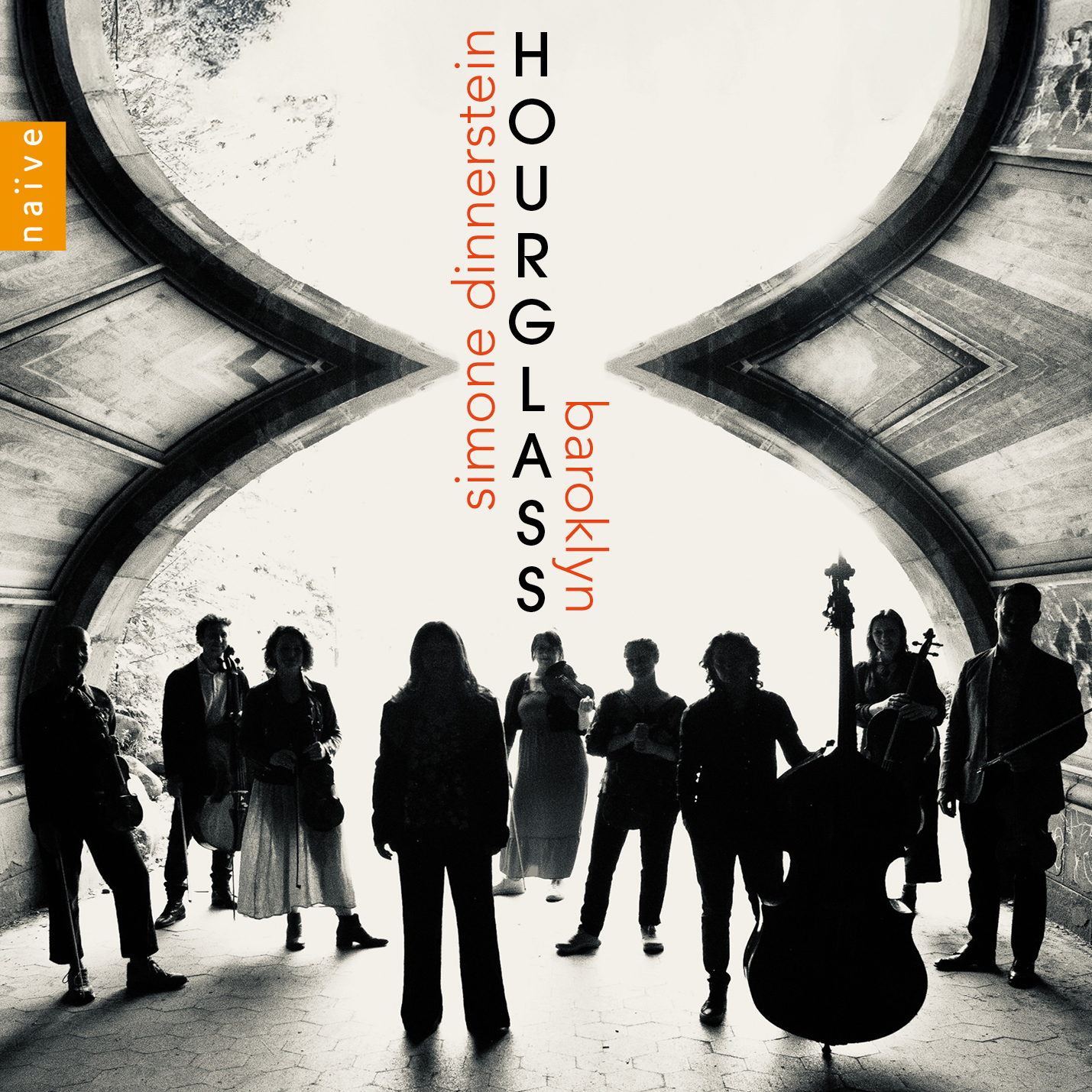
Although primarily known as a Bach interpreter, pianist Simone Dinnerstein and her string ensemble, Baroklyn, find a natural affinity for the music of Philip Glass, the subject of Hourglass, her first recording for the Naïve label. Yet affinity alone hardly explains the uncanny sense of inevitability that permeates these performances. What emerges instead is a meeting of imaginations preoccupied with the strange elasticity of passing moments and the hidden variations between them. In the album booklet, the ensemble’s leader observes that every repetition in Glass reacts to what preceded it while anticipating what follows. Nothing remains static. “We hear it as a constant becoming,” she writes, “not as a set of musical facts.”
That idea becomes the philosophical axis of the recording. More than a play on the composer’s surname, Hourglass evokes matter suspended within time’s narrowing chamber, each grain brushing against countless others on its descent. Dinnerstein approaches Glass not as a minimalist sculptor of patterns but as a composer of tides and gradual transformation. Her playing reveals an art founded on metamorphosis.
The Suite from “The Hours” (2002) opens the album in a state of exquisite unease. The source material already carries the weight of fractured interior lives, yet what emerges here reaches beyond narrative into something almost cosmological. Upper and lower strings move in subtle dislocations, circling one another like celestial bodies uncertain whether they approach union or catastrophe. Beneath them, the cellos sway with a dignified grief.
At the center of this emotional system burns no triumphant sun. Instead, one encounters the afterimage of a dying star, its radiance stretched thin across immeasurable distance. The musicians understand the necessity of restraint, receding whenever needed so that Dinnerstein’s piano may gather the evaporating particles left behind by the strings before they disappear into the surrounding dark. Every phrase feels suspended between touch and extinction.
What astonishes most is the music’s sense of disembodiment. It hovers just beyond ordinary consciousness, brushing against intuitions the intellect cannot fully stabilize. Glass is often reduced to discussions of process and structure, yet these performances uncover something deeply organic beneath the repetitions. Each figure develops its own ecology, its own gravitational field. Dinnerstein shapes the motifs as living terrains whose contours shift under changing light.
Time transforms recurrence into an altered emotional space. Every return carries traces of what came before. Meanings accumulate gradually, through accretion rather than declaration, until each phrase seems to open inward toward another hidden chamber.
A passage of fluttering trills briefly alters the atmosphere. Suddenly, there are birds suspended over immense fields, flashes of earthly tenderness interrupting the work’s abstraction. Yet even these remain touched by remoteness. The violins continue drawing the listener deeper into an immense interior cosmos where emotion belongs to matter itself.
Part II emerges from the husk of those earlier sorrows with newfound translucence. The strings unfold in slow waves, allowing the piano to float upon their surface as both reflection and witness. A faint harmonic shift changes the coloration of the entire landscape.
The transition into Part III possesses the delicate instability of waking from a dream whose images resist immediate translation. The piano searches through ascending gestures that feel at once anxious and ceremonial. Dinnerstein renders these moments with extraordinary sensitivity to weight and spacing. She never hurries revelation, allowing uncertainty to linger long enough to become attractive. And then, the melodies release us as gently as they first gathered us. One leaves the suite with the sensation of having crossed through several seasons in a single night.
The recording quality deserves particular praise. The keyboard exists both within the orchestra’s collective body and apart from it, intimate yet unreachable, a consciousness wandering among other consciousnesses. Harp and celesta enter with spectral luminosity, altering the chemistry of light itself.
From there, we enter the denser terrain of the Tirol Concerto for Piano and Orchestra (2000). Ostensibly Glass’s first piano concerto, the work balances inheritance and subversion, acknowledging a grand tradition while quietly hollowing out many of its assumptions.
From the opening’s shifting, sand-like textures, the listener is drawn into a landscape haunted by premonitions of Glass’s later Étude No. 13. The immense second movement forms the emotional core not only of the concerto but of the album itself. Spanning nearly 17 minutes, it unfolds with the patient majesty of something unconcerned with ordinary temporal measures. There is nothing exhibitionistic about its beauty. Few scores in Glass’s output achieve this degree of aching translucence, and the present recording approaches it with reverence unmarred by sentimentality.
Midway through the movement, ascending scales rise with almost unbearable clarity. Their motion suggests release while remaining tethered to gravity. Dinnerstein articulates these passages with crystalline poise, allowing every note to refract like sunlight entering deep water.
As the mood recedes into dissonance, the landscape changes once again. And by the time the final movement arrives with its dancing contours and coiling energies, joy has become inseparable from experience. Earlier shadows remain present within every gesture of exuberance. Yet Glass refuses the simplicity of triumph. Even heroism rests on the back of fragility. Such maturity gives the concerto its enduring power: resolution emerges not through conquest but through recognition that every forward motion leaves something behind.
Throughout Hourglass, Dinnerstein reveals herself not merely as an interpreter of Glass but as someone capable of exposing an underlying metaphysics. Too often, discussions of his music become trapped within debates over minimalism, repetition, accessibility, or influence. This recording bypasses those exhausted categories entirely. It restores mystery to music that many listeners assume they already understand.
The natural reaction to all this is not simply admiration for the performances, extraordinary as they are, but a heightened awareness of time’s strange interiority. Glass and Dinnerstein seem less interested in measuring duration than in revealing how the human soul inhabits it. The hourglass does not merely count passing grains. It transforms motion into memory.
Perhaps that is why this music lingers with such unsettling force. It reminds us that identity itself may consist of endlessly repeated patterns altered by the invisible pressures surrounding us. We return to familiar thoughts, believing them to be unchanged, only to discover they now contain the dreams of another life.
Hourglass is set for release on June 5.