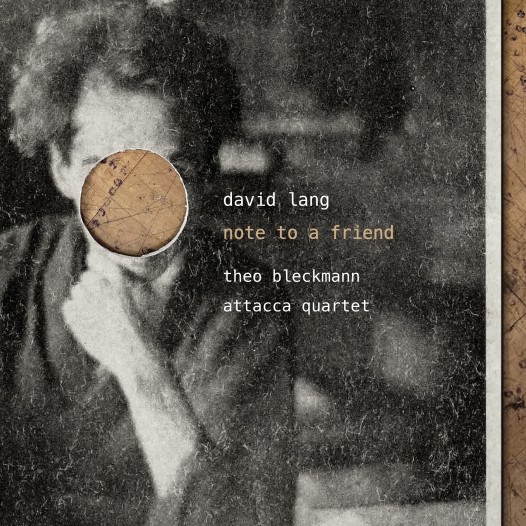
David Lang, note to a friend (Theo Bleckmann & Attacca Quartet) (Cantaloupe, CA21216)
(photo credit: Peter Serling)
TRIGGER WARNING: This review contains references to suicide and depression, which some readers may find distressing. Advice on suicide and mental health-related support can be found on the following websites: International Association of Suicide Prevention (IASP), World Health Organization (WHO), and Find a Helpline. Alternatively, text 988 or visit the National Suicide Prevention Lifeline’s chat to connect with a trained crisis counsellor.
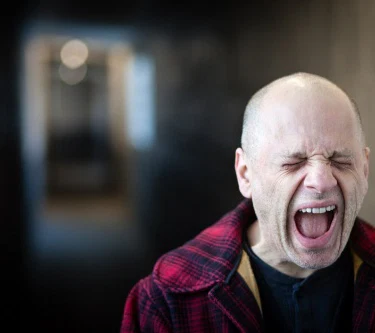
There’s a photograph of composer David Lang that in certain ways encapsulates his music. Occasionally popping up as a profile picture on various websites and streaming services, Lang is shown close-up, freeze-framed by a silent scream. Like the famous Edvard Munch painting that the photo appears to reference, Lang’s static scream is heightened and magnified, yet at the same time silenced by the visual medium in which it’s represented. We bear witness not so much to a suppressed cry as to one that’s erased and eradicated, its sonic source obliterated.
The Munch and Lang images differ in fundamental ways, however, which in turn offer further clues to the American composer’s creative approach. Whereas Munch’s cacophonous shriek is externalised—an expression projected outwards—Lang’s mute cry is internalised. One can really hear him not screaming.
His music exists in a similar state. We get journeys that travel across barren emotional landscapes and inhabit bleak terrains. Thoughts are endlessly worked over and obsessively analysed. Such themes lie under the surface of earlier Lang works, for example sweet air (1999), where a physical experience (an injection to numb the pain at a dental clinic) takes on cerebral form. However, in compositions such as death speaks and the loser, internal thoughts acquire more power, purpose, presence, and poignancy.
It’s as if Lang’s music has undergone a gradual purging process over time where it’s become leaner and leaner; a process described by Kate Molleson as one where layers of clutter are stripped back in search of “some nugget, some essence”.
This approach sets Lang somewhat apart from Bang on the Can stablemates Julia Wolfe and Michael Gordon, whose music (broadly speaking) tends to project outwards rather than inwards—whose subject matter highlights collective and group participation (or individuals’ roles within wider societal structures and frameworks) rather than forming parallels with Lang’s fragile, solipsistic sound world.
As a result, he has become almost by default the most minimal of post-minimal composers, whose aesthetic is predicated on the notion that incremental shifts in tone and nuance are equal to—or even possibly more important than—sharp juxtaposition, volume, weight, power, and force of numbers. It’s not by accident that Lang’s music is at its most effective in chamber contexts. Film directors have also been drawn to its subliminal qualities and subtle impact. Less is most definitely more in Lang’s case.
Commissioned by the Japan Society in New York and Tokyo Bunka Kaikan Centre, note to a friend is Lang’s silent scream writ large. Scored for baritone and string quartet, the hour-long monodrama was premiered at New York’s Prototype Festival in January 2023. Divided into nine numbers (or “scenes”), its subject matter draws on the writings of Ryūnosuke Akutagawa, one of the most important literary figures in Japanese culture during the early twentieth century.
Tragically, Akutagawa committed suicide in 1927 at the age of only thirty-five, having set out his reasons in a suicide letter later published as “A Note to a Certain Old Friend”, hence the opera’s title. The letter, along with other texts by Akutagawa, furnish Lang’s libretto.
Unlike suicide notes by well-known artistic figures such as Virginia Woolf and Vincent van Gogh—whose message is directed towards a recipient or addressee—Akutagawa’s letter evinces a sequence of internal thought processes from which one is led to conclude that there can only be one outcome. Beginning with the bold statement, “people who kill themselves don’t usually tell you what they think about killing themselves”, Akutagawa’s thoughts and words grapple with the ungraspable: they attempt to make sense of the nonsensical.
Mixing autobiography, reflection, guilt, introspection, analysis, and self-realization, Lang’s operatic character (called “the dead man”) probes into the tangled and troubled interstices of Akutagawa’s tormented mind. It’s as if we’re guided through the various stages of suicide in the opera—a stark psychological journey moving from pain and hopelessness to ideation and volition, planning, preparation, and ultimately death.
After a modal, plangent, and hymnlike “prelude”, the first “aria” (“people who kill themselves”) presents a haunting three-note melody that becomes entangled in a clutch of claustrophobic minor thirds. In a change of mood, the first of several aggressive outbursts slice through the bleak atmosphere as the dead man states that “I am not like them”. These interjections are accompanied by stabbing rhythms and sharp silences as he admits being haunted by thoughts of death for many years.
More narrative dimensions support the opera’s middle sections, where the bare bones of the dead man’s sorrowful tale are fleshed out in a series of autobiographical reflections. We hear about his mother’s descent into insanity and death (“my mother had lost her mind”). The dead man becomes plagued by the spectre of his sister’s untimely death (which occurred before he was even born), prompting fears of “some phantom woman watching over me”. After a chorale-like instrumental interlude (“amen”), the man experiences a sense of emotional detachment and distance while witnessing his father’s slow and ineluctable death.
The music’s compulsive repetitions merely serve to heighten the death drive trajectory that drags the dead man’s story towards its inevitable conclusion. A fragmentary folk melody in “my mother, my sister, my father” magnifies his troubled thoughts. Caught in a ruminative loop during the ticking-clock-like patterns in “I wanted to die”, a final visceral outburst to the words “what we think of as our life force is just our animal nature, our animal power” evaporates into silence. A brief reprise of the chorale-like “amen” section in the “long silence” ends with a single note hanging briefly in the air before life is snatched away.
Aided by Theo Bleckmann’s beautifully restrained and quietly conversational vocal delivery and Attacca Quartet’s subtly measured and perfectly weighted support, note to a friend inhabits a liminal space between life and death where, as Katelyn Simone has observed, “the border between us and the dead is more porous”. Anguished outbursts sometimes rise to the music’s surface with a shuddering jolt, offering temporary release, but ultimately there’s no escape from death’s clutches.
And perhaps therein lies a final clue to Lang’s music. Its power lies in its ability to present itself through the thoughts and ideas of other characters in such a way as to make us believe that they are, in fact, speaking. As Lang has stated, every piece presents an opportunity for the composer to reexamine himself. Perhaps it’s a mask that Lang wears to hide his silent scream. But these fragile studies in self-examination ultimately open the door to a whole bunch of truths about humanity, which we can all relate to, identify with, learn from, share, and understand.