Philip Glass, ‘Strung Out’ (OMM 0167)
Alongside Steve Reich’s Violin Phase (1967), Philip Glass’ Strung Out (1968) ranks as early minimalism’s most important work for solo violin. However, unlike Violin Phase—which has received countless performances and several recordings during its nearly sixty-year shelf life—Strung Out has largely gone unnoticed. This twenty-minute work has remained something of an outlier, consigned to the periphery of Glass’ back catalogue. Even when I’ve discussed Strung Out with violinists who frequently perform Glass, several have admitted to not knowing about it.
This definitive new release by gifted and versatile violinist Darragh Morgan will surely dispel any lingering doubts about the significance of this piece. It may not be Glass’ most important statement, but it certainly holds a special place in the composer’s early development.
Whereas Violin Phase’s canonical status was secured early on through its inclusion on Reich’s 1968 Columbia Masterworks Live/Electric album, with Paul Zukofsky playing, eight years elapsed before Strung Out was finally released on vinyl. Zukofsky was again the catalyst, with the disc appearing on the violinist’s own CP2 label, which also included music by Scelsi and Xenakis: an unlikely musical ménage à trois, one might say.
Still, Strung Out continued to languish in relative obscurity until Glass’ own label Orange Mountain Music issued an archival recording of the work’s first performance at the Filmmaker’s Cinematheque, New York, on 19 May 1968, featuring violinist Dorothy Pixley-Rothchild.
Despite their many attributes, neither the Pixley-Rothchild nor Zukofsky recordings do entire justice to Strung Out. Given the former’s context—a live account of a new work in a bold and innovative style that would have surely been challenging to both the musician playing it and audience listening—Pixley-Rothchild’s performance is extraordinary on several levels: not least the dogged, unwavering conviction of her interpretation. However, it does suffer from occasional lapses, becoming more uncontrolled as it goes along due to the violinist’s propensity to accelerate through the music’s gradual changes. The audio quality (inevitably, this being 1968) is not great, either.
Zukofsky’s accurately executed, more relaxed approach clearly benefits from the advantages that come with a studio recording. Nevertheless, the sound quality is not aided by a rather woolly and compressed mix, resulting in a violin timbre that sounds strangely synthetic and disembodied. Zukofsky’s more cautious approach to tempo (closer to crotchet = 120 than Glass’s metronome indication of crotchet = 144) results in a performance that clocks in at over twenty-one minutes; this compared to Pixley-Rothchild’s concise eighteen minutes. Zukofsky’s playing is nevertheless fluid, even graceful, when executing the steady flow of eighth notes throughout. His interpretation of the material is very literal and almost expressionless, however. Perhaps Zukofsky took Glass’s tempo indication (‘mechanically’) a little too literally…
Strung Out itself is divided into two large repeating sections, each lasting around nine minutes, with the second section ending differently to the first, on a rising three-note C-D-E figure. One might call these two sections A1 and A2.
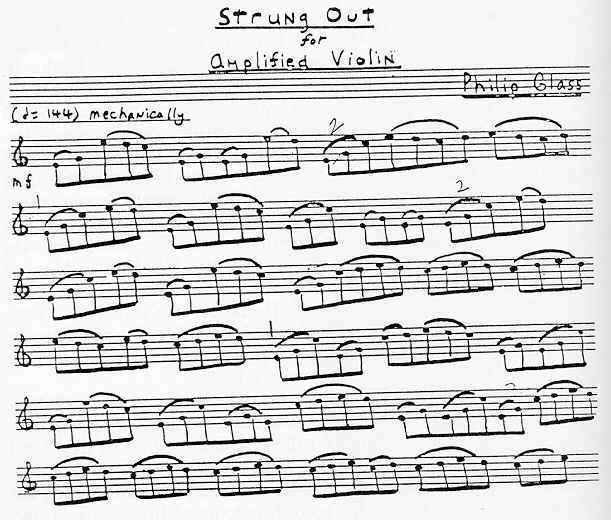
The piece starts with a distinctive 2+3 question-and-answer-type pattern, comprising a rising minor third E to G leap (question) followed by a falling three-note E-D-C pattern (answer), outlining a major third (see the image from the opening page of the score, reproduced above). Stated in this way, this five-note figure articulates an intervallic gap of a perfect fourth between its two constituent parts, which the piece ingeniously proceeds to ‘fill in’ somewhat in the manner of Leonard B. Meyer’s Implication-Realisation model.
Glass reshapes and extends these patterns, gradually increasing the piece’s sonic ambitus by incorporating additional pitches. By the time we get to the last two pages of the score (pages 7–8), this additive approach has generated a series of nine-note rising and falling patterns. Glass also imparts variety by constantly varying the grouping patterns for each modal module. For example, the opening 2+3 unit is transformed into 2+2+2, 3+4, 4, 3+2, 2+3, 3, 2+2, and so on. These subtle transformations mean that it’s difficult to second-guess what’s coming next.
While the opening is centred around C-Ionian, the piece’s direction soon moves towards A-Aeolian. This modal shift to aeolian is further emphasized by what might be called a ‘hiccupping’ short-short-long rhythm, first heard on page 3 of the score. This hiccupping figure comes as a surprise because it signifies the first break in the piece’s continuous melodic flow.
Normal service is resumed with the reintroduction of flowing lines (on pages 4 and 5 of the score), their general motion now directed downwards from Aeolian-A to Phrygian-F and eventually to Dorian-D, wherein a very similar pattern to the earlier rhythmic ‘hiccupping’ statement is heard. This acts as a cue for an upwards-moving trajectory towards tonic C (on pages 7-8), bringing with it the entire pitch set gradually introduced up to that point. Therefore, the return of the opening figure towards the end of A1 serves to connect it to the beginning of A2.
I explain this partly as context for Morgan’s performance, which manages to bring out all these elements—part and whole, micro and macro—making Strung Out function as an entirely complete and effective musical entity. This has only been partly achieved on previous recordings. Morgan takes the opening tempo at precisely crotchet = 144, and by adding a little weight to the low E-G dyad at the beginning, he creates the impression of an unfolding two-part texture between two interlocking lines, melody and countermelody. It’s a Bachian touch that works so well. The violinist also imparts more shape to these expanding and contracting lines, fastidiously observing Glass’s precise legato markings, resulting in a sonic stream that inhales and exhales—ebbs and flows—with captivating clarity and transparency.
During the two ‘hiccupping’ passages which appear in the middle portions of both parts, Morgan adds a little more snap and elasticity to the short rhythms, aided by carefully balanced and weighted bow movement. Furthermore, Morgan ever-so-slightly increases the tempo towards the ends of both sections, giving the music an added sense of purpose and momentum. The ending is thus perfectly placed.
When I interviewed saxophonist John Harle about performing minimalist repertoire several years ago for the Ashgate Research Companion to Minimalist and Postminimalist Music (Routledge, 2013), he rather unexpectedly referenced sixteenth-century Italian courtier and aesthete Baldessare Castiglione’s concept of Grazia (meaning ‘grace’ and ‘elegance’), wherein two key elements—decoro (musical technique and ability) and sprezzatura (a kind of improvisational flow)—appear in harmonious coexistence.
Attaining grazia is a rare and difficult thing, but Morgan achieves it here. His performance also manages to project the kind of ‘plateau of sound’ for which the violinist’s interpretations of minimalist repertoire have become renowned. The balance between what Morgan described in a recent article in Strad online as ‘restraint, and a vibrant, focused and clear quality of string tone’ is maintained throughout. It seems that, almost sixty years since its composition, Glass’ mini masterpiece has finally received its definitive statement, one worthy of Strung Out’s rightful place in the pantheon of minimalist works.