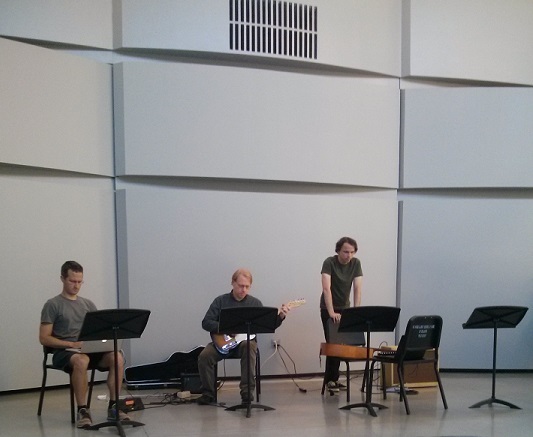
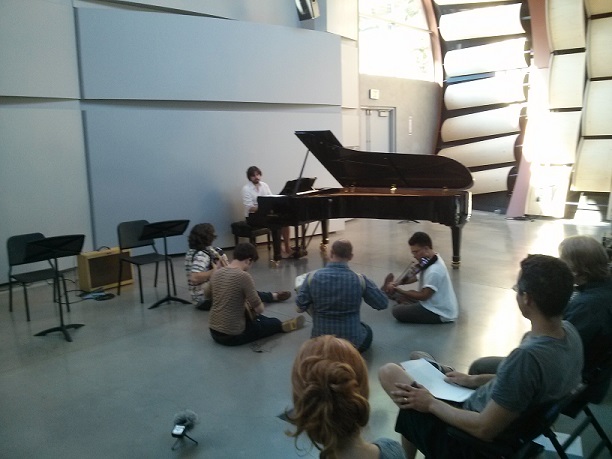
Fred Ho, Fanfare for the Creeping Meatball: This brief yet buoyant brass fanfare got played at the beginning of every FCM concert. But its jazz noir ambience, jocular rhythms, and even its campy “B-movie scream” (which, on Sunday night, caused unsuspecting Tanglewood fellows assembling onstage to leap out of their seats!) never wore out their welcome. New music gatherings tend to take on a somber demeanor and earnest programming needs to be leavened with a bit of humor. Ho’s piece fit the bill perfectly.
________
Milton Babbitt, It Takes Twelve to Tango and No Longer Very Clear: During the Festival of Contemporary Music, Tanglewood celebrated recently deceased composer Milton Babbitt (1916-2011) with several performances in his honor. Alas, we arrived too late in the week to get to hear Fred Sherry’s rendition of the late cello composition More Melismata. But judging by Babbitt memorials earlier in 2011 at which Sherry has shared the work, we would have gladly heard it again.
It TakesTwelve to Tango (1984) was Babbitt’s contribution to Yvar Mikhashof’s tango collection. Pianist Ursula Oppens included it on her FCM solo recital on August 7th. The piece is more explicitly referential of a regular dance rhythm than is Babbitt’s usual wont; even more so than the veiled references to swing era jazz that sporadically occur throughout his catalog. Still, the piece provides plenty of twists and turns that upend the usual tango form in favor of bustling counterpoint and playful misdirection. And yes, true to the punning title’s promise, Babbitt doesn’t dispense with dodecaphony, allowing his rigorous approach to commingle with a bit of witty humor in this occasional work.
At the morning concert on Sunday, August 7th, Soprano Adrienne Pardee and a small ensemble led by conductor Stefan Asbury performed Babbitt’s No Longer Very Clear (1994), a setting of a poem by John Ashbery. This piece isn’t heard as much as some of Babbitt’s other vocal pieces: a pity, as it a thoughtful and nuanced treatment of an intriguing poem, with shimmering instrumental textures and a delicately spun vocal line. Pardee, a TCM fellow, demonstrated a lovely tone, impressive control, and rapt attention to the score’s myriad details: wide-ranging dynamics, tricky rhythms, varied articulations, and abundant chromaticism. Both she and the instrumentalists did so well that Asbury, remarking that it was, after all, a short piece, asked them to repeat it; which they did, making the work’s charms even more abundantly clear.
David Fulmer plays his Violin Concerto at FCM. Photo: Hilary Scott
David Fulmer, Violin Concerto: Written in 2010, Fulmer’s chamber concerto revels in complexity. Those who have heard his performances of the music of Brian Ferneyhough or that of his teacher Milton Babbitt, which sizzle with hyper-virtuosic playing, can readily understand such predilections. Fulmer’s performance as soloist on the Sunday morning FCM concert (on 8/7) was imbued with similar intensity.
Compositionally, it’s an abundantly promising work: but it isn’t perfect. Occasionally, one feels that a bit of crowd control might be brought to bear on the thickly scored busyness of the orchestration, to better clarify the angular counterpoint that propels the proceedings. Also, the inclusion of three keyboard instruments for one player – piano, harpsichord, and celesta – (without terribly extended parts for either of the latter two) seems an impractical choice that may limit the number of ensembles who will mount the piece. That said, Fulmer’s compositional language and performance demeanor exemplify an edginess and gutsiness notably in short supply among many of his contemporaries in the emerging composer realm.
Marie Tachouet plays the solo part in Felder's Inner Sky. Photo: Hilary Scott
David Felder, Inner Sky: Tanglewood is blessed with excellent student performers. And while there were a number of fellows who distinguished themselves on the festival, the standout for me was flutist Marie Tachouet. A member of the New Fromm Players, Tanglewood’s SEAL Team Six equivalent for contemporary music, Tachouet played on several FCM concerts. But she took her solo turn on its finale, an orchestra concert held in the evening on Sunday, August 7th.
The flutist was featured in David Felder’s Inner Sky. Composed in 1994 and substantially revised in ’99, this piece requires the soloist to perform on four flutes: piccolo, concert, alto, and bass flute. The trajectory of the piece is charted by the move from high to low flutes, which is registrally mimicked by a supporting quadraphonic electronics part that features both distressed flute samples and synthetic sounds. An “analog” surround effect is also created by an even distribution of strings and percussion across the stage.
Inner Sky is an immersive listening experience. It’s also a highly sophisticated colloquy between soloist, ensemble, and electronics; one that achieves a carefully choreographed balance of elements, both acoustic and musical: a balance that is all too rarely found in works for orchestra plus electronics. It certainly helped to have Tachouet’s sensitive performance and Robert Treviño’s fine direction of the Tanglewood Music Center Orchestra.
Later this year, Inner Sky sees release in both stereophonic and surround-sound formats. I’m looking forward to checking it out again (hopefully in both versions!).
Those who’ve read File Under ? for a while may know that, two years ago, my wife and I went on our honeymoon to Tanglewood. We celebrated our first anniversary at the 2010 FCM (composers take note: if your prospective partner doesn’t mind taking in a contemporary music marathon as part of your honeymoon, he/she is a keeper!) Due to work obligations, Kay and I weren’t able to attend the first three days of the 2011 Festival of Contemporary Music. Those who’d like to read excellent coverage of the beginning of the festival should head on over to New Music Box for Matthew Guerrieri’sreview. But we did make it up to Lenox, MA for the final two days of the festival. And our short weekend was action packed; we heard five concerts and saw a play (a rather uneven performance of Romeo and Juliet by Shakespeare and Company).
Kay at Shakespeare and Company.
Pierre Jalbert, Music of Air and Fire: The Boston Symphony often does a contemporary work on one of its concerts during the week of FCM as a nod to the festival. This year, it was Pierre Jalbert’s Music of Air and Fire (2007), which the orchestra, lead by BSO assistant conductor Sean Newhouse, performed at the Shed on August 6.
Jalbert was a Tanglewood fellow back in the 1990s. A professor at Rice University, he’s now in demand as a composer, both of works for large orchestra and for smaller forces, as this month’s NMB profile attests.
This six minute overture was premiered by the California Symphony; it is Jalbert’s first piece on a BSO program. Music of Fire and Air is a lively and well-paced curtain-raiser, with deft writing for percussion and vivid neo-tonal harmonies from strings and winds. Apart from a small excerpt available for streaming on Jalbert’s website, it is as yet unrecorded. Given the bang-up job the BSO did with the piece, dare we hope they’ll commit it to disc sometime soon?
Karchin leads TMC Fellows. Photo Hilary Scott
Louis Karchin, Chamber Symphony: Karchin’s Chamber Symphony (2009) was the closer of FCM’s 10 AM concert on August 7 (one of three given in Ozawa Hall on the festival’s final day). Cast in three movements, its features limpid, flowing francophilic lines, daubed with tart counterpoint, as well brilliantly colorful verticals and bold Straussian horn calls. Despite leading an ensemble comprised primarily of student performers (albeit very talented student performers), Karchin’s conducting elicited a bright and assured rendition that rivaled its premiere by pros that I heard back in 2010. FCM should invite Karchin to return, both to hear his own works performed and to work with the students on contemporary repertoire.
My review of the League of Composers/ISCM concert at Miller Theatre can be found here.
League of Composers/ISCM Orchestra. Credit: Ron Gordon
My review of Talea/Linea at Lincoln Center can be found here.
And yes, these are available only to Musical America subscribers. But, it’s a terrific publication and they even let you try a free two-week trial to kick the tires.
A propos of the paid subscription model, the last quarterly issue of Signal to Noise Magazine has just hit the newsstands. It’s got two articles in it by yours truly, including a feature on Australian composer Andrew Ford and a review of Alex Ross’ Listen to This (I’ve also contributed several recording reviews).
I’ve been writing for Signal to Noise since 2002, and it’s hard to see it, like so many other print outlets, being forced by current economic circumstances to downsize . Its stalwart publisher/editor-in-chief Pete Gershon hopes to keep StN going as an annual, “yearbook” style publication. But the success of that venture will depend on support from labels (in the form of review materials), advertisers (in the form of … ads), and, yes, the support of readers like you. Want experimental music to still have a voice in print in the US? Then get thee to the newsstand and enjoy an issue of StN.
Last month, I interviewed Ryuichi Sakamoto for an article that will appear in the next issue of Signal to Noise. On October 18, 2010, I got a chance to hear Sakamoto perform live at the Skirball Center for the Performing Arts at NewYork University. It was the second show in a two month long U.S. concert tour promoting his new US release Playing the Piano/Out of Noise.
In recent years, many entertainers have become more outspoken about the consequences of their jet-setting ways. True, the environmental impact of concert tours, concerns about climate change, and, in turn, advocacy for human rights and fair trade are often associated with big-name pop acts: Bono, Sting, and David Byrne. But it isn’t only artists at the top of the charts who are trying to change their business practices. Sakamoto has become a forthright advocate for these causes as well. His touring schedule is crafted with climate impact in mind. A carbon offset is made to counteract the carbon dioxide emissions from the US tour.
The offset isn’t the only concession made on the tour. During the concert, several pieces are accompanied by projections or incorporate spoken-word recordings. Some of the visuals are abstract art projections – kind of benevolent large-scale screen-savers. But others encourage engagement on particular topics. These invariably reference social issues important to Sakamoto, and range from discussions of the melting of the polar ice caps by Greenland official Karen Filskov to principles for engaging in reconciliation by the Dalai Lama. Still, if rendering opinions on social issues from the concert stage has become a not-uncommon practice, one certainly prefers this kind of subtle insertion of the topic to the polemical speeches some artists make between songs. And there’s an organic component to their presence onstage. Sakamoto incorporates these ideas into his compositions themselves as well: often in a singular and evocative fashion.
One of the most overt examples of this is the piece “Glacier.” The composition appears on Out of Noise and is featured as the opener on many of Sakamoto’s concerts. It incorporates excerpts of field recordings that Sakamoto made while on a trip to Greenland featuring sounds collected while he visited several rapidly melting glaciers. The sounds he recorded are haunting, alternately brittle and percussive shards of cracking ice as well as the flowing sounds of water and howls from biting winds.
Sakamoto’s response to the sounds of Greenland’s glaciers is to play his instrument in an unconventional fashion. He plays inside the piano, using his fingers to elicit scratches, thumps, and plucked strings. Ample amplification and reverb add a cavernous echo to these extended sonorities. When listening to the recording, “Glacier” certainly makes an impression. But seeing Sakamoto play the piece live really brings its message home.
The concert starts in darkness, with glitch electronica and field recordings emanating from onstage speakers, creating an eerie ambience. Sakamoto takes the stage, standing beside one of the two grand pianos that adorn it, illumined by icy projections playing from a screen behind him and a small light on the piano. Playing inside the piano in this dimly lit setting, he is visually accompanied by projected titles that translate a calmly spoken but clearly urgent narrative about the impact of climate change on Greenland’s fragile ecosystem and on the fisherman who eke out a precarious living in the region: a vanishing way of life.
The music could scarcely be further from the public’s perception of Sakamoto, which is guided by Neo Geo fusion pop and hummable film score themes. Doubtless some of the sold-out crowd is taken aback, but they are very responsive to “Glacier:” to both its message and its music.
Glacier, like other socially engaged pieces on the program, manages to communicate without ever overreaching or seeming preachy. Just as Sakamoto is known for restraint and balance in his compositions, his approach to activism is similar in approach: gentle yet potent.
During the concert, Sakamoto presents several other pieces from Out of Noise. If one wonders why the pianist has two grand pianos onstage, the answer is supplied by the evening’s second selection: a new piece called “Hibari.” For “Hibari,” Sakamoto plays one grand piano, while the opposing MIDI grand creates a virtual duet, echoing back some of the music he’s already performed. It’s great fun to watch the keys move seemingly of their own accord, like a player piano. It’s even more fun to listen to the accumulation of repeating layers, over which Sakamoto continues to weave successively more intricate harmonic clusters and diaphanous lines. The overall effect is simultaneously minimalist and post-Impressionist. It’s as if Steve Reich and Oliver Messiaen were given “mash-up” treatment, with a little bit of the score for Silk thrown in for good measure! “In the Red” takes on a more avant-ambient space. The second piano remains silent, but Sakamoto is “accompanied” here by glitch guitar samples supplied by Cornelius and Christian Fennesz.
While there’s plenty of new material on the NY concert, Sakamoto also gives the audience an ample share of older songs. He even reaches back into his Yellow Magic Orchestra catalog, playing an instrumental version of 1979’s “Behind the Mask,” one of the hits from the group’s second album Solid State Survivor. He leaves the original’s vocoder at home, but the lyrics are displayed on the projection screen. This “music minus one” endeavor leaves more room for Sakamoto to craft an elaborately syncopated accompaniment; and the scrolling lyrics encourage more than a few audience members to take their cue to indulge in a little “concert karaoke.”
Spontaneous audience participation and multiple encores featuring Sakamoto’s biggest hits close out the show. But as soon as the houselights go up, we hear a recording of more glitch electronica from Out of Noise; bringing the evening full circle. And so it is with Sakamoto, who’s eager to present his latest creative endeavors, even to his oldest fans. Unlike some ‘dinosaurs of rock’ tours, where the audience grumbles when the concerts contain too many “songs from the new album,” few at NYU seem to mind – the queue for autographs is so long that it extends further than the line for the exits.
My tweet right after the concert on Thursday: “Magnus Lindberg’s Kraft: some very beautiful passages + intriguing spatial effects amidst a joyously chaotic maelstrom of sound.”
It’s a fascinating piece and a gutsy one for the New York Philharmonic to present. I do question the wisdom of programming it alongside Joshua Bell playing the Sibelius Violin Concerto. It threw some of the more conservative ticket-holders a curveball, as they had no idea (unless they’re checked out the promo videos on YouTube) what the Lindberg had in store for them.
There were far more than the “handful” of walkouts Anthony Tommasini noted in his otherwise superlative review in the New York Times. From where we were sitting in the Third Tier of Fisher Hall, we had a birds-eye view of a steady exodus of disgruntled patrons: perhaps 10-15%.
On Friday, I talked about the walkout phenomena with my analytical studies class. One issue we discussed was the notion that many orchestras seem to have of “one audience” vs. the possible lifesaving way forward of cultivating “many audiences.” The former notion seems pretty entrenched at the Phil. I’m glad to see that Alan Gilbert and some of the folks in the press office are exploring ways to curate and cultivate multiple kinds of music-making at the NYPO and leverage social media to find new audience sources. Last year, Ligeti’s Le Grand Macabre was a terrific example of that.
But Thursday’s concert seemed to me to be a holdover of the former way of thinking. Get people to come to hear Joshua Bell, and then have the conductor give a lecture explaining why they should like a loud piece with oxygen tanks and multiple gongs in the midst of the audience. I don’t entirely blame the folks who stormed out for being upset, although I do wish they’d taken the hint and left after the concerto if they weren’t up for an adventure.
Still, for those who stayed, it was quite an adventure. Here’s Lindberg discussing the piece.
How often does a promo video (and indeed, program booklet) from the NY Philharmonic namecheck experimental industrial postpunk collective Einstürzende Neubauten? This is perhaps the first time! But one can really see the connections between the group’s aesthetic and Magnus Lindberg’s Kraft in the videos below: check out their percussion setup!
There’s one more performance of Kraft on Tuesday. If you’re in New York, I heartily recommend checking it out!
Three Concerts in One Day! Twelve pieces, including two one-act operas: 6 1/2 hours of music.
Here’s what we heard:
10 AM
Fantasia for String Trio …Irving Fine
Ten Miniatures for Solo Piano … Helen Grime
Circles … Luciano Berio
Piece pour piano et quatuor de cordes … Oliver Messiaen
Since Brass, nor Stone … Alexander Goehr
Design School … Michael Gandolfi
_____________________________________
2:30 PM (BSO in the Shed)
An American in Paris … George Gershwin
Seven Studies on Themes of Paul Klee … Gunther Schuller
Prelude, Fugue, and Riffs … Leonard Bernstein
Piano Concerto in F … George Gershwin
______________________________________________
8 PM Two one-act operas
Full Moon in March … John Harbison
Where the Wild Things Are … Oliver Knussen
Christian’s Top Three
Knussen – a momentous experience to hear this piece live!
Fine – Beautiful performance. Makes me want to know his work better.
Schuller – His best piece: hands down.
Kay’s Top Three
Knussen – I loved how he evoked the different locations & moods — and the barbershop quartet near the end!
Gershwin – An American in Paris – It transports me to Paris every time I hear it. It was stunning to hear it played so beautifully by the BSO (in terrific seats!)
Messiaen – Unexpected sound qualities from the instruments – hearing a piano quintet played in such an exciting, colorful, and fresh way.
We both also enjoyed Helen Grime’s music a great deal. She’s a special talent – keep an eye out for her!
Just about the best thing I’ve heard thus far at the 2010 Tanglewood Festival of Contemporary Music is a performance of Roger Sessions’ relatively late (1975) Five Pieces for Piano by Tanglewood Fellow Alexander Bernstein.
While his From My Diary, an earlier non-dodecaphonic group for solo piano, is programmed more frequently, Five Pieces is some of Sessions’ best piano writing. Dedicated to the then recently deceased composer Luigi Dallapiccola, they are dazzling works that combine harmonic rigor and abundant virtuosity with an unerring sense of pacing. While Sessions is frequently described as having a somewhat vinegary palette, these pieces contain some considerably lush verticals. They don’t linger in this energetically modernist work, but these sumptuous glancing blows help to make the piece one of my favorites in Sessions’ catalogue.
The impression that Bernstein made is far more than a glancing blow. He played these pieces with such assurance and musicality that the audience could scarcely contain themselves. What was programmed as the ‘progenitor’s piece’ on a concert of later modernists, an appetizer to a hearty main course of Babbitt, Wuorinen, and Foss, was anything but an amuse-bouche. It received a number of curtain calls and a hearty share of hoots and hollers (happily, the students here are enthusiastic supporters of one another!). If this is what Bernstein can do now with Sessions, I can’t wait to hear his Babbitt, Carter, and Boulez in a few years. Scratch that: now please!
Knussen conducts Maderna. Photo credit: Hilary Scott
The 2010 Festival of Contemporary Music at Tanglewood has moved away from its recent model of having a solo curator conceive the festival. Instead, the curatorial duties are shared by three of its longtime faculty members: Gunther Schuller, Oliver Knussen, and John Harbison. The focus this year is on Tanglewood’s past and present faculty composers. Far from feeling like ‘old home week,’ the programming has demonstrated a wide range of stylistic diversity among those who’ve taught at Tanglewood. In addition, one can observe how each successive generation of Tanglewood students has benefited from their instruction here and, in several cases, returned to mentor the Festival’s next generation of up and coming composition fellows.
Thursday August 12′s concert felt the curatorial presence of Gunther Schuller looming large, although the composer himself wasn’t present (apparently, he has a conflicting commitment at the Edinburgh Festival). One could hear why he might be attracted to George Perle’s Concertino for piano, winds, and timpani (1979). Though Perle isn’t generally known for jazziness in his music, the Concertino mixes some lushly voiced verticals – recalling Gershwin or, indeed Schuller in Third Stream mode – amidst the otherwise prevailingly neoclassical ambience. William McNally played the solo piano part with dextrous execution. Both he and the ensemble, led by Cristian Macelaru, provided a well prepared account of the Concertino, sensitively shading its complex harmonic palette.
Theodore Antoniou’s Concertino for Contrabass and Orchestra (2000) was a virtuoso showcase for soloist Edwin Barker. Rhythmically propulsive and harmonically eclectic, it demonstrated a host of playing techniques for the instrument. Barker rose to every challenge, suggesting that the bass fiddle is not just some lumbering beast to be kept confined to anchoring the orchestra’s low end. Rather, in Barker’s hands, it proved nimble, wide-ranging, and capable of thrilling effects: one especially noticed the brilliant glissandi harmonics.
Schuller’s Tre Invenzioni (1972) an angular piece for five spatially dispersed chamber groups, was conducted by Oliver Knussen, who artfully shaped its often punctilious, angular surface. One didn’t envy the students for having to tackle some of the exposed and punishing altissimo lines Schuller put in their paths. But it was an impressive rendering of this unforgiving and formidable piece.
Written in 1922, it’s somewhat curious to find Hindemith’s Kammermusik No. 2, an incisive but conservatively neoclassical work, on a festival devoted to contemporary music. But Hindemith did indeed serve on Tanglewood’s compositional faculty back in 1940-41. That connection alone might not suffice for some, who might wonder why they couldn’t program one of his more daring works. But the piece was well worth hearing if only to enjoy pianist Nolan Pearson, who played with dazzling virtuosity and impressive, almost Mozartean, elegance, as well as the fine support he received from an ensemble conducted by the youthful up and comer Alexander Prior.
The highlight of the evening was a thrilling performance of Bruno Maderna’s Il Giardino religioso (1972), led by Oliver Knussen. Dedicated to longtime Tanglewood patron Paul Fromm (the title’s religioso is a pun on the meaning of Fromm: “devout”), this chamber orchestra piece contains quasi-aleatoric complexity and bold theatricality.
Things began with a bit of a snag. In the midst of the work’s hushed introduction for antiphonally seated solo strings, an audience member took a cell phone call, interrupting the proceedings. Sans histrionics, Knussen stopped the performance, tramped offstage, and returned after a moment. “Let’s try again,” he said.
One was certainly glad that he did, as the delicate balance of the resumed opening brought the now raptly attentive audience into a fascinating labyrinth of sounds. Knussen got to do double duty as a performer, first playing chimes, then drums, and finally celesta. The piece builds to a ferocious climax which is punctuated by two large cymbals being flung to the ground. In a gradual denouement, it returns to gently haunting antiphony. Incantatory music, magically rendered. Makes me want to hear much more Maderna!
The festival continues through Monday, August 16th. Stay tuned for more dispaches from Lenox.
Robert Dick in Recital
Institute and Festival of Contemporary Performance
Mannes College of Music (New School University)
June 17, 2010
Flutist Robert Dick
Robert Dick was a name we heard in graduate school, spoken by flutists and composers alike in hushed, almost reverent tones. His treatise on contemporary playing techniques, The Other Flute, has long commanded a hefty price at various online bookstores (which is somewhat puzzling, as the tome has remained more or less continuously available). I finally found one for less than a king’s ransom a few weeks ago: just in time to ‘study up’ before finally hearing Dick live in recital.
The opener was Luciano Berio’sSequenza for flute. It’s a little scary to hear Dick’s rendition of this piece – he makes a fantastic virtuosic workout sound like a walk in the park. That said, his rendition of the Berio was not only technically assured, but thoughtful and musically detailed as well. Before performing Shulamit Ran’sEast Wind, Dick mentioned how it had been initially difficult to secure the commission; the composer initially balked at what she viewed as a limited palette. But one heard no hesitation in the end product, a soaring, microtone-inflected essay. The Ran piece was, in its own way, every bit as technically demanding as the Berio, but exuded a passionate linear narrative that was most compelling.
Toru Takemitsu’sItinerant was equally emotive. This time the solo flute is used as an instrument of elegy; the piece was written while Takemitsu was mourning the then recent death of artist Isamu Noguchi. While there are aspects of the piece that are evocative of the shakuhachi, one never feels like Itinerant is merely a transcription. Rather, it transports the flute into an appealingly hybridized manifestation.
Robert Morris’Raudra is a musical sketch of the rasa (sentiment) of anger from Indian literature. It indulges the flutist’s ‘inner child’ in tantrum mode, angrily riffing up and down the entire instrument’s compass. Morris’ interest in Indian music has found a fascinating outlet here; Raudra combines an awareness of ethnomusicology with a vibrant depiction of fury!
The second half of the program was comprised entirely of compositions by Dick. According to Dick, Afterlight is the first flute piece he’s aware of where multiphonics are a structural determinant of the composition, rather than merely serving as an embellishment or special effect. Whether or not it is actually the first piece to do so, its certainly one of the best – a beguiling etude filled with one shimmering vertical after another. I very much want to get my mitts on the score and recording of this one!
Dick’s a Metallica fan (Who knew?!?). On Air is the Heaviest Metal, he reinterprets thunderous riffs and chugging rhythms for his own instrument. While its not an experiment I would’ve thought likely to work, it brought out an intriguing facet of the flutist’s playing – an abiding interest in popular music – that proved a palette-cleansing corollary to all of the avant-flute pieces surrounding it.
The last two works on the concert were for alternate members of the flute family. Heat History is written for a flute equipped with glissando head joint. “Its kind of like a whammy bar for the flute,” quipped Dick. But the sounds elicited from the instrument thus equipped weren’t just glissandi ‘on steroids.’ Dick also took advantage of many timbral shifts that can occur as a result of the moving head joint, eliciting haunting multiphonics and chirruping microtones as well as the big bends. The title of the work came from an idea suggested to Dick by his father – that objects that undergo chemical makeup changes when subjected to high temperatures have a ‘heat history.’ This made the work’s many kettle whistles and rasps resonate in both musical and programmatic fashion.
Fumarole was inspired by deep sea, sulphur breathing creatures: another evocative image for a title. It was performed on the contrabass flute, which sounds two octaves below a regular flute. Key clicks almost take on the weight of drum thwacks. Sustained notes are potent and weighty. It is an instrument that has to be seen – and heard – to be believed (we’ve included a YouTube clip from 2009 below). Fumarole was a mind-blowing conclusion to an outstanding evening of extended techniques. Anyone who thinks that ‘special effects’ can’t be used in a purposeful fashion to create well-integrated compositions needs to hear Robert Dick in recital.
IFCP is in session this week and next, with events at Mannes and at Le Poisson Rouge. See the festival’s website for more details.