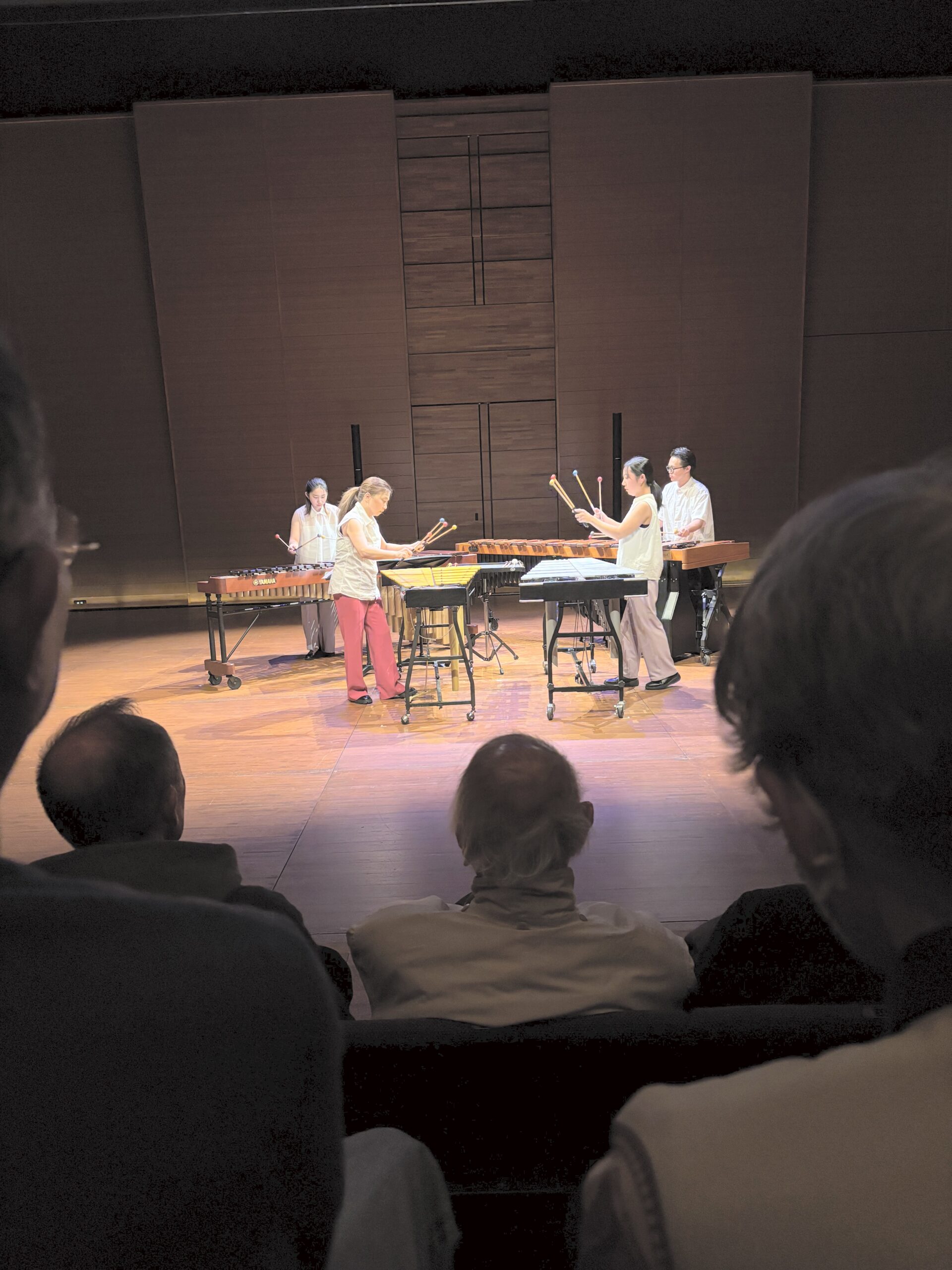
Reich / Pärt 90, Kuniko Kato & Musicians (Toyohashi Arts Theater PLAT, Toyohashi, Japan November 20th, 2026)
An interesting subplot in several concerts I’ve attended this year celebrating Steve Reich’s ninetieth birthday has been the inclusion of works by other composers in those programs. Whether intended or not, this inevitably prompts comparisons between those composers and the American’s music.
Matching Reich with names clearly aligned with his aesthetic—such as John Adams, Michael Gordon, Julia Wolfe, and David Lang—seems like a failsafe option, and there have been plenty of examples of those during the past eleven months. Perhaps more interesting outcomes arise when Reich’s music is combined with the likes of, say, Witold Lutosławski and György Kurtág, as was the case with concerts held at Manchester’s Bridgewater Hall in February and Aldeburgh Festival in June. Ostensibly containing a broader remit, these programs encourage listeners to view the American’s works within a wider—and arguably more modernist/Eurocentric—framework than the so-called ‘minimalist’ tradition with which he has often been associated. There again, the inclusion of Anna Thorvaldsdóttir and Josephine Stephenson in Reich-centred events (at London’s Kings Place in March and Liverpool’s Tung Auditorium in April respectively) indicates that the composer continues to exert his influence over much younger and more diverse ranges of composers.
In many respects, however, the best concert program companion for Reich’s music is Arvo Pärt.
Both are almost exact contemporaries, with Pärt (b. 1935) just over a year older than the American. One might call this relationship an attraction of opposites. While Reich’s music is full of driving rhythms and propulsive patterns, in Pärt we hear slowly shifting lines and harmonic halos of sound. There are exceptions, of course, such as Reich’s Pärt-sounding Proverb (1995) or Pärt’s Reich-like Hymn to a Great City (1984). Nevertheless, broadly speaking, Reich’s music is often regarded for its visceral, physical impact and rapturous qualities, while Pärt’s introspective sound world invites spiritual reflection.
Both composers have, in very distinct ways, carved unique languages from music’s basic building blocks: Reich’s phasing technique and use of gradual process finding its near-equivalent in Pärt’s triad-centred tintinnabuli technique. Over time, both have relaxed those once-strict methods, resulting in more expressive freedom. Religious beliefs and convictions have also underpinned their music.
What’s more, both have publicly acknowledged an admiration for each other’s music. Reich stated in a 2004 interview in The Guardian that the Estonian’s music “fulfils a deep human need that has nothing to do with fashion”, while the Arvo Pärt Centre marked Reich’s ninetieth birthday this year by announcing that he is “one of the few contemporary composers to have his own unique compositional style, his own voice.”
Strange, then, that their music has not been programmed together as often as one might expect, since their contrasting styles complement each other in fascinating ways.
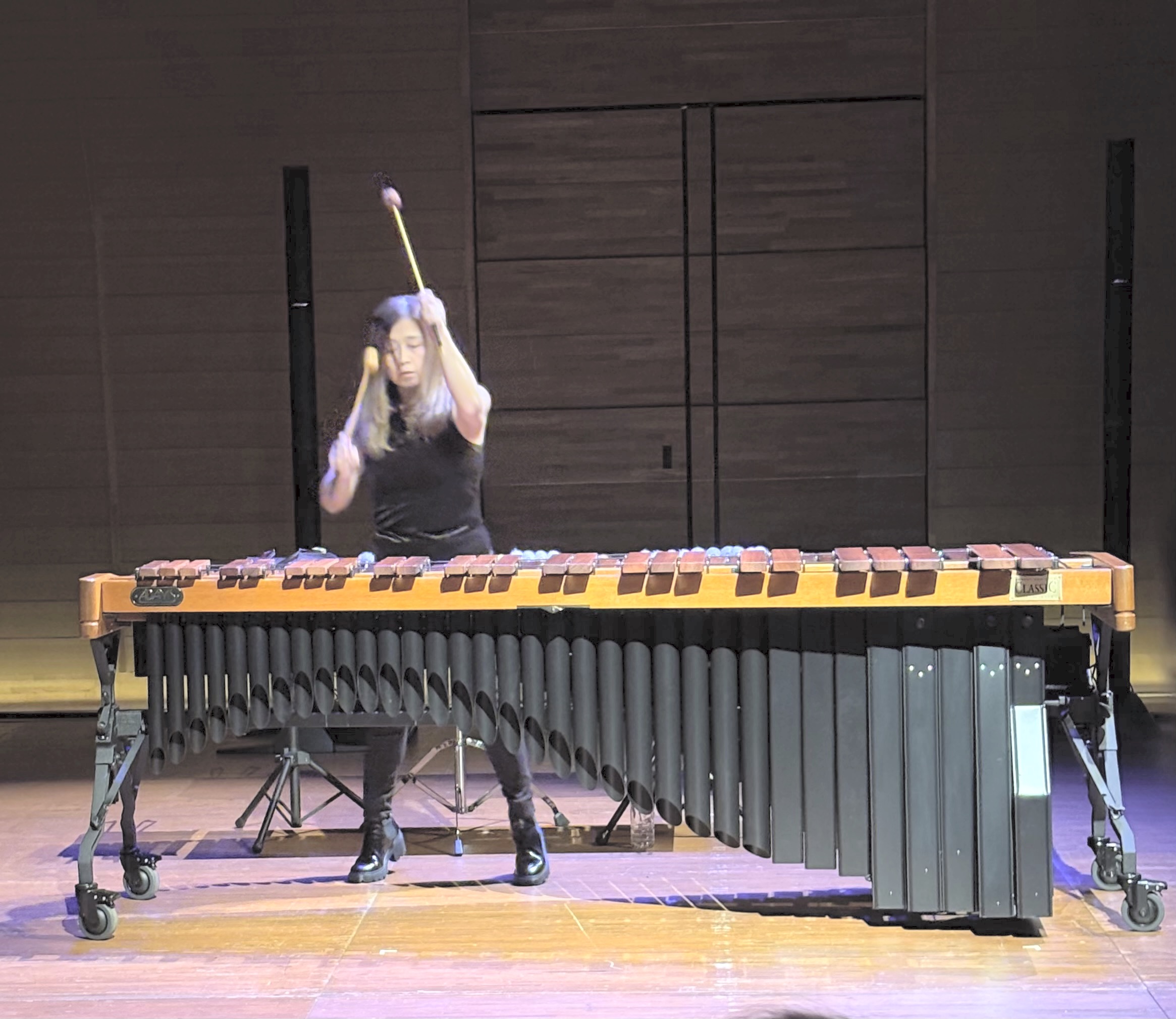
This was plainly evident in Friday evening’s concert at Toyohashi Arts Theater PLAT, featuring renowned Japanese percussionist Kuniko Kato & Musicians. Foregrounding Kuniko’s talents as a solo percussionist, the recital’s first half began solemnly and reflectively with an arrangement of Pärt’s Für Alina (1976), the vibraphone providing the triadic (T-voice) accompaniment against ringing melodic (M-voice) lines on tuned crotales, the latter’s resonating tones hanging in the air before disappearing into silence.
Originally for multiple clarinets, Reich’s New York Counterpoint (1985) worked well in Kuniko’s arrangement for live marimba and backing tracks, with each of its three sections given its own distinctive character and colour. Live patterns zoomed in and out of view during the opening section, while the second part projected a warm glow. In the dynamic, dance-like third section, Kuniko’s performance resembled that of a sonic juggler. Phrase after phrase was thrown high into the air before being caught by the percussionist as they fell back down. It was all made to sound so effortless under Kuniko’s assured hands.
Six Marimbas Counterpoint (1973/1986, arr. 2011), for five prerecorded and one live marimba, was taken at a brisk pace, lines carefully threaded through the textural weave. Here, Kuniko’s physical presence was strongly sensed, forming a different impression from that of Western ensembles who regularly perform Reich’s music, such as Colin Currie Group and Sō Percussion.
Meanwhile, back in the land of Pärt, quivering spirals of falling lines sounded like cascading slow-motion tears of grief in Cantus in Memory of Benjamin Britten (1977), while Fratres (1977) evoked a similar response to Für Alina, its chorale-like theme placed against a soundtrack of bowed marimbas and drones. A nuanced and focused rendition of Pärt’s Spiegel im Spiegel (1978) brought the first half’s proceedings to a close. Kuniko’s performance also gained much from the musician’s extraordinary ability to perform the entire set from memory. Later, manager Andy Ito explained to me that this is something the percussionist does as a necessary step towards fully absorbing and internalizing the music prior to performing it.
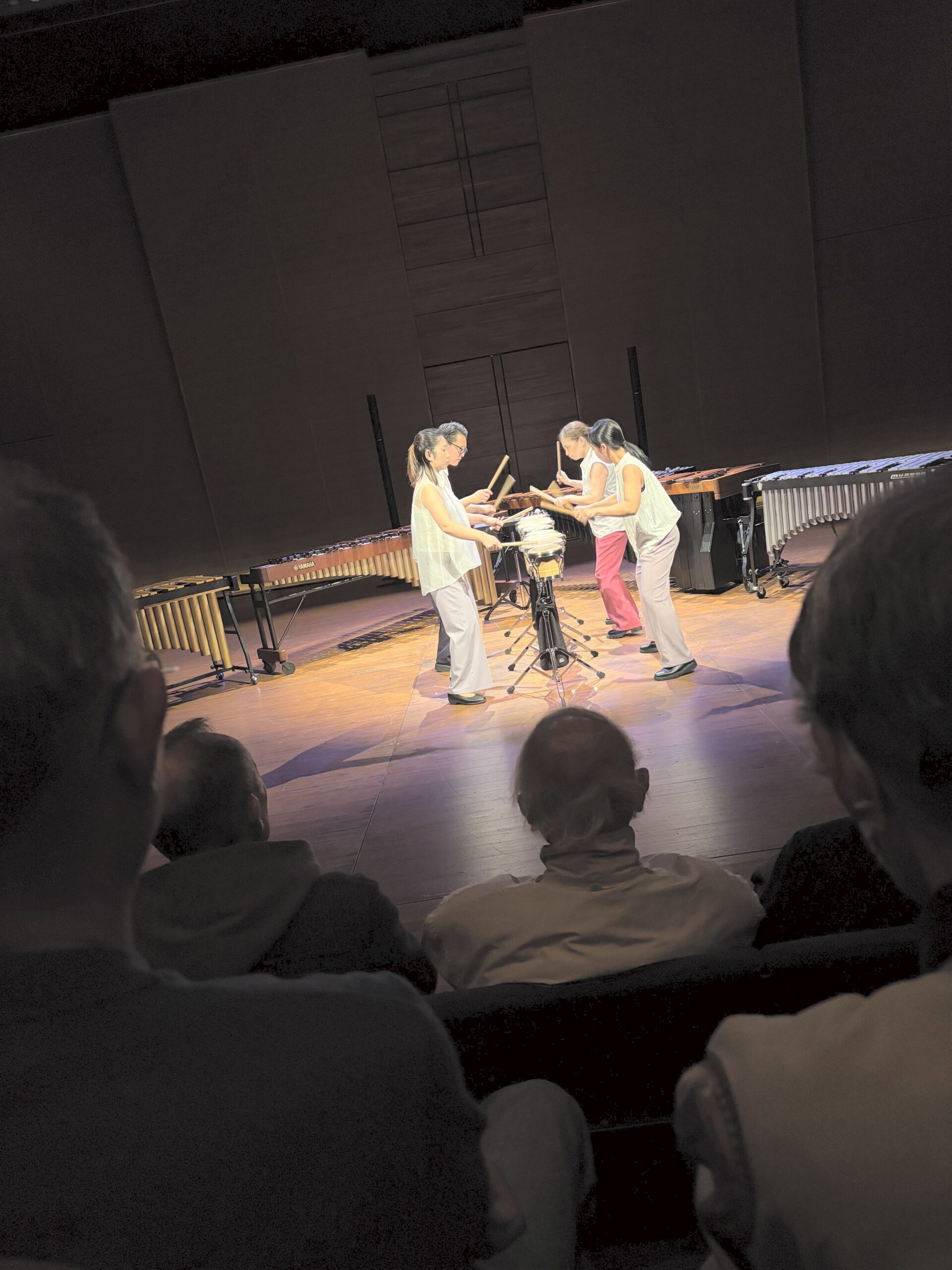
Kuniko was joined after the interval by fellow percussionists Haruka Aoyagi, Kanna Ashida and Koichi Hosono for Drumming – Part 1 (1970–71) and Mallet Quartet (2009).
A ritualized focus underpinned the quartet’s performance of Drumming, with each set of phases gaining in dramatic intensity during the first half of Part 1. In the opening exchanges of Part 1’s second half, the dynamic was dialled down before again exploding into life at the end. While some of the phase executions appeared somewhat tentative and a little cloudy, this was a highly competent performance that blended youthful vigour with streetwise experience.
The opening of Mallet Quartet, for pairs of vibraphones and marimbas, was given added depth by the ensemble’s ability to foreground melodic lines on vibraphones against pulsing harmonic accompaniment on marimbas.
Especially impressive during these opening exchanges was Kuniko’s fellow vibraphonist Aoyagi, whose effortless and fluent playing caught one’s attention from the moment she locked in with Kuniko’s lines. All three musicians acquitted themselves well throughout, but Aoyagi stood out as a player certainly worth keeping an eye on in the future. While Mallet Quartet waned a little in focus during its third and final section—partly due to the physical exertion required to execute its relentless rhythms and patterns—this was once more a performance of high quality, bringing the program to a fitting and satisfying conclusion. It made me wonder why these two giants of contemporary music aren’t brought together more often.