Review: Steve Reich’s “Music for 18 Musicians”: Staged Variations at the Park Avenue Armory
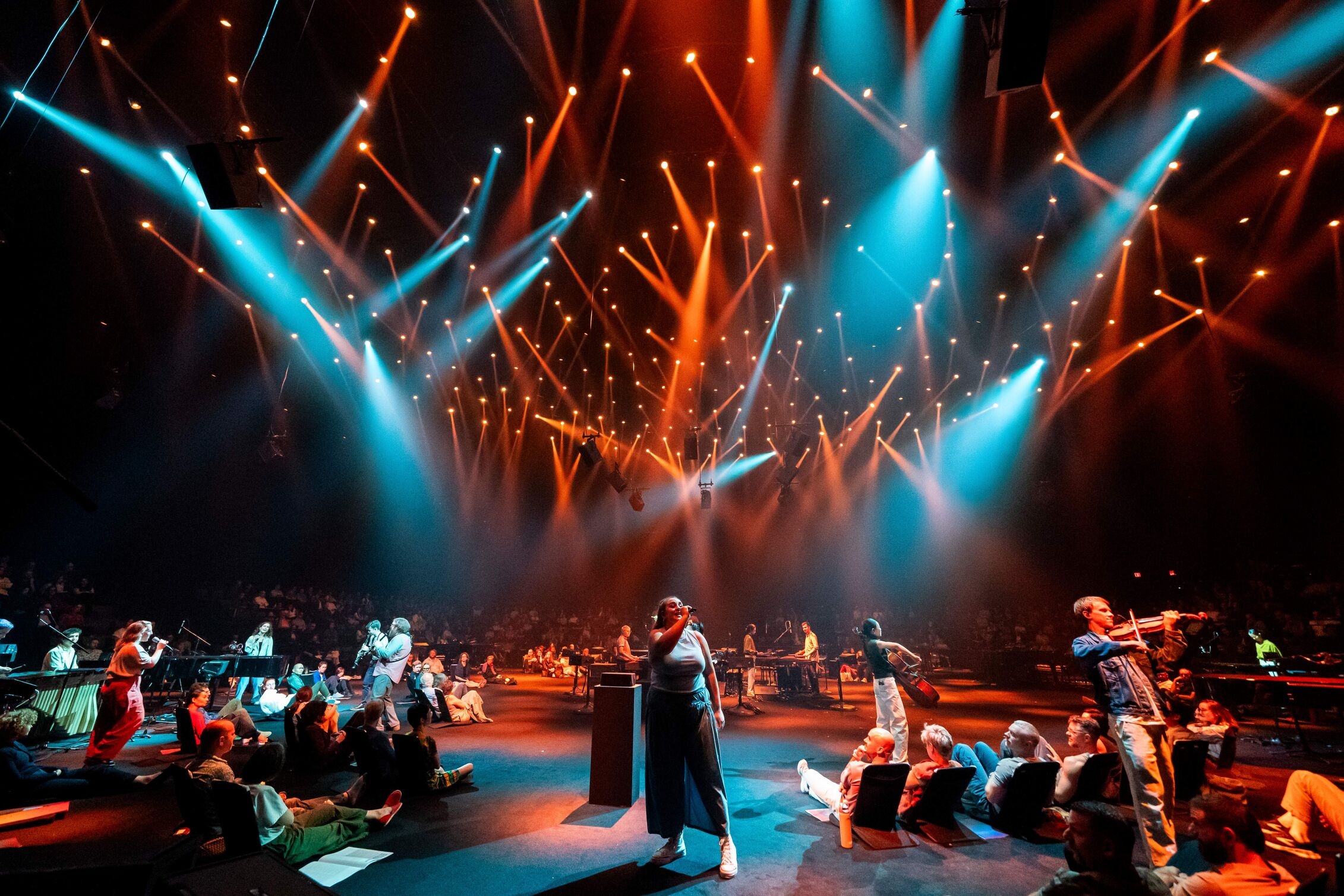
Steve Reich’s “Music for 18 Musicians,” three times in a row, is an exercise in endurance. Not just for the musicians – it’s an athletic feat for them – but for the audience, too.
Alan Pierson’s staging at the Park Avenue Armory (through Oct. 18) runs three and a half hours and gives the piece to three different groups, back to back: Steve Reich Ensemble (the OG), Manhattan School of Music students (the next generation), and Alarm Will Sound (somewhere in between). The staging coincided with Reich’s 90th birthday, and it’s one of many celebratory concerts this fall in New York and around the country.
About three-quarters of the way through the first iteration, I stopped wondering when it would be over and just gave in to it. The repetitive repetitive repetitive rhythms washed over me, and I began to notice the lighting effects (lighting design by Urs Schönebaum): a hundred or so bulbs in concentric circles on the ceiling, bathing me in yellow and orange. I also noticed a gradual exodus of the audience, as if to say, “I think we’ve heard this part already.”
Caroline Shaw, draped in scarves of many colors, bridged the gap between iterations of Reich’s work with a performance of Viaduct, a work she created for this occasion. The music consisted of humming, wordless vocalese and violin, a real relief from the relentless drubbing of Reich’s work. With a single ethereal voice, the music was looped to create echoing, as Shaw stood in the spotlight like a Messiah. Meanwhile, black-clad stagehands quietly took apart some of the pianos, vibraphones and marimbas at the center of the stage to prepare for the next iteration of “Music for 18 Musicians,” an ad hoc choreography of its own.
Round two was choreographed (movement by John Heginbotham). The young musicians from Manhattan School of Music gathered in trios and quartets and moved around the room in slow motion, no sudden moves, sometimes advancing in a mass like zombies. They spent a year memorizing this beast, which makes you wonder why the producers bothered with the first part of the evening. The movement made it more interesting, so why subject us to the duller version first?
The piece in the hands of the MSM students was lighter and more energetic. A man shaking maracas ran circles like an Olympic torch bearer. Two musicians pulled off a fancy hand-off of hand percussion instruments and the audience applauded like it was an Olympic feat. The physical movement seemed to inspire crescendos in the music. Or perhaps it was the other way around.
The long-running contemporary music ensemble Alarm Will Sound wore purple and yellow robes. In this final iteration of “Music for 18 Musicians,” it was intended for the audience to sit in the center of the hall, with the performers surrounding them. This happened gradually as the musicians moved individually from the center to the edges of the performance space. I was surprised to see a bass clarinetist appear a few steps above me on the bleachers, and heard some of the percussionists, out of sight, on the other side of the bleachers. As this third round wore on, the lighting on the musicians in the center became increasingly eerie, slowly shifting like a solar eclipse, until ultimately fading to black.
Three and a half hours of continuous performance is a lot to ask of a person’s sitzfleisch. Is it too late to say that minimalism is not my thing?