Daniel Temkin: Maksimal
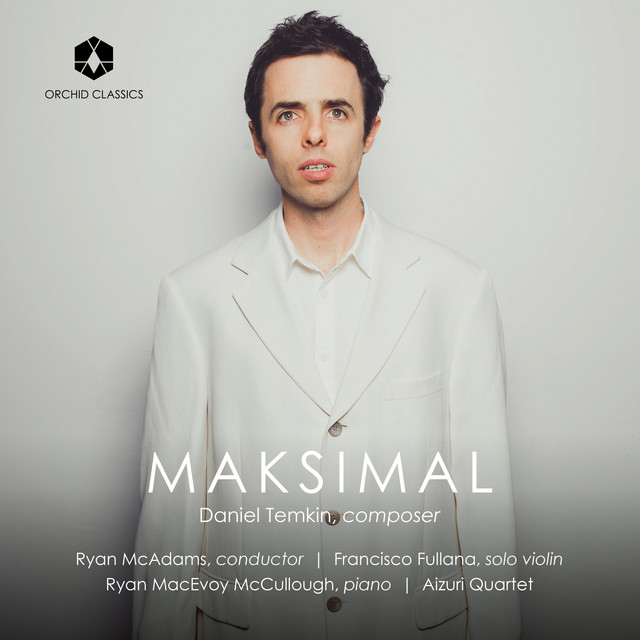
The stars appear first. Their light seems to have traveled through the interior of a violin before reaching us, gathering the grain of wood and the pressure of a human hand along the way. Throughout Maksimal, Daniel Temkin thus treats music as celestial mapmaking, drawing places where the horizon turns out to be an instrument played from both sides.
The title composition, written in 2022, carries the genetic traces of the Baroque concerto grosso into a world of fractured memory and unstable terrain. Francisco Fullana is the violin soloist, giving the music its incandescent center. Ryan McAdams conducts the Maksimal Ensemble with a keen understanding of the score’s shifting scale, allowing its smallest gestures to retain their mystery even as the orchestral field opens around them.
“White Heat” begins with bells and glockenspiel drawing an aperture through which the violin’s restless language can spill across the page of the sky. Images arrive with a precision unavailable to the crude constellations of ordinary imagination, bearing the spirit of something immeasurable yet intimately knowable. Temkin’s orchestration blooms in radiant layers, creating enough space for the violin to run and fly without severing its connection to the ensemble. Fullana’s virtuosity serves as a vehicle for the music’s spirited intelligence, while winds and percussion orbit his line, occasionally catching its light.
“Continuum” begins with the violin alone, carving space from time with resolute purpose while scarcely disturbing the air around it. As the orchestra unfolds along the periphery, molecular connections form between vanished cities and the people who once carried those urban spaces inside them. The piano exhales, while the brass catches and draws that breath underground. Though relatively brief, the movement produces the peculiar sensation of arrival. “Circle Games” then opens in buoyant motion before pivoting into contemplation, tracing a recurring exchange between outward momentum and inward gravity. The music brushes against the open-spaced pastoralism one might associate with Copland, yet its landscape keeps slipping beyond the trappings of such comparisons.
Dreamed Landscapes, composed between 2017 and 2018 and rendered joyfully by pianist Ryan MacEvoy McCullough, brings this cartographic impulse into a more private cosmos. “Starfield” welcomes us into light as darkness’s fullest utterance, an illumination generated from within the black fabric itself. Dance-inflected steps puncture that fabric and reveal flashes of an alien expressivity, briefly exposing a grammar whose syntax exceeds the human nervous system. The suspicion of otherness soon becomes one that consciousness has always been plural. In “Glaciers crumbling, assembling,” the title’s entropy enters immediately through blocky textures and splintering masses. Fragments break loose from an immense harmonic body, while reformation becomes audible only in the ensuing silence, in which absence begins arranging the wreckage into a structure the ear can enter but never see. “Echoes of the Horizon” draws the cycle’s luminous points into its large-scale dissolutions. The insistent left hand establishes the fundament, while the right hand opens the firmament, hurling packets of emotional voltage across the distance between them. Under McCullough’s touch, the piano becomes a machine for folding vastness until mountains and oceans briefly occupy the same trembling surface.
Ocean’s Call, composed in 2015 and revised in 2021, is a string quartet inspired by Big Sur and its environs. The Aizuri Quartet performs it with grace and exacting acuity, preserving the music’s sensuousness without softening its strange geological awareness. In “Hanging Cliffs, Rising Mist,” the cello draws a taut rope of purpose through the texture as the higher strings make room for a rising sun. Pizzicato details become lunar phases, while gradual coalescences deepen the field and pull the listener toward “The Bitter Salt of the Sea.” This central movement speaks in whispers, each phrase carrying the friction between water and air. The strummed cello sends tremors toward the crests of the waves, and the developing urgency becomes a form of surrender with a pulse still beating inside it. Temkin understands that yielding can possess enormous force and allows the music to lean into that paradox until submission and propulsion become indistinguishable. “Lullaby Waves” carries traces of Chinese folksong into harmonizations of light, setting them aboard a vessel woven from tenderness. As it travels farther across the water, the vessel gradually sheds the jurisdiction of the visible world.
Across this recording, Temkin teaches the ear to draw maps, then quietly removes the territory beneath the pencil. Memory emerges as the architect of dimensions in which the vanished can continue to resonate. The sky finally collapses into the dark anatomy of listening itself, pierced by the patient apertures we once mistook for stars.