"There are no two points so distant from one another that they cannot be connected by a single straight line -- and an infinite number of curves."
Composer Lawrence Dillon has produced an extensive body of work, from brief solo pieces to a full-length opera. Three disks of his music are due out in 2010 on the Bridge, Albany and Naxos labels. In the past year, he has had commissions from the Emerson String Quartet, the Cassatt String Quartet, the Mansfield Symphony, the Boise Philharmonic, the Salt Lake City Symphony, the Ravinia Festival, the Daedalus String Quartet, the Kenan Institute for the Arts, the University of Utah and the Idyllwild Symphony Orchestra.
Although he lost 50% of his hearing in a childhood illness, Dillon began composing as soon as he started piano lessons at the age of seven. In 1985, he became the youngest composer to earn a doctorate at The Juilliard School, and was shortly thereafter appointed to the Juilliard faculty. Dillon is now Composer in Residence at the University of North Carolina School of the Arts, where he has served as Music Director of the Contemporary Ensemble, Assistant Dean of Performance, and Interim Dean of the School of Music. He was the Featured American Composer in the February 2006 issue of Chamber Music magazine.
Last month I had four premieres, which is very unusual for me, and reflects the unusually fortuitous set of creative circumstances I had last summer and fall, which I may write about in a future post.
At this point, I’m dealing with the aftermath of those four premieres. Not just the professional aftermath, which is nice, and for which I am grateful, but the artistic aftermath.
I learned early on not to buy into the popular vision of the creative artist as someone who throws brilliant ideas on a page in a fit of inspiration, then waits for the next fit before starting the next piece. For me, composing is a slow, labor-intensive process. Great ideas are crucial, but they are just the key in the ignition. A whole lot more has to happen if you are ever going to get out of the garage.
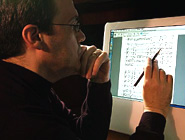
One of the most important parts of the process for me is the time of reflection after the premiere, which is also a time of tremendous ruthlessness. At that point, I am in the mindset that says a piece of music is only as great as its weakest moment. I go through the work over and over, both with and without recording, seeking out those moments that don’t measure up. Of course, I do this throughout the composition process, but the post-premiere phase is particularly unsentimental.
After a few days (never in haste), I begin cutting and refurbishing. Sometimes just a single note, or even a single articulation, gets a tweaking. Sometimes (thankfully, not so common at this point in my life) entire passages get tossed.
Russell Peck once likened this aspect of composing to cutting off fingers, but I don’t feel that it’s quite so painful as all that. In fact, I enjoy the idea that I’m getting very close to having the piece just right.
So here I am, in a serious post-premiere phase, revising like crazy. I’ve refinished the flute sonata that was premiered on May 17, which really only had one passage I was unsatisfied with. Now I’m working on the wind ensemble piece. With a large ensemble work, I find it very revealing to collect all of the individual parts and see what the players have written in them. Little indications of what to listen for, what to blend with, and where to catch the conductor’s eye can give me valuable insights into notational refinements.
Next will be the horn concerto from February, and finally the piano quartet from two weeks ago. Through it all, I’m also reworking the piano/vocal score of my opera, which I didn’t pay enough attention to the first time through, in 2001. Composing the opera took so much out of me, I’m afraid I shortchanged the piano/vocal score, thinking it wasn’t all that important. Boy, was I wrong.
Somewhere in there I have to get to work on a new quartet that’s supposed to be premiered in October. But I won’t, I can’t, rush through this final stage of refinement -- even if it costs me a few fingers.
posted by Lawrence Dillon
6:07 PM