"There are no two points so distant from one another that they cannot be connected by a single straight line -- and an infinite number of curves."
Composer Lawrence Dillon has produced an extensive body of work, from brief solo pieces to a full-length opera. Three disks of his music are due out in 2010 on the Bridge, Albany and Naxos labels. In the past year, he has had commissions from the Emerson String Quartet, the Cassatt String Quartet, the Mansfield Symphony, the Boise Philharmonic, the Salt Lake City Symphony, the Ravinia Festival, the Daedalus String Quartet, the Kenan Institute for the Arts, the University of Utah and the Idyllwild Symphony Orchestra.
Although he lost 50% of his hearing in a childhood illness, Dillon began composing as soon as he started piano lessons at the age of seven. In 1985, he became the youngest composer to earn a doctorate at The Juilliard School, and was shortly thereafter appointed to the Juilliard faculty. Dillon is now Composer in Residence at the University of North Carolina School of the Arts, where he has served as Music Director of the Contemporary Ensemble, Assistant Dean of Performance, and Interim Dean of the School of Music. He was the Featured American Composer in the February 2006 issue of Chamber Music magazine.
If you are reading this, you are on the old address for my blog. My blog has moved to http://www.sequenza21.com/dillon/ with a splashy new design by Elliot Cole.
When new trains grow into old trains, do they grow steam stacks?
When people bloom, do the blooms on the people hurt?
Do you know where hotels are born?
Does water float?
Why do Easter eggs have to dye?
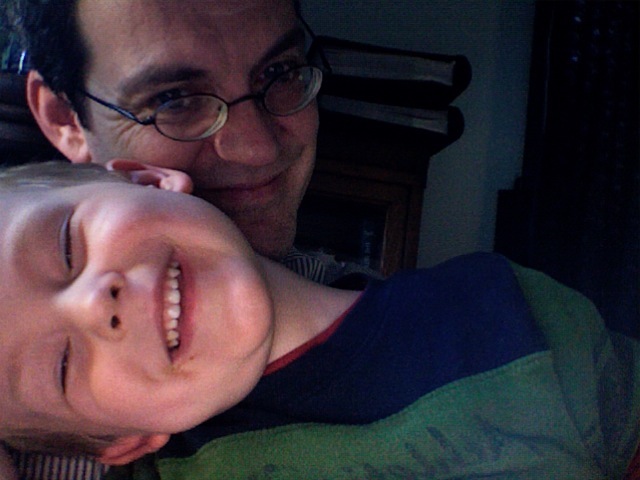
Happy fourth birthday, big guy. I know I still have a lot to look forward to, but I want to stop for a moment to thank you for some of my favorite questions from the past year.
As I noted earlier, I took the second half of July off from working on my fifth quartet to start sketching my Schumann Trilogy. In 12 days, I made a good draft of the third piece, a few healthy sketches of the first piece, and batted my head hopelessly against the second. More on that later.
Now I’m back on the home stretch of the fifth quartet. This is when I try to find the weakest passage in the piece and see if I can improve it, on the assumption that a chain is only as strong as its least durable link.
In the case of the fifth quartet, the weakest passage is very obvious to me: it’s a little more than halfway through the last movement. I wanted this passage to be an abrupt detour from the path of the piece, but I’m not convinced I’ve got it right. So, with five weeks to go before score and parts have to be delivered, I’m completely tearing down the last movement and rethinking it from the ground up.
And that’s a scary place to be – but a place I’ve been often enough before.
For anyone who is curious about releasing a recording on a major label, here is the timeline for my violin disk on Naxos:
Four days of recording sessions: February 2009
Editing and mixing completed: July 2009
Release: April 2011
That’s right – more than two years from recording sessions to release. And we were given just one week to submit our feedback on the edits.
When I asked about the delay, I found out it was because they have 680 recordings in the pipeline. Amazing how well they are able to do what they do, with such a backlog.
As I frequently tell my students, music is a sublime art form, but a preposterous profession.
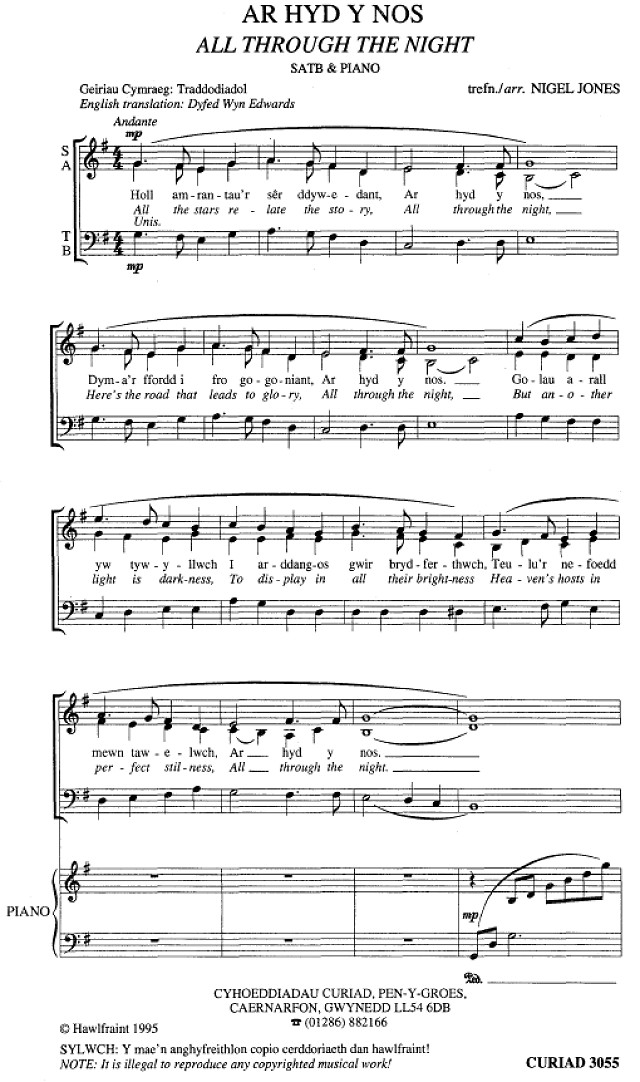
Holl amrantau'r sêr ddywedant Ar hyd y nos Dyma'r ffordd i fro gogoniant Ar hyd y nos. Golau arall yw tywyllwch I arddangos gwir prydferthwch Teulu'r nefoedd mewn tawelwch Ar hyd y nos.
O mor siriol, gwena seren Ar hyd y nos I oleuo'i chwaer ddaearen Ar hyd y nos. Nos yw henaint pan ddaw cystudd Ond i harddu dyn a'i hwyrddydd Rhown ein golau gwan da'n gilydd Ar hyd y nos.
posted by Lawrence Dillon
6:44 AM
Thursday, July 23, 2009
Cool Night
I’ve just about finished my fifth quartet, so now I’m taking a couple of weeks off from it to begin sketching Cool Night, the third installment of my Schumann Trilogy. I love doing this – getting a piece just about done, then setting it aside for a while to work on something else. When I come back to the quartet in August, I will be ruthless. Time away gives me the distance I need to make sure I haven’t become so familiar with every aspect of the piece that I’ve lost sight of the parts that don’t quite fit.
Writing Cool Night is a bit of an adventure for me. One of the characters is voiced by two people – a tenor and an actor. I’ve always known this would be the case, from when I first conceived of the Trilogy, but I was never sure why I needed a singer and an actor, or how exactly they would share the text.
Now I’m discovering how to make it happen, phrase by phrase. It’s a strange puzzle, to be sure. Just to give a sense of what I’m up against, here’s an excerpt of the text, a dialogue between Florestan and Eusebius over Robert Schumann’s deathbed:
F: When the dance concludes, I will remove my mask and reveal who I really am.
E: Who you are! You will remove one mask and find another.
F: That may be so. But the mask will come off, and then another, and another.
E: You have more masks than time.
F: Yes, I have more masks than time. But they will come off, not to reveal, but to revel in the removal. I will be verb, not noun. I will be action. I will be masks removing, one by one.
E: You will be masks removing. You will be me.
F: You? No, we are not the same. I am verb, you are noun.
E: I am noun, you are verb. But we are the same. We shed the chrysalis, only to find another.
F: And another.
E: And another. Together, we are half as much.
F: Yes, together, we are half as much. And yet, apart, we are nothing. We hear nothing in the cool night.
To make things stranger, although Cool Night is the third part of the trilogy, I’m sketching it first. Don’t know why, just seems like the right thing to do.
Of course, if it turns out to be the wrong thing to do, I can always start over. About the only thing I love more than starting a new piece is starting over.
Composers, how much time to you spend listening to recordings of your music? I find my answer to that question fluctuates dramatically.
Sometimes, when I am feeling particularly self-critical, I can’t listen to a minute of my music without cringing. Most of the time, I don’t want to listen to older pieces because I’m too focused on what’s coming next.
But occasionally, for one reason or another, I find myself listening to the same piece or pieces over and over. I’m in that place right now, as I get the proofs for the Naxos recording of my violin music and walk around with 25 years’ worth of compositions in my ear. And I’m surprised at how pleasant it is. Life is full of anxieties, big and small – it’s nice to lose touch with the moment as my mind scans back over the decades, hearing old things from new angles, hearing different places I’ve been, different avenues explored – all preserved so magnificently by such wonderful artists.
I find myself smiling privately at the oddest moments.