"There are no two points so distant from one another that they cannot be connected by a single straight line -- and an infinite number of curves."
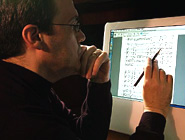
Composer Lawrence Dillon has produced an extensive body of work, from brief solo pieces to a full-length opera. Three disks of his music are due out in 2010 on the Bridge, Albany and Naxos labels. In the past year, he has had commissions from the Emerson String Quartet, the Cassatt String Quartet, the Mansfield Symphony, the Boise Philharmonic, the Salt Lake City Symphony, the Ravinia Festival, the Daedalus String Quartet, the Kenan Institute for the Arts, the University of Utah and the Idyllwild Symphony Orchestra.
Although he lost 50% of his hearing in a childhood illness, Dillon began composing as soon as he started piano lessons at the age of seven. In 1985, he became the youngest composer to earn a doctorate at The Juilliard School, and was shortly thereafter appointed to the Juilliard faculty. Dillon is now Composer in Residence at the University of North Carolina School of the Arts, where he has served as Music Director of the Contemporary Ensemble, Assistant Dean of Performance, and Interim Dean of the School of Music. He was the Featured American Composer in the February 2006 issue of Chamber Music magazine.
“Do things, act. Make a list of the music you love, then learn it by heart. And when you are writing music of your own, write it as you hear it inside and never strain to avoid the obvious.” -- Nadia Boulanger
Wise words from a wise teacher. The most important part is the end: “never strain to avoid the obvious.” It’s an easy mistake for young composers to make, thinking that great music is something outside of themselves, rather than something that comes from within. These composers often fail to realize that what is obvious to them can be revelatory to everyone else.
I’ve been fortunate enough to meet a lot of outstanding composers over the years, some of the most important voices of our time. The one thing they have in common -- Cage, Carter, Bolcom, Reich, etc. – their music flows naturally from who they are. Their imitators, on the other hand, grasp at the techniques, the surfaces of the music, and miss the foundations, which come from life experiences, upbringings, intuition, personal quirks – in short, their humanity.
Young composers: Learn the techniques of the composers you love, but don’t mistake their paths for yours. The amazing truth is, no matter how many people there are on this planet, no matter how many there have ever been or ever will be, no two are exactly alike. The world needs to hear what you have to say, even if you may not think it’s all that significant. Approach your art with a microscope – leave the telescopes to the musicologists.
In his latest novel Here is Where We Meet, John Berger writes “…all you have to know is whether you’re lying or whether you’re trying to tell the truth…you can’t afford to make a mistake about that distinction any longer.”
The truth is in you.
posted by Lawrence Dillon
6:17 AM