"There are no two points so distant from one another that they cannot be connected by a single straight line -- and an infinite number of curves."
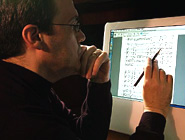
Composer Lawrence Dillon has produced an extensive body of work, from brief solo pieces to a full-length opera. Three disks of his music are due out in 2010 on the Bridge, Albany and Naxos labels. In the past year, he has had commissions from the Emerson String Quartet, the Cassatt String Quartet, the Mansfield Symphony, the Boise Philharmonic, the Salt Lake City Symphony, the Ravinia Festival, the Daedalus String Quartet, the Kenan Institute for the Arts, the University of Utah and the Idyllwild Symphony Orchestra.
Although he lost 50% of his hearing in a childhood illness, Dillon began composing as soon as he started piano lessons at the age of seven. In 1985, he became the youngest composer to earn a doctorate at The Juilliard School, and was shortly thereafter appointed to the Juilliard faculty. Dillon is now Composer in Residence at the University of North Carolina School of the Arts, where he has served as Music Director of the Contemporary Ensemble, Assistant Dean of Performance, and Interim Dean of the School of Music. He was the Featured American Composer in the February 2006 issue of Chamber Music magazine.
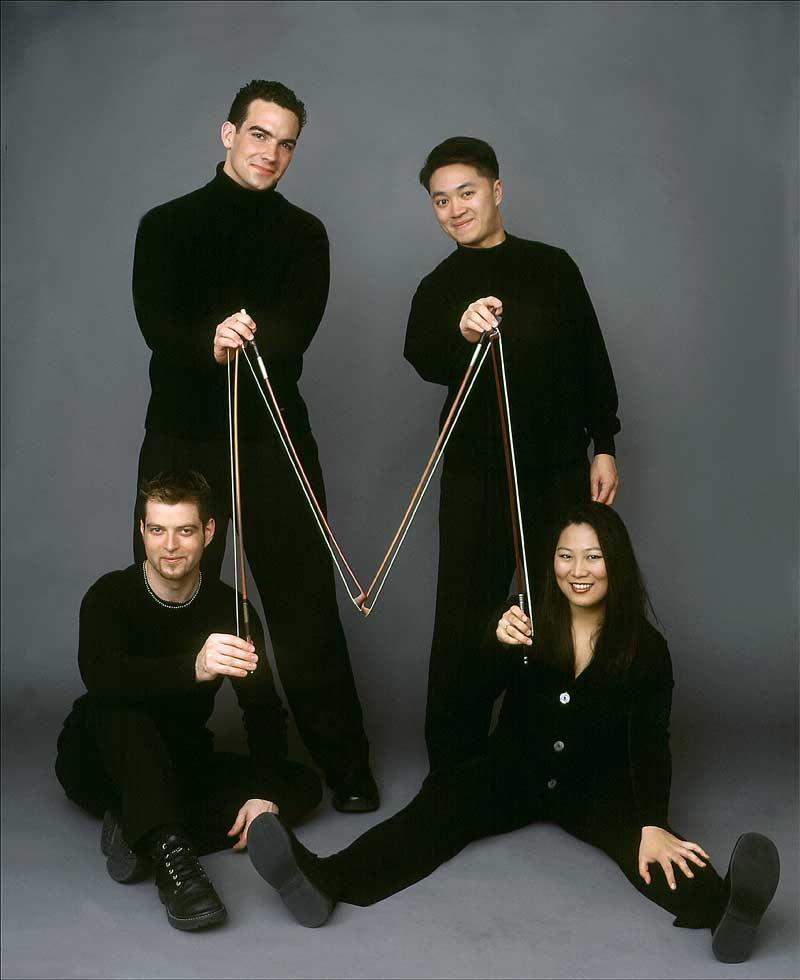
We had the outstanding Miró String Quartet in residence this week. There were many highlights to their visit, but the best part to me was the seminar they gave for our composers. They did a reading session on one of my students’ works, giving feedback on notation, pacing, expression and string technique. Several good points were raised. One in particular resonated strongly, I hope.
Composition students learn a lot about how each instrument functions, and what techniques are specific and idiomatic to each instrument. With this newfound knowledge, there is sometimes a tendency to rely too heavily on the technical side of the instrument, forgetting that this knowledge, for a non-performer, is conceptual, as opposed to tactile.
Example: composer wants a really rough sound from a passage, and instructs the violinist to do a tremolo bowing near the bridge. The result is satisfactory, probably. But it might have been better to simply mark the passage “roughly” and leave it to the violinist to find the best way to get that sound.
I’m not saying that specific technical instructions aren’t a boon in many situations, and, in fact, absolutely necessary in some. But it’s easy to fall in love with a superficial awareness of how the instrument works, at the expense of a deeper awareness of how the musician works.
Giving the performer an idea of the resulting sound you want can actually be much more challenging -- and much more rewarding -- for everyone than simply saying “put your finger here and move the bow like this.” I suppose there may be some people who go into music because they enjoy following instructions, but I can’t believe there are that many. And I don’t think I would want them playing my music.
All of this brings to mind an experience I had a number of years ago in a similar reading session. The ensemble came to the conclusion of a passage, and I turned to the student composer and asked, “How was that?”
His answer: “Well, could we bring up the volume a bit on the cello?”
Great example of a young composer spending too much time with technology, to the point of being out of touch with what it actually means to perform a piece of music.
Speaking of which, I was a bit disconcerted to see most of the students with their faces buried in copies of the scores at this reading session. There is plenty of time to follow a score while listening to recordings. Young composers need to make use of their opportunities to sit close to a first-rate ensemble, watching their bows, watching the way they interact with one another, gaining insights into how four great musicians think as one.
(And finally, I have to note how much fun it was to have Sandy Yamamoto, Miró’s second violinist, back all these years later after she swept through my theory classes with flying colors in the late 1980s.)