"There are no two points so distant from one another that they cannot be connected by a single straight line -- and an infinite number of curves."
Composer Lawrence Dillon has produced an extensive body of work, from brief solo pieces to a full-length opera. Three disks of his music are due out in 2010 on the Bridge, Albany and Naxos labels. In the past year, he has had commissions from the Emerson String Quartet, the Cassatt String Quartet, the Mansfield Symphony, the Boise Philharmonic, the Salt Lake City Symphony, the Ravinia Festival, the Daedalus String Quartet, the Kenan Institute for the Arts, the University of Utah and the Idyllwild Symphony Orchestra.
Although he lost 50% of his hearing in a childhood illness, Dillon began composing as soon as he started piano lessons at the age of seven. In 1985, he became the youngest composer to earn a doctorate at The Juilliard School, and was shortly thereafter appointed to the Juilliard faculty. Dillon is now Composer in Residence at the University of North Carolina School of the Arts, where he has served as Music Director of the Contemporary Ensemble, Assistant Dean of Performance, and Interim Dean of the School of Music. He was the Featured American Composer in the February 2006 issue of Chamber Music magazine.
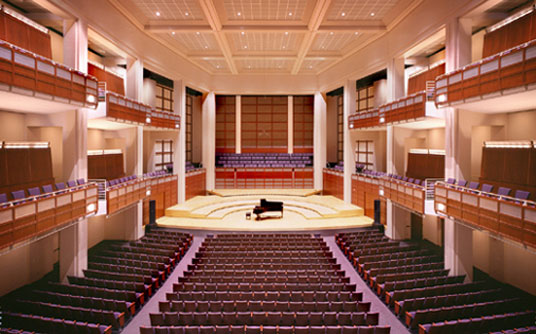
A couple of weeks ago, I got to hear the North Carolina Symphony in its new performance space, Meymandi Hall, thanks to a very kind invitation from Dr. Meymandi himself. Meymandi Hall is an outstanding space for listening to music. There are 1700 seats, but they are cunningly arranged to give the audience a sense of intimacy with the performers. Acoustically, the hall is very supportive, particularly to the rich, lower range of the orchestra. Fortissimos were powerful without being raucous. Of course, it helps to have such a solid ensemble. The main work on the program was Mahler’s Fifth Symphony, which showed off the suppleness and strength of the orchestra, with really gorgeous playing from the principal trumpet and horn.
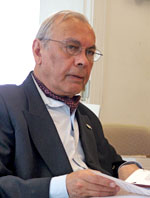
And Assad Meymandi is a very unusual, erudite man. Renowned as a psychiatrist, philanthropist and humanitarian, the Iranian-born scholar has long argued for the importance of music and the arts to a healthy society, in countless journal articles and an increasing number of lectures around the nation. And he’s always been quick to put his money where his heart is. Along with his wife, Emily, he established a $10-million foundation in 1996 to support programs for children, the arts and humanities, and health care in the United States and Iran.
In addition to all of his other admirable qualities, Meymandi is a very gracious man, and a brilliant conversationalist. It’s always reassuring, in discouraging times, to remember that there are people like this on our planet.