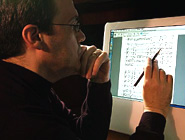
I’ve got a major new project underway: three orchestral pieces, which may be played together or separately, on the elusive and contradictory figure of Robert Schumann. Commissioned by the Idyllwild Symphony Orchestra, this trilogy –
Fantasiestück, The Marriage Diary and
Florestan and Eusebius – will be premiered in May 2010, marking the Schumann bicentennial.
Schumann’s not the most popular figure these days, but I’ve always found him intriguing. When he was at his best, there was nobody like him for fantastical experiments in melody, harmony and rhythm.
I also find Schumann the man both fascinating and disturbing – a figure of oddly matched parts. He was a radical and a homebody. He was a writer and composer who chose the latter path somewhat late. He was incredibly arrogant and oddly shy. His music criticism can shift from strictly rational to intensely sensual in a butterfly’s heartbeat.
Okay, I couldn’t resist the butterfly image – because I think the metaphor of the butterfly’s metamorphosis is a key to understanding Schumann’s life and work. It plays a major role in part three of my trilogy,
Florestan and Eusebius – I’m even rewriting a famous Heine elegy to include a set of butterfly wings in the culminating passage:
Um mein Bett erhebt sich die Hülle,
Drin tanzt die junge Schmetterling;
Sie tanzt die Schritte der Liebe –
Die Flügel erscheinen in Fülle
And Schumann’s final disease, which put him in an asylum for his last three years, brought him both raving lunacy and intense solitude -- he wasn’t even permitted to see his wife Clara until just before he died.
At this point, I’ve sketched some of the music, and given a lot of thought to some of the themes – musical and otherwise – I’ll be exploring. I’ll be working intermittently over the course of the coming year, then everything else will be set aside for about six months so I can completely immerse myself in the process. ETA is fall 2009.
You can read more about this trilogy
here. And if you know any other orchestras that might be interested in this, drop me a note!