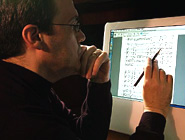
"There are no two points so distant from one another that they cannot be connected by a single straight line -- and an infinite number of curves."
Composer Lawrence Dillon has produced an extensive body of work, from brief solo pieces to a full-length opera. Three disks of his music are due out in 2010 on the Bridge, Albany and Naxos labels. In the past year, he has had commissions from the Emerson String Quartet, the Cassatt String Quartet, the Mansfield Symphony, the Boise Philharmonic, the Salt Lake City Symphony, the Ravinia Festival, the Daedalus String Quartet, the Kenan Institute for the Arts, the University of Utah and the Idyllwild Symphony Orchestra.
Although he lost 50% of his hearing in a childhood illness, Dillon began composing as soon as he started piano lessons at the age of seven. In 1985, he became the youngest composer to earn a doctorate at The Juilliard School, and was shortly thereafter appointed to the Juilliard faculty. Dillon is now Composer in Residence at the University of North Carolina School of the Arts, where he has served as Music Director of the Contemporary Ensemble, Assistant Dean of Performance, and Interim Dean of the School of Music. He was the Featured American Composer in the February 2006 issue of Chamber Music magazine.
The governmental response to the aftermath of Katrina last week brought home again the profound disconnect between principle and belief that has become a hallmark of American sensibility in the twenty-first century.
“God helps those who help themselves.” Many Americans have adopted this adage as a central theme in their social and religious interactions. They believe that good citizens are self-reliant and resourceful, which is certainly a fine principle on the face of things. Reflecting the will of these many Americans, the current administration has adopted the spirit of this adage as domestic policy, professing that government should leave the disadvantaged to fend for themselves.
The problem comes from the fact that 75 percent of Americans think that “God helps those who help themselves” comes from the Bible, which means they are blurring any distinction between their concepts of being good Americans and being good Christians.
As a matter of fact, “God helps those who help themselves” is about as un-Christian as you could imagine. You can search through every translation of the Bible in existence, and you won’t find those words.
On the contrary, if you look through the New Testament, it doesn’t take long to find this: “Give everything you have to the poor and follow me.” The story of Jesus is a story of someone who never hesitated to help total strangers in need. It’s a story of someone who neither gave nor promised any worldly benefit to anyone who followed him, but rather encouraged everyone to share everything they had with those who were disadvantaged.
Not even close to “God helps those who help themselves.”
Because of this misapprehension, we have a substantial number of Christians in America who believe that sharing the wealth is against their religion, when, in fact, it should be a central tenet of their religion. This misconception fuels a knee-jerk reaction against welfare, federalized health care, federal flood relief – anything that might be construed as a free handout. Rather than being a philosophical position of arguable merit, this mistaken belief is brandished as a religious imperative.