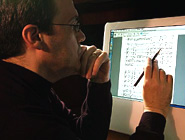
"There are no two points so distant from one another that they cannot be connected by a single straight line -- and an infinite number of curves."
Composer Lawrence Dillon has produced an extensive body of work, from brief solo pieces to a full-length opera. Three disks of his music are due out in 2010 on the Bridge, Albany and Naxos labels. In the past year, he has had commissions from the Emerson String Quartet, the Cassatt String Quartet, the Mansfield Symphony, the Boise Philharmonic, the Salt Lake City Symphony, the Ravinia Festival, the Daedalus String Quartet, the Kenan Institute for the Arts, the University of Utah and the Idyllwild Symphony Orchestra.
Although he lost 50% of his hearing in a childhood illness, Dillon began composing as soon as he started piano lessons at the age of seven. In 1985, he became the youngest composer to earn a doctorate at The Juilliard School, and was shortly thereafter appointed to the Juilliard faculty. Dillon is now Composer in Residence at the University of North Carolina School of the Arts, where he has served as Music Director of the Contemporary Ensemble, Assistant Dean of Performance, and Interim Dean of the School of Music. He was the Featured American Composer in the February 2006 issue of Chamber Music magazine.
Conductors seem to be in the news as never before these days. Dudamel, Alsop, Gergiev, Levine, Gilbert, Tilson-Thomas, etc. – a day doesn’t go by without a substantial article about one or more of these figures in one of the nation’s prominent newspapers or Classical-internet stomping-grounds.
I had a conversation recently with a retired violinist-conductor, whose many years on both sides of the podium gave him an interesting perspective. “I can assure you,” he said, “the conductor does not have more impact on the performance than the concertmaster.”
But articles on concertmasters are few and far between. I can imagine a fascinating study comparing the concertmasters of various orchestras and what they bring to each orchestra’s sound world and interpretation. Why have I never read such an article, yet every day I read about the men and women who stand on the podium and don’t play a note?
Don’t get me wrong – great conductors are wonderful beasts, and their impact on orchestras is undeniable.
But our fascination with conductors often seems out of proportion to their roles in shaping the music. Why is that? Is there a process of identification taking place? I suppose if you don’t play an instrument, it might seem easy (it’s not) and gratifying to imagine yourself waving your arms around in time to the music. Surely it’s easier to imagine mastering that skill than mastering the intricacies of the violin.
Or is it the baton itself, the wand that seems to magically pull forth lush sound with each wizardly stroke? Do we have an innate desire to believe in supernatural powers, a desire gratified by the visual-aural confluence of a maestro cutting an enormous swath of sound?